


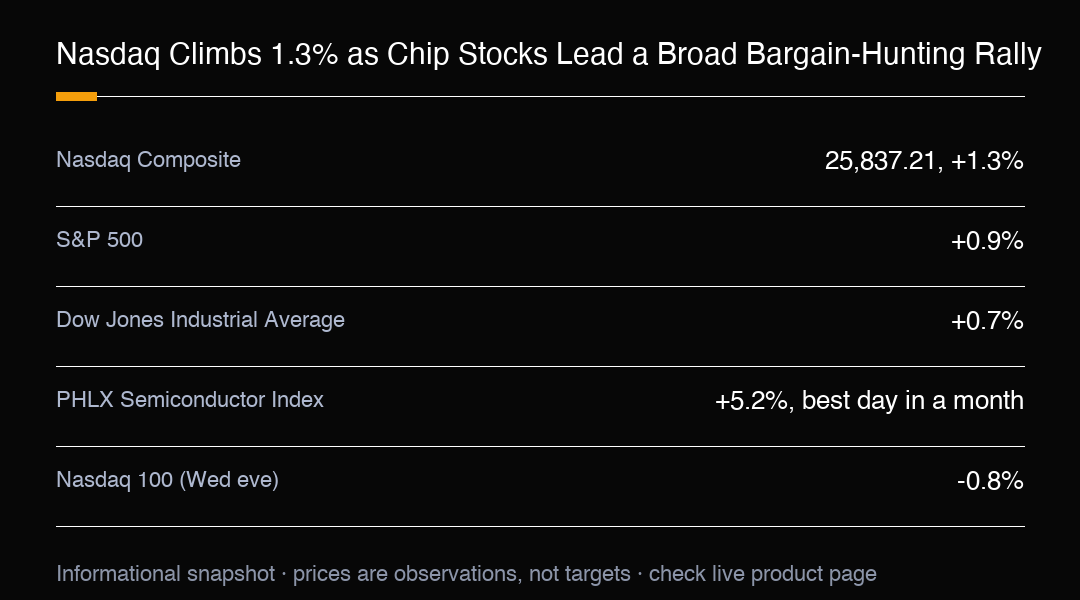
Wall Street closed a three-day losing run on Tuesday as bargain hunters piled back into chip stocks. The Nasdaq Composite rose 1.3%, the S&P 500 added 0.9%, and the Dow Jones Industrial Average gained 0.7%. The rebound followed last week's sharp pullback in technology names, and it arrived just in time for one of the busiest earnings weeks of the season.
The move was led by the semiconductor complex. Micron, Sandisk, SK Hynix and Seagate all surged 10% or more, while Intel, AMD and Applied Materials each rose at least 7%. The PHLX Semiconductor Index jumped 5.2%, its strongest single-day gain in a month. Traders framed the prior week's selloff as a clearance sale rather than a change in the underlying story.
The catalyst was straightforward: more competition in artificial intelligence does not shrink demand for chips, it tends to grow it. Every company building large AI models still needs enormous amounts of computing power, memory and storage. When one buyer slows, others step in, and the total addressable infrastructure bill keeps climbing. That thesis has carried the group through several violent swings this year.
China's emerging AI chip challengers were barely a wrinkle. Investors chose to read the new entrants as proof of expanding demand rather than a threat to incumbents. The result was a broad-based rotation back into quality hardware names that had been beaten down the week before, a sign that the dip-buyers still believe the long-term case is intact.
The rotation was not limited to a single corner of the market. Software, hardware and the broader basket of megacap technology names all participated, suggesting the buying was a re-risk into the index as a whole rather than a narrow bet on one supplier. Breadth like that tends to be healthier than a one-stock spike, because it means the move is backed by a wider base of conviction.
Volume told a similar story. The session's gains came on above-average turnover in the largest names, which often indicates that institutional desks, not just fast money, were rotating back in. When the biggest holders of the index add rather than trim, the bounce carries more weight than a low-volume relief pop would suggest.
Attention now shifts to the earnings calendar. Alphabet reports after Wednesday's close, with Tesla, IBM and Intel following soon after. The number that matters most may be capital expenditure: the money companies spend on data centers, chips and AI infrastructure. If Alphabet keeps spending aggressively, it reinforces the investment story; if it pulls back, investors may ask tougher questions about returns.
The setup is delicate because expectations are already elevated. Stocks do not need a miss to fall; they often fade when guidance merely meets a high bar. After a 5%-plus day in the chip index, the upcoming prints have to clear a rising hurdle, and any hint of softening demand for AI hardware will be greeted far less forgivingly than it would have been a quarter ago.
There is a caveat beneath the optimism. Futures turned lower ahead of Wednesday's session despite Tuesday's rally, with Dow futures off about 0.2%, S&P 500 futures down 0.3%, and Nasdaq futures slipping 0.8%. After a buying spree comes the real test: can the upcoming results justify the valuations? For now, the market is betting that they will.
The late-session caution is a reminder that one strong day does not end a debate. The chip trade has been the most crowded position in the market for over a year, and crowded trades correct hard when sentiment turns. Tuesday's bounce shows the appetite is still there, but the earnings window will decide whether the relief rally has legs or simply marks a pause before the next leg.
What is clear is that the AI infrastructure cycle has not lost its grip on the index. So long as hyperscalers and hardware makers keep spending, the market will keep finding reasons to own the picks and shovels. The question for the rest of the week is whether the companies reporting can show that the spending is translating into the growth the prices already assume.
For traders, the playbook is now familiar: buy the dip on any sign that the AI build-out is accelerating, fade it when the spend narrative wobbles. Tuesday reinforced the first half of that loop. Whether the second half stays dormant depends entirely on the earnings that land between now and the end of the week.
The bigger picture is that the index has become a proxy for the AI trade, and the AI trade has become a proxy for confidence in growth itself. When the chip stocks lead, the whole market tends to follow, which is why a 1.3% gain in the Nasdaq gets read as a signal about risk appetite far beyond the technology sector.
That linkage is a source of strength and fragility at once. Strength, because the AI theme is the most durable growth story of the cycle; fragility, because so much of the index's weight now rests on a single narrative holding together through earnings. Tuesday's rally was a vote of confidence in that narrative, and the coming days will test how deeply it runs.
One useful way to frame the day: it was less a new thesis than a confirmation of an old one. The market already believed in the AI build-out; Tuesday simply showed that the belief survives a bad week and reasserts itself the moment valuations look less stretched. That resilience is exactly what keeps the index's floor elevated, even when the headlines turn noisy.
The bottom line for the session is that the rebound was broad, well-supported and earnings-driven, not a thin speculative flicker. Whether it marks the start of a fresh leg higher depends on results that have not landed yet, but the quality of Tuesday's move gives the bulls a foundation to build on.
Trading Insight
The index rebounded as traders rotated back into chips, betting the AI infrastructure cycle is intact. The rally sets up a key earnings test this week, with futures already ticking lower into Wednesday.