


The Dow entered Fed day from a record 52,747.32 cash close on July 28, while E-mini Dow futures—ticker YM—carried that benchmark risk into the overnight session. The setup looked less like a clean breakout than a coil: blue chips were at a record, but technology breadth was already weakening and the Fed decision still carried a meaningful rate-hike tail.
That distinction matters. The 52,747 figure belongs to the Dow Jones Industrial Average cash close, not a YM settlement. CME Group describes YM as the futures contract providing exposure to the 30 blue-chip companies in the index. For the related market, see the US30 product page; for the growth-heavy contrast, see NAS100.
Key takeaways
- The Dow rose 1.0% to 52,747.32 on July 28, but the Nasdaq fell 0.2%—a record with narrow participation.
- The Fed held at 3.50%–3.75%, yet three officials preferred a 25-basis-point increase.
- YM became most useful when read with oil, the 10-year Treasury yield and index breadth—not as a standalone signal.
What did the Dow’s 52,747 record actually show?
It showed strength in blue chips, but not broad agreement across US risk assets. According to Associated Press closing data for July 28, the Dow gained 537.24 points, or 1.0%, to 52,747.32. The S&P 500 added just 0.2%, the Russell 2000 rose 0.2%, and the Nasdaq Composite slipped 0.2%.
The divergence underneath the record was the first warning. Kiplinger’s same-session recap reported the SOXX semiconductor ETF down 4.8%, while AMD fell 8.2% and Micron dropped 8.9%. AP also recorded an almost 11% fall in South Korea’s KOSPI as weakness in AI-linked shares spread across regions. The Dow’s price-weighted mix could reach a high even while the technology complex was sending a different message.
| Market | July 28 close | What it said before Fed day |
|---|---|---|
| Dow Jones | 52,747.32; +1.0% | Record blue-chip strength |
| S&P 500 | 7,428.78; +0.2% | Broad market positive, but muted |
| Nasdaq Composite | 24,876.91; −0.2% | Growth and chip pressure persisted |
| Russell 2000 | 2,953.80; +0.2% | Small caps did not confirm the Dow’s 1% move |
Why did YM futures matter into the Fed decision?
YM mattered because futures kept repricing the Dow basket while the cash market was closed and the FOMC outcome was still unknown. A record close is a fixed endpoint; futures are the next venue where changes in rates, oil, overseas equities and earnings expectations can show up. That makes YM a useful bridge between the July 28 close and the July 29 cash open—not a separate claim that the futures contract itself settled at 52,747.
The event risk was real. Kiplinger reported that CME FedWatch assigned a 64.2% probability of a hold on July 24, down from 87.2% a week earlier. A hold was the base case, but it was not a certainty. With the Dow at a record and technology already soft, the market had little room for a hawkish surprise in either the decision, the vote or the press conference.
What broke the coil after the Fed held rates?
The coil broke because “hold” did not mean “easy”: the vote exposed a hawkish split while oil, long yields and chip weakness all tightened financial conditions at once. The Federal Reserve kept the target range at 3.50%–3.75% on July 29, but three members preferred a 25-basis-point increase. That dissent changed the quality of the hold.
Associated Press reported that Brent crude jumped 7.3% to settle at $88.09 as renewed fighting raised supply concerns. The two-year Treasury yield eased to 4.24% from 4.26%, but the ten-year yield rose to 4.68% from 4.61%. That split matters: the front end reflected the unchanged policy rate, while the long end kept absorbing inflation and growth risk.
By the close, the Dow had fallen 1,153.18 points, or 2.2%, to 51,594.14. The S&P 500 lost 1.5% and the Nasdaq Composite fell 1.7%. Nvidia dropped 3.6%, SK Hynix lost 9.6%, and the KOSPI fell another 6%. The record-to-repricing sequence was therefore broader than one Fed headline: narrow participation met a hawkish vote, an oil shock and persistent technology stress.
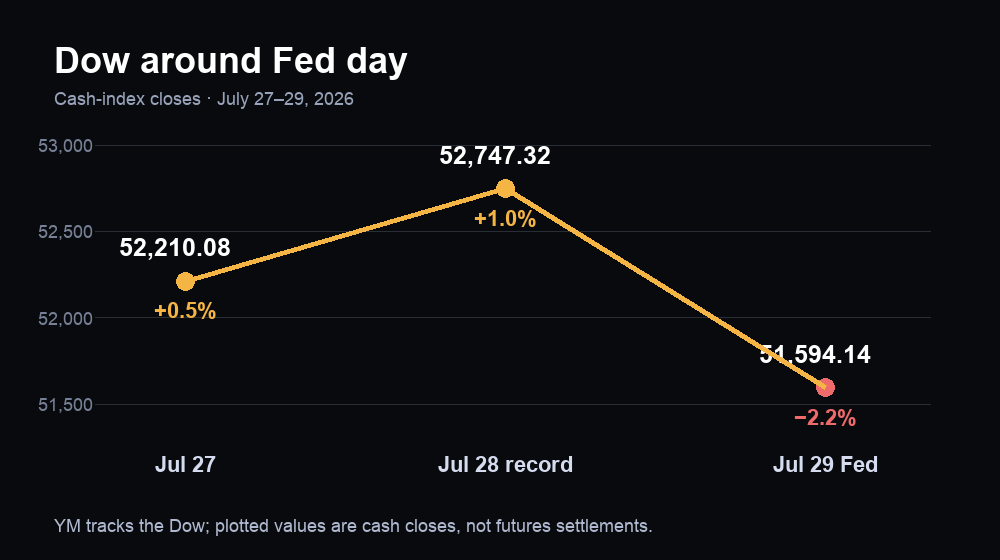
Cash-index closes from AP’s July 27–29 reporting. YM tracks the Dow, but these plotted values are not futures settlements.
How can crypto and global traders read YM without overfitting it?
Use YM as one leg of a cross-asset check, not as a direct forecast for Bitcoin, Asian equities or every US index. The Dow leans toward mature industrial, financial, healthcare and consumer franchises; NAS100 carries more growth-duration sensitivity. A stronger YM tape alongside weak technology can therefore signal rotation rather than broad risk appetite.
For crypto traders, the more durable question is whether YM agrees with the forces that also shape global liquidity: long Treasury yields, the dollar and energy-driven inflation expectations. If YM weakens while long yields and oil rise, the message is tighter conditions across multiple markets. If YM stabilizes but technology and crypto remain weak, the move may be Dow-specific rather than a system-wide recovery.
The same discipline applies across time zones. KOSPI’s two-day fall showed how AI and semiconductor stress could reach the US session before New York opened, but the Dow initially resisted that pressure. Cross-market confirmation arrived only when the July 29 selloff broadened. A related transmission example is the Nasdaq futures oil-risk map.
Which confirmations matter after a Fed-day reversal?
Watch whether oil, long yields and market breadth keep telling the same story. They separate a one-session position reset from a wider repricing cycle.
| Confirmation | If pressure persists | If pressure fades |
|---|---|---|
| Brent and WTI | Energy keeps the inflation risk premium elevated | Part of the macro shock is being absorbed |
| US 10-year yield | Long-duration valuations remain under pressure | Financial conditions stop tightening at the long end |
| Dow vs S&P/Nasdaq breadth | Weakness spreads beyond the original chip pocket | Rotation replaces broad risk reduction |
| YM vs cash Dow | Overnight sellers receive cash-session confirmation | The futures move is not confirmed after US liquidity arrives |
None of these observations is sufficient alone. The point of the framework is to demand agreement: participation explains the record’s quality, rates price the policy path, and oil tests whether inflation risk is easing or returning.
Final thoughts
The Dow’s 52,747.32 record was real, but so was the narrowing beneath it. YM futures made that tension visible between sessions, then the cash market confirmed the reversal after a divided Fed hold, higher long yields and another oil surge. The useful lesson is not that every record ahead of the Fed must fail. It is that a headline high carries more information when traders also ask who participated, what the rates market priced and whether energy reinforced the move.