


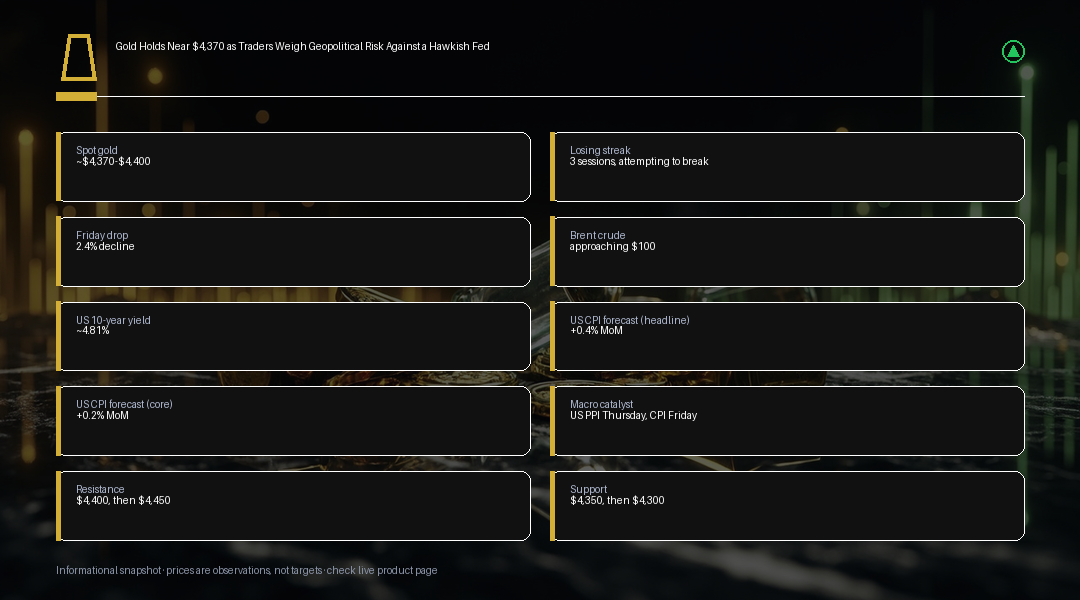
Gold held near $4,370 an ounce on Wednesday, attempting to snap a three-session losing streak that had chipped away at the metal's summer gains. Escalating Middle East tensions, a softer US dollar and cautious global sentiment combined to attract buyers, although the recovery stayed modest following last week's stronger-than-expected US jobs report. Live pricing through the session kept bullion trading between $4,372 and $4,400, underscoring how tightly the market is coiled ahead of this week's inflation data.
Bullion fell as much as 2.4% on Friday after accelerating employment growth suggested the US economy could tolerate, or even require, another interest-rate increase. That shift in the Federal Reserve outlook weakened gold's relative appeal against interest-bearing assets almost overnight. The result looks less like a rush into safety and more like a carefully measured hedge: investors want protection from geopolitical escalation, but they remain reluctant to chase an asset that pays no yield while government bonds keep offering increasingly competitive returns.
Oil is turning into a genuine two-sided trade for gold. Brent crude pushed toward $100 a barrel this week after fresh attacks involving Saudi cities, Iranian tankers and a US base in Jordan. The immediate uncertainty supports bullion, particularly for investors who fear a wider regional conflict, disrupted shipping lanes or damage to Gulf energy infrastructure. Yet expensive oil also threatens to keep inflation elevated, a dynamic that could force the Fed to raise rates again or hold them higher for longer, lifting bond yields and increasing the opportunity cost of holding a non-yielding metal. The same shock that draws in safe-haven buyers can just as easily invite monetary-policy sellers.
The US 10-year Treasury yield has recently traded near 4.81%, making government bonds harder for gold bulls to ignore. That gold has managed to stabilize beside such elevated yields is itself encouraging for buyers, but a more convincing recovery probably needs one of two things to happen: yields need to retreat, or geopolitical risk needs to cool. Absent either shift, bullion is likely to keep chopping inside its current range rather than staging a clean breakout.
Inflation data now holds the final word. US producer-price figures land Thursday, followed by the more consequential consumer-price report on Friday. Economists expect headline CPI to rise around 0.4% month over month, while core inflation, which excludes food and energy, is forecast near 0.2%. A hotter-than-expected report would strengthen the case for a September rate hike, potentially lifting yields further and extending gold's slide. A softer print, on the other hand, could weaken the dollar, pull rate expectations lower and help the metal reclaim the $4,400 level it has struggled to hold this week.
That psychological $4,400 mark is the immediate technical test. Clearing it convincingly would put the recent futures area near $4,450 back in view as the next resistance zone. On the downside, support sits around $4,350, with a deeper floor near $4,300 if selling pressure returns. Gold has several competing forces acting on it at once right now, and Friday's inflation print looks set to determine which argument wins top billing heading into next week.
Three drivers are effectively pulling bullion in opposite directions at the same time: a softer dollar and rising geopolitical risk are supportive, while elevated Treasury yields and firming Fed rate-hike expectations are capping the upside. That tug-of-war explains why gold's attempted recovery from Friday's selloff has been modest rather than sharp, even with oil pushing toward triple digits and Middle East headlines running hot.
For traders, the setup into Thursday and Friday is genuinely two-way. A benign inflation print paired with any cooling in Gulf tensions could see gold push cleanly through $4,400 toward $4,450, rewarding buyers who have stayed patient through the three-session decline. A hot CPI number stacked on top of $100 oil, however, would likely reinforce the yield-driven headwind and open the door to a fourth consecutive losing session, testing the $4,350 support band before $4,300 comes into play.
Positioning ahead of the data has stayed relatively cautious, with the metal's ability to hold above $4,350 through the geopolitical noise seen as a reasonable sign of underlying demand. Central-bank buying and safe-haven flows continue to provide a floor beneath the market, but neither is likely to overwhelm a genuinely hawkish inflation surprise. The next two sessions of data will do more to settle gold's near-term direction than the geopolitical headlines that have dominated the past week.
Cross-asset signals are worth watching alongside the headline chart. A dollar index that keeps drifting lower would normally be read as unambiguously supportive of bullion, but this cycle is different because the same forces pressuring the dollar, namely a hawkish Fed repricing and elevated Treasury yields, are also the ones capping gold's upside. That unusual pairing is why the metal has traded in a tight band rather than staging the kind of decisive rally that pure dollar weakness would typically produce. Traders who focus only on the currency leg risk missing the yield story running underneath it.
Options and futures positioning heading into Thursday and Friday suggest the market is bracing for a wider-than-usual move rather than a quiet drift. That kind of setup often rewards patience over conviction: chasing a break above $4,400 before the inflation data is confirmed carries real reversal risk if Friday's CPI comes in hot, while selling into support near $4,350 ahead of a potentially soft print risks getting caught on the wrong side of a fast reversal. The more disciplined approach is to let Thursday's PPI narrow the range of likely outcomes before committing meaningfully in either direction.
Trading Insight
Gold's attempted break of its three-session losing streak is unfolding inside a well-defined range, with $4,400 the immediate line in the sand and $4,450 the next resistance if buyers clear it. Support sits at $4,350, then $4,300 below that. The trade into Thursday's PPI and Friday's CPI is genuinely two-sided: a softer inflation print alongside cooling Middle East headlines favors a push through $4,400, while a hot CPI print stacked on oil near $100 would likely extend the pullback toward $4,350 and put $4,300 in play. With the 10-year Treasury yield holding near 4.81%, treat any bounce above $4,400 as conditional on yields easing rather than assume the losing streak is fully broken. Position sizing into Thursday should account for the possibility of a wide overnight gap once Friday's CPI print crosses the wire, since both the upside and downside scenarios described above carry a realistic path to follow-through over the following sessions.