


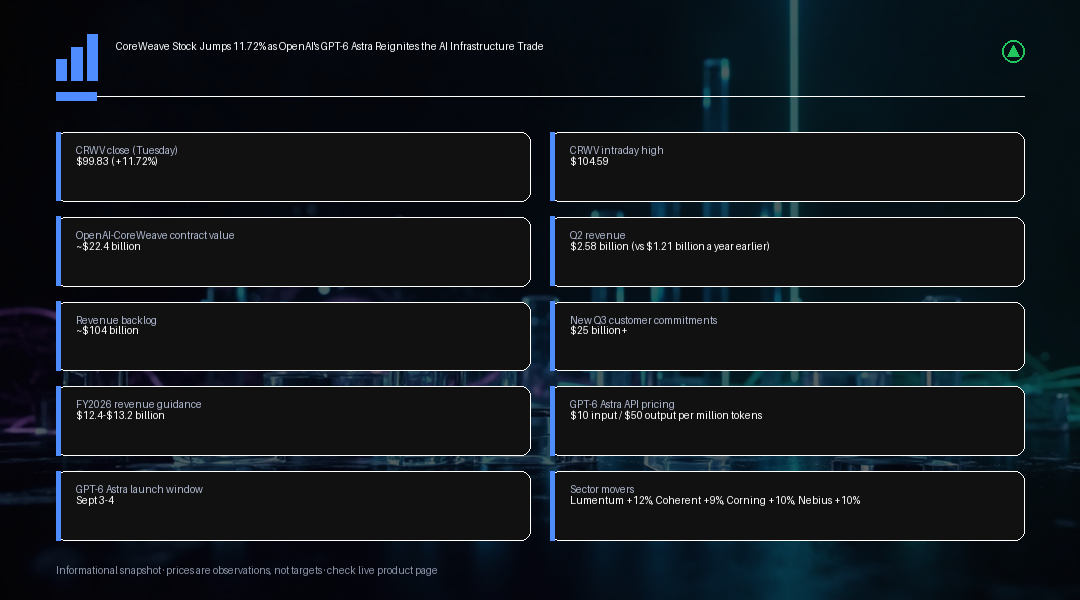
OpenAI's newest model sent traders racing back into AI infrastructure on Tuesday, lifting cloud, photonics and fiber-optic stocks while software companies landed on the less comfortable side of the disruption. CoreWeave stock CRWV surged as much as 12% intraday, touching $104.59, before closing up 11.72% at $99.83 after OpenAI released GPT-6 Astra, an advanced large language model capable of handling increasingly complex tasks.
Astra's rollout has been unusually fast for a frontier model. The system launched September 3 in limited preview and reached general availability September 4. By the time CoreWeave's rally hit its stride, Astra was already live across ChatGPT Plus, Pro and Business tiers, the OpenAI API, priced at $10 per million input tokens and $50 per million output tokens, Microsoft Azure and AWS Bedrock, although enterprise access remained off by default. Astra is also the first OpenAI model to reach a Critical cybersecurity capability rating under the company's Preparedness Framework, so its most advanced cyber-capable features stay gated to approved trusted-access programs rather than open to every subscriber.
The connection between Astra and CoreWeave's share price is unusually direct. CoreWeave has approximately $22.4 billion of contracts with OpenAI, a deal originally announced in 2025, to provide AI infrastructure. Every leap in model capability potentially means more processors, electricity and data-center capacity, giving traders a relatively straightforward way to express their enthusiasm for Astra through a pure-play compute name rather than buying OpenAI itself, which remains privately held.
CoreWeave already had considerable momentum behind its operating story before Tuesday. Second-quarter revenue rose 112% year over year to $2.58 billion, more than double the $1.21 billion booked a year earlier, while its contracted revenue backlog reached approximately $104 billion. It also secured more than $25 billion of new customer commitments early in the third quarter and has guided full-year 2026 revenue toward $12.4-$13.2 billion.
CoreWeave was not celebrating alone. Lumentum climbed 12% and Coherent advanced 9%, reflecting demand for the optical components that move enormous volumes of information between AI servers. Training smarter models is one challenge; preventing the data center from becoming an extremely expensive traffic jam is another. Corning gained 10%, helped by enthusiasm for the fiber-optic networks connecting data centers and a separate broadband agreement with Verizon. Fiber may lack the glamour of a cutting-edge model, but AI infrastructure still depends on physical cables transporting data quickly enough to keep thousands of chips working together. Nebius also rose about 10%, giving the rally a second AI-cloud beneficiary.
The uncomfortable part remains the bill. CoreWeave must spend heavily on processors, buildings and power before collecting revenue from customers, which creates substantial debt, cash-flow pressure and execution risk. A $104 billion backlog is impressive, but turning contracts into profitable revenue requires enormous upfront investment, and the market has repeatedly shown it will punish infrastructure names that stumble on the capital-intensity side of that equation.
Not every analyst is willing to hand Astra full credit for the move. Several note that no CoreWeave-specific news accompanied the rally and that broader AI-cloud momentum, plus rival cloud announcements earlier in the week, likely contributed alongside the model launch. That nuance matters for traders trying to size positions: a rally built on one company-specific catalyst behaves differently than one built on sector-wide repricing that could unwind just as broadly if sentiment cools.
Whether the post-Astra breakout holds or fades is likely to depend on the same peer group that drove Tuesday's move. Continued strength across Nebius, Lumentum, Coherent and Corning would support a broader infrastructure trade rather than a single-stock story. If those gains unwind together in the coming sessions, Tuesday's surge may prove to have been more model-launch adrenaline than a durable repricing of the AI infrastructure complex.
Traders will also be watching for confirmation through CoreWeave's own operating updates: whether backlog conversion accelerates, whether enterprise-tier Astra access widens beyond its current default-off setting, and whether additional contract wins materialize on top of the roughly $25 billion already booked early in the third quarter. Each would reinforce the demand story; a slowdown on any of those fronts would raise fresh questions about how much of the current valuation already reflects best-case assumptions.
The broader context here is a capital-spending cycle that shows no sign of slowing. Every major cloud platform is racing to secure processors, power capacity and data-center space ahead of the next wave of model releases, and CoreWeave has positioned itself as one of the more direct ways for public-market investors to gain exposure to that build-out without owning a diversified hyperscaler where AI infrastructure is only one line item among many. That specialization cuts both ways: it makes CRWV unusually responsive to positive catalysts like Astra, but it also means the stock carries more concentrated risk if AI infrastructure spending growth ever slows or if a single large customer relationship comes under pressure.
For now, the options market and the peer-group reaction both point to a rally that traders are treating as meaningful rather than a one-day headline spike. A $104 billion backlog and guidance toward $12.4-$13.2 billion in 2026 revenue give analysts a framework for modeling out CoreWeave's growth trajectory well beyond this week's news cycle, even if the stock's day-to-day price action continues to track the next AI model announcement more closely than any single earnings report.
Trading Insight
CRWV's intraday round trip from a $104.59 high to an 11.72% close at $99.83 shows how much of Tuesday's move was pure catalyst-driven enthusiasm rather than a clean breakout. The stock's direct exposure to OpenAI, roughly $22.4 billion in contracted infrastructure spend and a $104 billion backlog give the AI-trade narrative real substance, and 112% year-over-year revenue growth shows the underlying business is scaling alongside the stock price, but heavy capital spending ahead of revenue collection keeps execution risk elevated. Watch whether Nebius, Lumentum, Coherent and Corning hold their Tuesday gains together; a shared unwind would suggest the rally was model-launch adrenaline rather than durable repricing, while continued group strength would support chasing further upside in the Nasdaq-listed AI-infrastructure complex. Size positions with the understanding that single-model-launch catalysts can reverse as quickly as they arrive.