


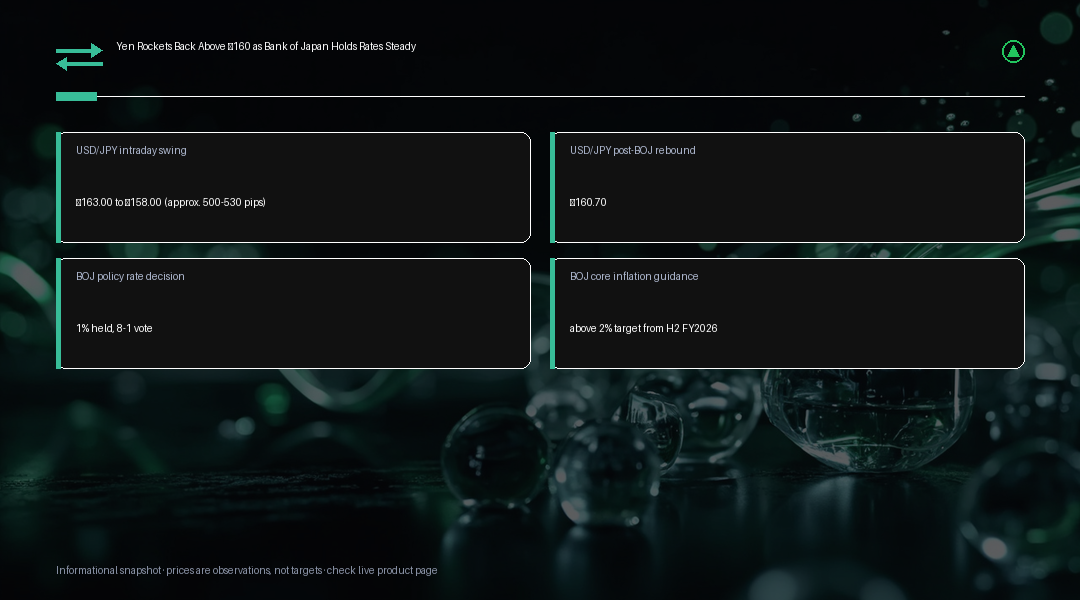
The dollar-yen pair swung through one of its most dramatic sessions in recent memory this week, tumbling from beyond ¥163.00 to near ¥158.00 in a matter of hours before steadying back above ¥160.00 as the Bank of Japan wrapped up its latest policy meeting. The move, estimated at roughly 500 to 530 pips peak to trough, ranks among the yen's largest single-session swings in years and has traders across Tokyo, London and New York asking the same question: did Japanese authorities just step into the market again.
No confirmed statement has been issued by the Ministry of Finance or the Bank of Japan acknowledging direct currency intervention, and any official confirmation would typically only surface later through government transaction data. Still, the shape of the move, a vertical drop with no obvious headline catalyst, fits the pattern traders have come to associate with stealth intervention. The timing was notable too. The yen crossed ¥163 per dollar for the first time in roughly four decades just before the reversal, a level that had been flagged repeatedly by Japanese officials as a line few in Tokyo wanted to see breached.
Finance Minister Satsuki Katayama had warned only days earlier that authorities stood ready to take what she called appropriate and bold action if currency moves became excessive. Traders who had grown numb to verbal warnings after months of jawboning got a far more concrete answer this week, whether or not Tokyo ever formally admits to it.
Japan is no stranger to this playbook. Earlier in 2026, the Ministry of Finance is understood to have run one of its largest intervention campaigns on record, with spring operations estimated near ¥11.7 trillion, dwarfing the roughly $70 billion Tokyo is separately understood to have spent defending the yen across April and May. Those efforts produced sharp, short-lived rallies but little durable strength, a pattern that appears to be repeating itself now. Intervention can shock the market for a session or two, but it rarely changes the underlying interest rate gap that has kept the yen under pressure for years.
That gap was on full display Friday when the Bank of Japan opted to leave its benchmark rate unchanged at 1%, in an 8-1 vote. Board member Hajime Takata was the lone dissenter, pushing for an immediate increase to 1.25%. The split vote underscores a real and growing debate inside the central bank about whether policy is still too loose for an economy where price pressure keeps building.
The bank's accompanying language did most of the work that a rate hike normally would. Policymakers warned that core inflation could run clearly above the 2% target from the second half of fiscal 2026, a fiscal year that in Japan runs from April through the following March. That is a deliberately hawkish signal dressed up as a hold, effectively telling markets that further tightening remains firmly on the table even if the board was not ready to move Friday.
The reaction was almost immediate. USD/JPY, which had been pinned near its intervention-era lows, rebounded toward ¥160.70 as the hawkish inflation language offset some of the intervention-driven yen strength. It is a reminder of how quickly gains manufactured by intervention can fade once a data point or policy statement shifts the conversation back to fundamentals.
For traders, the practical takeaway is that the ¥160-¥161 zone has effectively become the new front line. Analysts had previously treated ¥162 to ¥165 as Tokyo's most sensitive range, but this week's action suggests the threshold for uncomfortable official attention may now sit lower than assumed, precisely because authorities already showed a willingness to act near ¥163. A retest of that zone without a clear fundamental driver could just as easily invite another bout of official activity.
The broader setup leaves USD/JPY caught between two forces pulling in opposite directions. On one side, a Federal Reserve that has been in no rush to cut aggressively keeps the dollar side of the pair supported through a persistent yield advantage. On the other, a Bank of Japan that is now explicitly signaling more tightening ahead, paired with a finance ministry that has shown it is willing to intervene at increasingly lower thresholds, argues for a yen that should structurally strengthen over time even if the path there is choppy.
The episode also carries implications beyond the dollar-yen pair itself. A sharp, intervention-linked yen rally tends to ripple through other yen crosses, and desks reported comparable volatility in EUR/JPY and GBP/JPY as the move unfolded, even though neither the euro nor sterling had any direct catalyst of its own that session. Cross-asset desks also flagged a brief pickup in demand for Japanese government bonds as the yen strengthened, consistent with unwinding of some carry-trade positioning that had built up while the yen sat near multi-decade lows. None of that changes the core policy story, but it is a reminder that Bank of Japan decisions and suspected Ministry of Finance intervention now carry weight well beyond a single currency pair.
Traders positioning around this pair need to respect both realities. Chasing the dollar higher into round-number resistance near ¥163 and on toward ¥165 carries clear intervention risk, given how recently and how forcefully Tokyo appears to have acted. At the same time, fading every yen rally on the assumption that intervention gains always evaporate ignores a central bank that is now openly flagging a firmer stance on inflation. The most durable setups are likely to come from Japan's own data and rhetoric rather than from guessing the next intervention trigger, with the upcoming inflation prints from the back half of fiscal 2026 shaping up as the next real test of whether the Bank of Japan follows through on its warning.
Trading Insight
The ¥160-¥161 area now functions as a practical pivot for USD/JPY. A clean break and hold above ¥163 without an accompanying fundamental catalyst should be treated as intervention-risk territory rather than a low-risk breakout, given the timing of this week's reversal and the finance ministry's escalating rhetoric. Conversely, dips back toward ¥158 may attract dollar buyers if U.S. yields hold firm, since intervention alone has not historically reversed the pair's medium-term trend without a matching shift in the rate differential. Watch Japan's core inflation prints through the back half of fiscal 2026 and any follow-up commentary from Governor Ueda's board; a confirmed move toward 1.25% would materially narrow the yield gap that has kept the yen structurally weak and could turn ¥160 from a pivot into resistance.