


Monday was not a great day for risk assets. The major US indices opened the session in the red, with traders holding back despite a relatively quiet macro calendar. The S&P 500 slipped, the Dow Jones Industrial Average lost ground, and the Nasdaq Composite drifted lower as market participants weighed geopolitical headlines against selective bottom-fishing in beaten-down sectors.
The immediate catalyst was renewed tension between the US and Iran, which sent crude oil briefly above $90 a barrel. That spike reminded markets that energy supply risk is never far from the surface. Higher oil can support energy producers, but it also raises the cost-of-business worry for everything from airlines to consumer names. By the close, crude had eased from its peak, but the intraday move was enough to keep traders cautious.
Beneath the soft headline, there was a more constructive undercurrent. Last week’s worst-performing groups saw some buying interest, especially in semiconductors. Micron, Sandisk, and Seagate all found support after the prior week’s selloff. That rotation suggests investors were not abandoning the AI-capital-expenditure story; they were simply pausing after a sharp round of profit-taking. The distinction matters because a corrective pullback in a bull market is different from a trend change.
The rebound extended into Asia overnight, where South Korea’s Kospi rallied strongly. Samsung Electronics climbed and SK Hynix followed, both drawing buyers back into memory-chip names. Asian strength is not a guarantee for US opens, but it does signal that the chip sector is not in a one-way downdraft. The emotional damage from last week’s semiconductor selloff may be easing faster than the price action suggested.
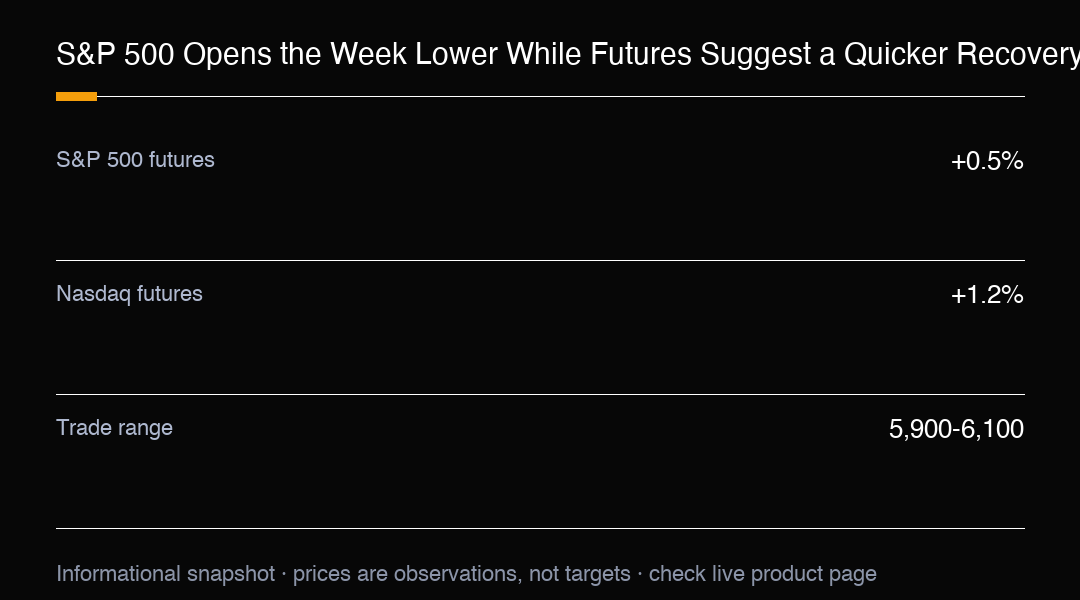
More important for the immediate session is what happened in US equity futures. After Monday’s close, Dow futures, S&P 500 futures, and Nasdaq futures all turned higher early Tuesday. The Nasdaq led the bounce, with futures outperforming the broader averages. That divergence fits the broader narrative: tech and chip names are recovering faster than old-economy stocks still burdened by oil and geopolitical risk.
Several catalysts are converging this week. Alphabet, Tesla, and IBM all report earnings on Wednesday. Intel and American Airlines follow on Thursday. With Federal Reserve officials now in their pre-meeting blackout period, there will be fewer macro soundings to move markets. That leaves earnings as the main directional driver, especially for names that have moved sharply on positioning rather than results.
The undercurrent of weakness in Monday's session was not limited to US equities. European markets finished lower as well, with the Stoxx 600 weighed down by energy and technology names. That global backdrop matters because it suggests Monday's risk-off move was not an isolated US phenomenon. When multiple regions sell off simultaneously, it usually reflects a broader reassessment of macro risk rather than a single-country issue.
One sector that stood out for all the wrong reasons was semiconductors. The group has been volatile for weeks, but Monday's action was particularly bruised. Micron, Sandisk, and Seagate all fell sharply before stabilizing late in the session. The selling was driven by concerns that AI-related memory demand may be overheating, and that the capital-expenditure surge from hyperscalers could slow. If the AI trade is losing momentum, semiconductor stocks could remain under pressure even if broader indices recover.
Traders should also watch the dollar. The US Dollar Index has been grinding higher as markets price in slower Fed easing. A stronger dollar pressures emerging-market assets and commodity prices while helping US exporters. If the dollar continues to firm ahead of the Fed meeting, risk assets could face another headwind. Currency markets are often a leading indicator for equities, and the current dollar trajectory suggests caution.
For options traders, Monday's action reset the volatility surface. The VIX at 18.65 does not reflect panic, but it is elevated enough to make protective puts expensive. Selling volatility into earnings can be profitable if the market overprices risk, but it can also lead to large losses if a single earnings report triggers a gap. The asymmetry favors defined-risk structures rather than naked directional bets.
Commodity markets added another layer of risk sentiment to Monday's session. The US-Iran tensions that briefly pushed oil above $90 also strengthened the case for risk-off positioning in portfolios. Energy traders handled the volatility by adding to longs near Tuesday's open, while equity traders remained cautious. That split behavior is typical during geopolitical scares: crude can spike on supply disruption fears while stocks fall on demand-destruction concerns. The result is a market where macro hedges are being tested and traditional correlations are behaving unpredictably.
Another factor working against equities was positioning. After a strong prior week, many traders had already established long exposure ahead of earnings. When geopolitical headlines hit, those longs were ripe for reduction. The result was a self-reinforcing selloff into the close, especially in names that had run the most. Samsung Electronics and SK Hynix, for example, gave back some of their early gains before stabilizing. Even in recovery markets, the path is rarely straight. Traders who chased the Asian rebound in the US session found themselves holding positions that were quickly marked to market lower.
Looking ahead, the S&P 500's ability to hold the 7,440-7,450 zone will be tested by the earnings onslaught. Alphabet and Tesla both carry heavyweight influence in the index, and their results will be scrutinized for signs of AI-demand durability and advertising resilience. If either report triggers a double-digit move, the rest of the market will follow. IBM's report on the same day adds a mainframe-to-hybrid-cloud narrative that can either soothe or deepen concerns about technology spending. Thursday's Intel and American Airlines reports will provide a cross-section of both technology demand and consumer travel strength.
Bond markets remained relatively stable despite the equity selloff. The 10-year yield at reflects a market that is not panicking about growth but is also not optimistic enough to chase stocks at higher prices. The Fed blackout means there will be no official guidance on whether the September meeting should deliver a rate cut, leaving the decision to incoming data. That data dependency is healthy for the economy but uncomfortable for traders who want a clear directional bias.
Trading Insight
Equities opened the week softer, but futures recovered quickly, especially in tech and chip names. The oil spike faded, and attention is shifting back to earnings and rate-sensitive positioning into the Fed blackout.