


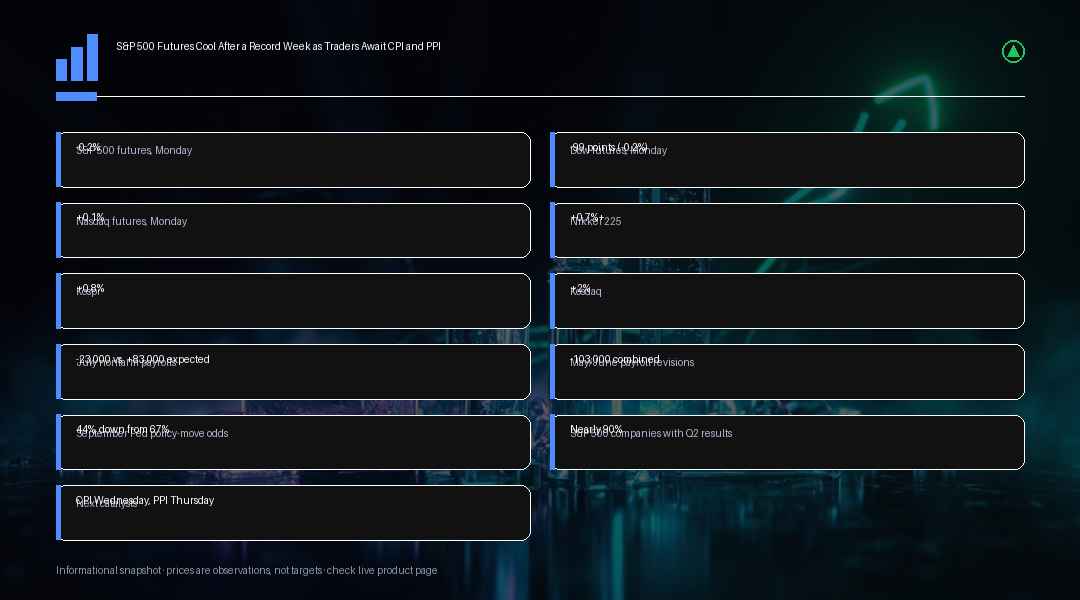
S&P 500 futures eased 0.2% in early Monday trading, a mild pause after Wall Street's best week since April. Dow futures slipped 99 points, also down 0.2%, while Nasdaq futures inched 0.1% higher as traders rotated out of Friday's celebratory mood and back into a more familiar habit: worrying about what comes next. The S&P 500 had closed Friday at a record high, capping a week in which all three major U.S. indexes advanced despite a growth backdrop that looked anything but strong.
The catalyst behind Monday's pullback was less about economics and more about diplomacy. Optimism had been building around a potential U.S.-Iran arrangement to reopen the Strait of Hormuz, a corridor through which a substantial share of the world's seaborne oil trade passes. That optimism faded after Iran denied that direct talks with Washington were underway, and the U.S. side described the process as only semi-negotiating. Neither side has declared the talks dead, and neither has confirmed they are alive; for now the situation sits in a diplomatically ambiguous middle ground that traders will need to watch rather than assume resolved.
Asia told a calmer story overnight. Japan's Nikkei 225 gained more than 0.7% and the broader Topix index also advanced, while South Korea's Kospi rose 0.8% and the smaller-cap Kosdaq climbed 2%. The regional divergence underscored how much of Monday's softness in U.S. futures was tied to a specific geopolitical headline rather than a broad risk-off shift across global markets.
The more interesting story is why stocks rallied into Friday's record close in the first place. July's U.S. payrolls report showed the economy unexpectedly shed 23,000 jobs, a sharp miss against economist forecasts for a gain of roughly 83,000 positions. Revisions compounded the surprise, stripping a combined 103,000 jobs from the previously reported May and June figures. On its face, that is a weak labor-market print. Markets read it instead as a reason for relief, on the logic that a cooling jobs market reduces the odds that the Federal Reserve will need to keep policy tight.
That interpretation shows up directly in futures pricing. Contracts tied to the Fed's September meeting now imply roughly a 44% probability of a policy move, down sharply from about 67% just a week earlier. It is worth being precise about what that shift means: it reflects reduced market conviction that the central bank needs to hold a restrictive stance, not a guarantee of easier policy and certainly not a mechanical law that weak jobs data always lifts equities. If the labor-market softness is eventually read as an early recession signal rather than a reason for policy relief, the same data could just as easily turn into a headwind.
That is precisely the tension traders now carry into this week's inflation calendar. The Consumer Price Index, which tracks what households pay for goods and services, and the Producer Price Index, which tracks what businesses receive for the goods they sell, both land this week and will do more to shape the path forward than Monday's quiet calendar. A cool set of readings would tend to validate the bad-news-is-good-news logic that carried stocks to a record close. A hot print, on the other hand, could revive rate-hike anxiety and undercut the very rally that weak jobs data helped produce. Commentary from major asset managers has already flagged that core inflation could stay firmer than hoped into the final months of the year given tariff effects and energy costs, so this is a genuine two-sided risk rather than a formality traders can wave through.
Earnings season adds a supportive backdrop, if a fading one. Nearly 90% of S&P 500 companies have already reported second-quarter results, and corporate America has broadly cleared the bar that was set for it. That track record helps justify record index levels, but it also means the market has less earnings-driven surprise left to lean on this week. A handful of notable reports are still due, including Rocket Lab, Cava, Super Micro and CoreWeave, a mix that spans space technology, restaurants and AI infrastructure and offers a useful cross-section of how differently exposed sectors are digesting the current environment.
For active traders, the mechanical read-through matters as much as the headline. Deterioration in Iran-related diplomacy tends to raise oil-supply and shipping-risk concerns, which can lift inflation expectations and Treasury yields even before any physical disruption occurs, and higher yields are typically a drag on equity valuations, particularly for longer-duration growth names. That gives Monday's geopolitical headline a plausible transmission channel into equity pricing beyond simple sentiment, and it is one reason futures reacted the way they did even without an actual Hormuz shipping disruption occurring.
The setup into Wednesday and Thursday is straightforward to describe and harder to trade: a market sitting at record highs after a rally built on economic weakness, waiting on two inflation reports that could either confirm or undercut the rate-relief narrative that got it there. Traders should treat both the Strait of Hormuz storyline and this week's CPI and PPI prints as live, unresolved risks rather than settled outcomes, and size positions with the understanding that a market priced for a soft landing has more room to disappoint than one already pricing caution.
MC Markets does not cite exact source levels without independent market-data verification. Traders should confirm current index levels, futures pricing and economic-release timing through their own market-data feeds before acting on any of the figures discussed above.
Trading Insight
The key swing factor this week is not Monday's modest futures dip but Wednesday's CPI print and Thursday's PPI release, both of which will test whether the market's bad-news-is-good-news logic can survive a hot inflation surprise. A cool CPI/PPI pairing would tend to reinforce the reduced-tightening narrative that lifted futures-implied September policy-move odds to roughly 44% from 67%, supporting a continuation toward fresh records. A hot pairing would cut the other way, reviving hike concerns just as record-high valuations leave less room for disappointment. Separately, watch the Strait of Hormuz storyline for any concrete confirmation or denial of renewed talks, since a genuine breakdown could lift oil and yields together and pressure equities through a channel unrelated to the domestic data calendar. With nearly 90% of S&P 500 earnings already in, upcoming reports from Rocket Lab, Cava, Super Micro and CoreWeave are more likely to move individual names than the broad index.