


US equity markets delivered another session that underscored just how divergent performance has become beneath the index-level headlines. The Dow Jones Industrial Average closed at a fresh record for a third consecutive session, while the S&P 500 and Nasdaq Composite both retreated as investors trimmed exposure to some of the market's most crowded artificial-intelligence trades. The split outcome is a useful reminder that a record close in one benchmark does not guarantee a uniformly positive session across the broader market.
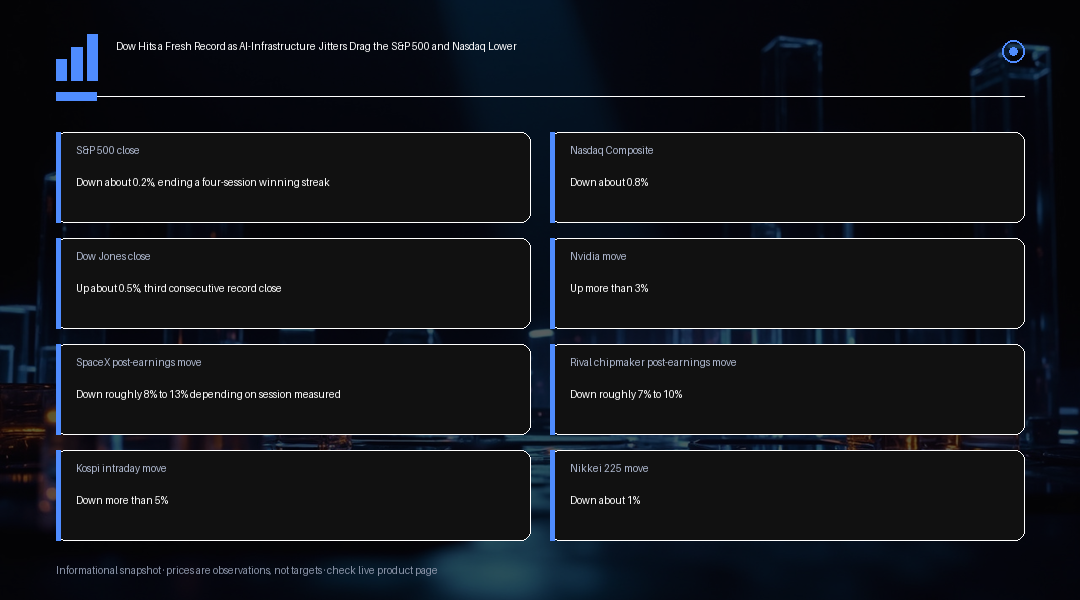
The S&P 500 pulled back from an intraday record and closed roughly 0.2% lower, ending a four-session winning streak in the process. The Nasdaq Composite fell a sharper 0.8% as AI-linked names came under pressure, while the Dow added roughly 0.5% to reach its latest record close, helped by strength in blue-chip names that sit outside the more richly valued AI infrastructure trade. That combination, a tech-heavy pullback alongside blue-chip strength, illustrates how differently the market is currently treating AI-exposed growth stocks versus more traditionally valued industrial and consumer names.
The session's most consequential single headline came from outside the benchmark index moves entirely: Elon Musk's comment that SpaceX would build its future AI infrastructure exclusively around Nvidia hardware. Nvidia shares rose more than 3% on the endorsement, while the announcement simultaneously weighed on a rival chipmaker whose shares fell sharply on the same day as investors recalibrated expectations about future AI-infrastructure order flow. The episode is a clear example of how a single comment from an unusually large, unusually influential AI-infrastructure buyer can move sentiment across an entire chip-sector supply chain within a single trading session.
SpaceX's own results added to the day's turbulence. The company posted its first public earnings report since going public, and while revenue nearly doubled year over year and losses came in better than expected, the market's attention shifted quickly toward the size of its artificial-intelligence infrastructure spending, which approached $16 billion in capital expenditure for the quarter. Shares fell sharply, with reported declines ranging from roughly 8% to 13% depending on the exact session and timestamp measured, as investors weighed the scale of that spending against the company's near-term profitability.
A separate chipmaker's results told a similar story from a different angle. Despite posting a genuine double beat on both revenue and profit, with data-center revenue more than doubling year over year, shares fell by an estimated 7% to 10% after the earnings call, as the accompanying outlook only modestly exceeded expectations rather than delivering the kind of acceleration a richly valued AI story has increasingly needed to satisfy the market. Guidance that would have been considered strong in almost any other environment was read as underwhelming for a stock that had already priced in continued rapid growth.
The selling pressure in AI-adjacent names did not stay confined to Wall Street. Asian chip stocks followed US markets lower the next trading day, with South Korea's benchmark index sinking more than 5% intraday before paring some of its losses, while two of the country's largest semiconductor manufacturers each fell by mid-to-high single-digit percentages. Japan's benchmark index declined by roughly 1%, though its broader, less concentrated counterpart edged modestly higher, again illustrating how narrowly the selling was concentrated in the most AI-exposed names rather than spreading evenly across entire markets.
The combination of a record-setting Dow and sharp single-stock declines elsewhere carries a clear message for active traders: broad index strength can mask meaningfully different conditions underneath the surface. A market that is simultaneously setting records in blue-chip industrials while punishing AI-infrastructure spenders for the scale of their capital expenditure is a market that has become more selective about which parts of the AI trade it is willing to reward, rewarding profitable, disciplined growth while showing far less patience for spending that outpaces near-term earnings visibility.
Looking ahead, the dense earnings calendar remains the dominant near-term catalyst. Traders should expect the current pattern, broad index-level strength driven by blue-chip earnings beats layered against sharp, stock-specific reactions to AI-infrastructure spending disclosures, to persist as more companies report over the coming weeks. Breadth measures, such as the share of index constituents trading above their key moving averages, are worth monitoring closely, since narrow, concentration-driven advances have historically proven more vulnerable to sharp reversals than genuinely broad ones. Futures pointed modestly higher heading into the next session, a signal that traders were not immediately looking to extend the prior day's AI-related selling, though a single session of follow-through is rarely enough on its own to confirm a durable shift in sentiment.
This is not the first time this year that AI-related capital spending has produced an outsized market reaction. Investors have grown increasingly sensitive to the gap between headline revenue growth and the capital intensity required to sustain it, particularly for companies still early in their public-market life or still building out infrastructure at a pace that outstrips current cash generation. The market's willingness to reward genuine AI-driven revenue growth remains intact, as shown by Nvidia's gain on the same day, but its patience for capital expenditure that management frames as necessary for future competitiveness rather than immediate returns appears to be thinning with each successive earnings cycle.
For traders positioning around the remainder of this earnings season, the practical lesson from this session is to separate company-specific capital-spending disclosures from broader index-level direction. A single company's decision to concentrate its AI infrastructure spending with one hardware supplier, while newsworthy and market-moving for the stocks directly involved, does not by itself change the fundamental demand backdrop for AI computing capacity industry-wide. What it does change is near-term sentiment and positioning in the specific names caught on the wrong side of that decision, which is exactly the pattern seen in this session's chip-sector reaction on both sides of the Pacific. Traders should also keep an eye on options-market positioning in the most AI-exposed names, since elevated implied volatility around single-stock earnings has been a recurring feature of this cycle and can amplify moves in either direction.
MC Markets does not cite exact source levels without independent market-data verification. Traders should confirm current index levels and company-specific data through their own market-data feeds before acting on any of the information discussed above.
Trading Insight
With the Dow at fresh records while the S&P 500 and Nasdaq retreat, the near-term path likely depends on whether this week's dense earnings calendar keeps rewarding disciplined, profitable growth while punishing outsized AI-infrastructure spending. Traders should track breadth measures, such as the share of index constituents trading above key moving averages, to judge whether index-level strength is broadening out or concentrating in a narrower set of blue-chip names, since narrow advances have historically proven more vulnerable to sharp reversals. The spillover into Asian chip stocks is worth monitoring as a leading indicator of sentiment toward AI-infrastructure spending broadly; a stabilization there without further deterioration would suggest the selling was a sentiment-driven reaction to one earnings cycle, while continued weakness would suggest a more durable repricing of AI-infrastructure valuations is underway.