


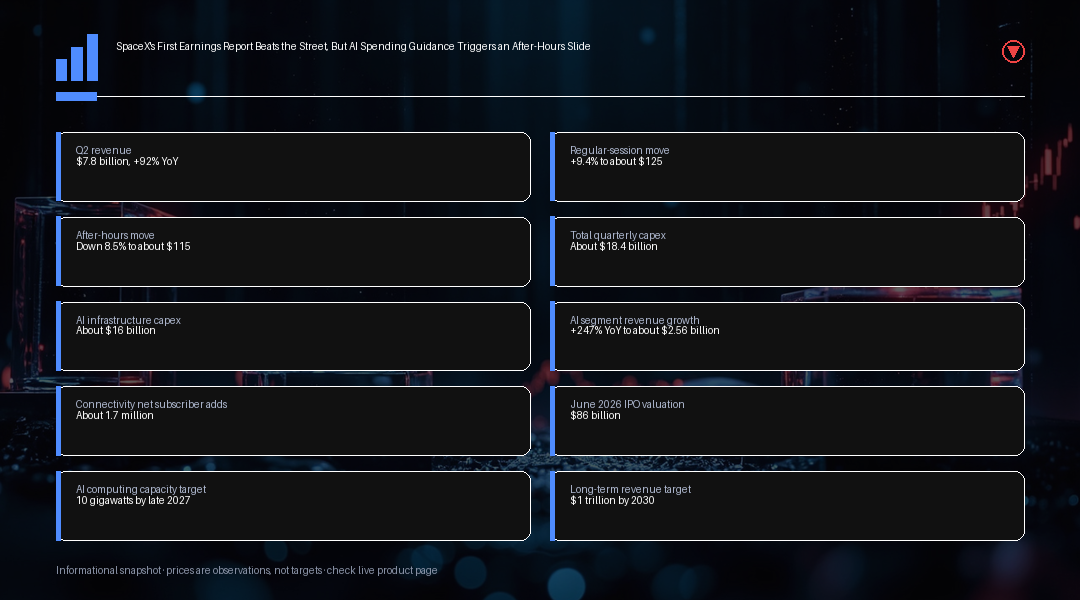
SpaceX delivered its first quarterly earnings report as a newly public company, and by the traditional scorecard, it was a clean beat. Second-quarter revenue surged 92% year over year to $7.8 billion, comfortably ahead of the roughly $6.8 billion Wall Street had modeled, while the net loss narrowed to around $541 million against an expected shortfall closer to $2.1 billion. Shares initially rallied about 9.4% during the regular session to roughly $125 as traders welcomed the numbers. The mood shifted only after the closing bell: once the earnings call turned to capital spending, shares slid roughly 8.5% in after-hours trading to around $115, as investors weighed the scale of the company's AI build-out against its near-term profitability.
The pattern is a familiar one this earnings season. A company clears the headline bars on revenue and losses, then loses the room the moment management describes how much it plans to spend chasing the next leg of growth. For a business running rockets, satellites and data centers inside the same operating plan, that tension is especially pronounced, and it helps explain why a genuine beat still produced a same-day reversal once the market had time to digest the guidance.
The capital-spending detail is significant. Total quarterly capital expenditure reached roughly $18.4 billion, about six times higher than the year-ago period, with close to $16 billion of that directed specifically at AI infrastructure: the data centers, chips and power capacity needed to train and run large models at scale. Adjusted EBITDA came in near $3.5 billion, evidence that the underlying business is still generating real cash even as capital spending accelerates aggressively.
Segment detail adds useful texture. Connectivity revenue, the Starlink-style satellite internet business, reached roughly $4.3 billion with about 1.7 million net subscriber additions in the quarter. A separate AI segment generated close to $2.56 billion in revenue, up around 247% year over year. Both figures point to a business diversifying well beyond its original launch-services roots, even as the AI build-out dominates the spending conversation.
Management indicated that AI-related spending would likely hold near current levels for at least two more quarters. Musk described plans to grow AI computing capacity from about 2 gigawatts by year-end toward closer to 10 than 5 gigawatts by late 2027. Each incremental gigawatt of capacity can cost tens of billions of dollars to build out, which helps explain why the market reacted more to the spending trajectory than to the headline beat itself.
Musk also committed future AI infrastructure exclusively to Nvidia hardware, covering the current Blackwell platform and its successors. That commitment effectively leaves a rival chipmaker outside SpaceX's AI supply chain for now, a detail that rippled into chip-sector sentiment the same day, alongside a broader earnings season already leaning heavily on AI-related capital spending decisions across multiple companies.
The report followed June's initial public offering, which valued the company near $86 billion and initially sent shares toward $225. Shares have since traded well below that peak, changing hands between $115 and $125 in the sessions covered above, leaving the company valued at roughly $1.65 trillion by some estimates, an approximate figure that moves with the live share price rather than a fixed number.
Longer term, Musk reiterated a target of $1 trillion in annual revenue by 2030, a year earlier than previously guided, describing what he called a non-zero chance of reaching that mark as early as 2029. That framing is worth keeping separate from the confirmed quarterly results: it is explicitly a low-probability upside scenario floated by management, not a base-case forecast that the current $7.8 billion quarterly run rate is already on track to hit.
None of this points to a failed product or a botched mission, despite the cheeky framing that has circulated since the print. The rocket, so to speak, launched cleanly: revenue, margins and loss trajectory all cleared expectations. What spooked the after-hours tape was the scale of the spending required to compete in AI infrastructure, a concern shared across the sector rather than unique to this one earnings call.
For traders, the setup now separates into two distinct questions. The first is whether SpaceX's core launch, connectivity and government businesses keep compounding at anywhere close to their current pace, which the quarter's growth numbers support. The second, more open question is whether the AI capital-spending cycle converts into durable, profitable growth on the timeline management is describing, or whether the market ultimately decides the company is over-committing capital to a young, unproven segment of its business.
It is also worth flagging what remains unverified independently. Musk's commentary about Tesla's growing collaboration with SpaceX through a proposed chip-manufacturing initiative called Terafab, along with the exact electricity-consumption comparison used to illustrate the scale of a 10-gigawatt data-center footprint, comes directly from the earnings call itself rather than from a second, independently confirmed source. Traders should treat those specific details as company commentary and directional color rather than audited fact, even though they are broadly consistent with the rest of the capital-spending narrative.
From a trading standpoint, the after-hours print near $115 now functions as a useful near-term reference point. A slide meaningfully below that level on continued capex concern would suggest the market wants a clearer payback timeline before rewarding further AI investment, while a recovery back toward $125 would suggest the after-hours reaction was largely a knee-jerk response to the size of the spending figures rather than a lasting reassessment of the growth story.
Trading Insight
Active traders should treat this as a capital-intensity story about a newly public, high-growth company, not a story about missed execution. The after-hours slide reflects the market pricing in years of aggressive AI infrastructure spending, not a shortfall in launch cadence, connectivity growth or government demand. Watch three signals over the next two quarters: whether capital expenditure guidance holds near the pace management described this quarter, whether Nvidia exclusivity holds as computing capacity scales toward the 5 to 10 gigawatt range by late 2027, and whether AI segment revenue growth, running near 247% year over year this quarter, decelerates meaningfully from that pace. A stabilization near current after-hours levels around $115 would suggest the market has priced in the spending story; a further slide toward the lower end of the post-IPO trading range would suggest lingering doubt about return timelines. Position sizing matters here given the stock's short trading history and the binary nature of headline-driven AI capex swings.