


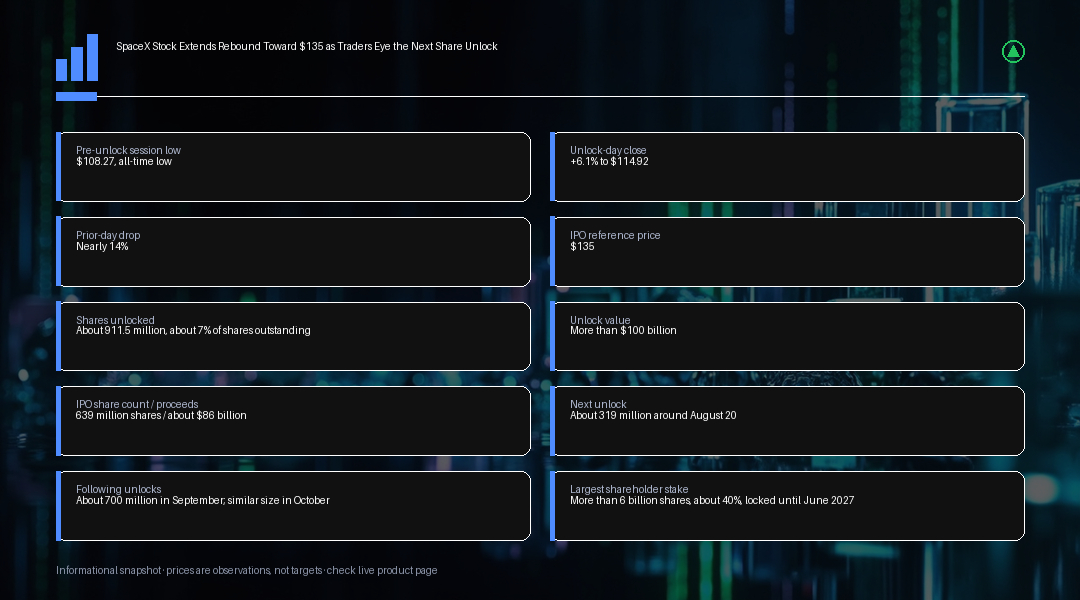
SpaceX shares have spent the past several sessions doing something the market did not fully expect when nearly a billion previously restricted shares first became tradable: climbing. The stock tumbled almost 14% to an all-time low of $108.27 in the session immediately before the unlock, then rebounded 6.1% to $114.92 as roughly 911.5 million shares tied to the company's first major post-IPO lockup became eligible for trading. Rather than fading once the initial relief rally passed, that recovery has continued to build in the sessions since, with the stock working its way back toward its $135 initial public offering price.
A lockup is a standard IPO feature that prevents company insiders, employees and early investors from selling their shares for a fixed period after a company goes public. Its expiration does not force anyone to sell; it simply removes that restriction and leaves each holder to decide independently whether to take profits, hold for the long run, or wait for a better price. Because the newly eligible block was so large, roughly 7% of SpaceX's total shares outstanding and worth more than $100 billion at the unlock-week close, the market spent days bracing for the possibility that a meaningful share of holders would sell at once.
That has not been the pattern so far. Instead of an orderly or disorderly selloff, the days following the unlock have brought a steady grind higher, with the stock closing the gap toward its IPO reference price rather than widening it. For context, SpaceX's debut sold 639 million shares and raised about $86 billion at that $135 price, meaning the freshly unlocked block alone is larger than the entire original IPO float. A market that can absorb a block of that size without a disorderly reaction is telling traders something about how much genuine demand exists for the stock beyond the original IPO buyer base.
None of this means the supply story is finished. SpaceX's unlock calendar remains busy well beyond this single event. Another roughly 319 million shares are scheduled to become eligible around August 20, followed by a further release of about 700 million shares in September and a similarly sized batch in October. Each of those dates functions as its own test of whether demand can keep pace with an expanding float, and the fact that the market handled the first and largest unlock calmly does not guarantee the same outcome at the next one.
A separate, much larger slice of the ownership structure is not part of this story at all. Elon Musk, SpaceX's largest shareholder, holds more than 6 billion shares, or roughly 40% of the company, and that stake stays locked until June 2027. That keeps the single biggest potential source of future supply out of the market for nearly another year, which gives both bulls and bears a long runway before that particular risk needs to be priced into the stock at all.
For traders, the psychologically important level to watch is the $135 IPO price itself. Reclaiming that level would mean every investor who bought at the debut is back to breakeven or better, a milestone that tends to draw fresh attention and can attract additional buying interest as it approaches. On the downside, the $108.27 low set just before the unlock is now the more relevant support reference than the unlock event itself; a failure to hold above that level on any future unlock date would suggest the market's patience with the supply calendar has limits after all.
The larger float created by the unlock is not purely a risk factor. A bigger pool of freely tradable shares generally narrows bid-ask spreads and makes a stock easier to trade in size, a genuine liquidity improvement for both institutional and retail participants that is separate from the directional question of whether more holders choose to sell. Traders should avoid conflating the two effects: SpaceX can become structurally easier to trade even during a stretch where the net direction of the stock is unresolved.
The broader lesson extends past SpaceX itself. Newly public companies with unusually large, thinly floated share structures tend to produce exactly this kind of multi-stage story: an unlock date that sounds unambiguously bearish on paper, a market reaction that turns out calmer or even positive, and a series of follow-on unlock dates that keep the supply question alive for months rather than resolving it in a single session. A stock that has already survived its largest scheduled unlock without a disorderly drop enters the next one with more benefit of the doubt, but not with the risk fully removed.
Volatility around the stock is likely to stay elevated regardless of how the next few unlock dates play out. SpaceX shares have already swung from an all-time low to a multi-day recovery approaching the IPO price within the space of about a week, a reminder that high-profile, recently listed companies with large pools of restricted stock can move sharply in either direction as their ownership structure continues to evolve through year-end.
MC Markets does not cite exact source levels without independent market-data verification. Traders should confirm current share prices, unlock dates and share counts through their own market-data feeds before acting on any of the figures discussed above.
Trading Insight
The immediate focus for traders is whether SpaceX can close the remaining gap back to its $135 IPO price, a level that would return debut-quarter buyers to breakeven and could draw fresh attention as a round-number magnet. The $108.27 low set just ahead of the unlock is now the key support reference, and a clean hold above it through the August 20 unlock of roughly 319 million shares would reinforce the view that the market has genuinely absorbed the float increase rather than merely delayed a reaction. September and October bring further releases of a similar scale, so the real test of this recovery is not the single unlock already behind the stock but whether demand keeps pace across a full calendar of releases stretching toward year-end. Elon Musk's locked 40% stake, unavailable until June 2027, remains the largest deferred supply risk and is not a near-term factor either way.