


Sandisk delivered one of the more dramatic earnings reactions of this reporting season: a genuinely record quarter that still triggered a sharp sell-off, a reminder that in markets already pricing in extraordinary growth, beating expectations is necessary but not always sufficient. Shares fell sharply in premarket and after-hours trading once investors moved past the headline numbers and focused on what the outlook implied about the pace of growth from here.
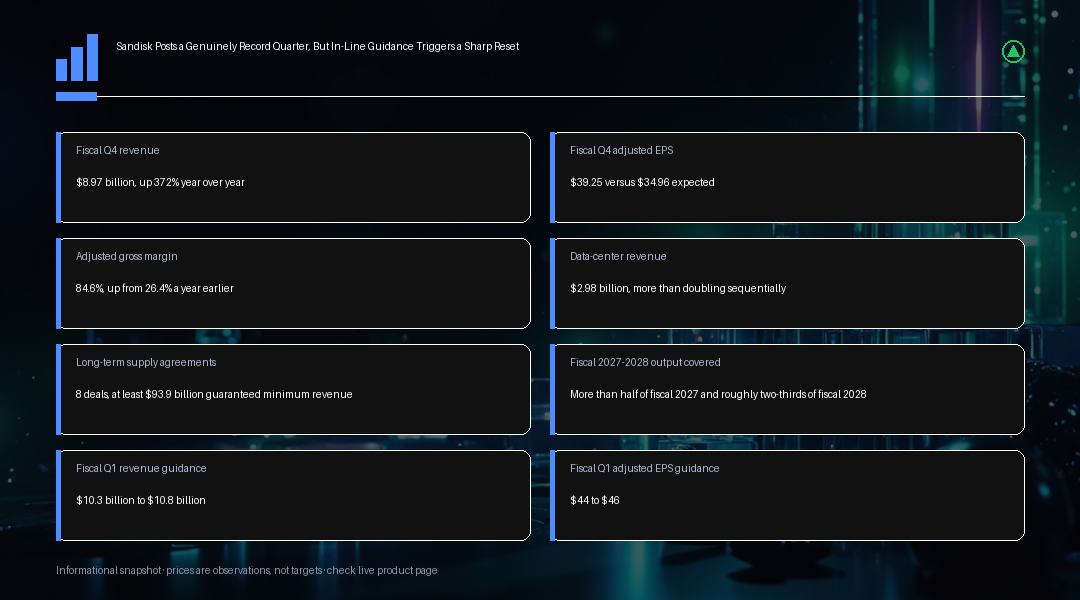
The headline figures were genuinely exceptional. Fiscal fourth-quarter adjusted earnings reached $39.25 per share, comfortably ahead of the roughly $34.96 per share Wall Street had modeled, while revenue climbed to $8.97 billion against expectations near $8.48 billion. A year earlier, the company had earned just $0.29 per share on $1.9 billion of revenue, meaning adjusted profit grew by roughly 13,400% year over year while sales climbed 372%. Numbers of that scale can look almost like a typo, and they reflect how quickly the underlying business has been transformed by a single demand driver.
That driver is artificial intelligence infrastructure. Data-center revenue reached $2.98 billion, beating analyst estimates near $2.74 billion and more than doubling on a sequential basis. Cloud and hyperscale computing customers are purchasing large volumes of memory to build out AI data centers, and supply has struggled to keep pace with that demand. The imbalance between limited supply and surging orders has pushed memory pricing, and Sandisk's profitability, sharply higher: adjusted gross margin reached 84.6% in the quarter, up from just 26.4% a year earlier, an improvement in profitability that is unusually large even by the standards of a fast-growing technology company.
Perhaps the most important detail for long-term investors is the visibility management has now locked in. The company has signed eight long-term supply agreements with major customers, together worth a guaranteed minimum of $93.9 billion in future revenue, with roughly $16.5 billion in customer default protections layered on top. Those agreements already cover more than half of the company's expected fiscal 2027 output and roughly two-thirds of its fiscal 2028 output. In an industry that has historically been defined by boom-and-bust pricing cycles, that level of contracted, multi-year revenue visibility is a meaningful structural shift, not simply a favorable quarter.
So why did the stock fall so sharply if the results and the longer-term outlook both looked so strong? The answer lies in guidance and valuation. Sandisk guided fiscal first-quarter revenue to a range of $10.3 billion to $10.8 billion, essentially in line with Wall Street's $10.82 billion estimate, with adjusted earnings expected between $44 and $46 per share. That outlook is genuinely healthy in absolute terms, but for a stock that had already priced in continued acceleration, guidance that merely meets expectations rather than sharply exceeding them can read as a disappointment rather than a confirmation.
Valuation context matters here as much as the earnings print itself. Heading into the report, the shares had already surged by an extraordinary multiple from year-ago levels, and momentum indicators had pushed into territory typically associated with an overbought market, the kind of positioning where even a strong quarter carries elevated risk of a sharp reversal if the outlook does not clear an unusually high bar. That is precisely what unfolded: shares that had rallied aggressively into the print gave back a substantial portion of their gains once traders concluded the next several quarters were unlikely to accelerate meaningfully faster than what had already been guided.
The broader read-through for the memory and AI-infrastructure trade is nuanced. On one hand, the results confirm that underlying demand for high-capacity storage tied to AI workloads remains extremely strong, with data-center revenue more than doubling sequentially and gross margins expanding at a pace rarely seen outside of software businesses. On the other hand, the market's reaction is a clear signal that valuations across the AI supply chain have moved to a level where continued outperformance, not just continued growth, is now the bar for a positive stock reaction. That distinction matters for how traders think about the broader basket of AI-infrastructure suppliers heading into the rest of this earnings season.
For traders assessing what comes next, the key variables are relatively clear. Sustained data-center demand, continued discipline on the supply side that keeps pricing power intact, and the durability of the contracted revenue base under the long-term supply agreements are the structural pillars supporting the stock over a multi-quarter horizon. In the near term, however, price action is more likely to be governed by how the shares stabilize after this reset: a base building near current levels without further deterioration would suggest the market has digested the guidance, while continued weakness would suggest lingering concern that this quarter marks the peak rate of acceleration for the current cycle.
It is worth placing this quarter inside the broader arc of the memory industry's history. Storage and memory chips have long been viewed as one of technology's most cyclical corners, prone to boom periods followed by painful gluts once supply catches up with demand. What makes the current cycle different, at least so far, is the presence of contracted, multi-year revenue commitments from a concentrated set of large customers rather than the historically diffuse, spot-market pricing dynamics that defined prior cycles. That structural difference is a big part of why some investors are willing to pay a premium multiple for the stock even after this quarter's sharp pullback, though it does not eliminate cyclical risk entirely if AI-related capital spending from hyperscale customers were ever to slow.
Risk framing matters as much as the bullish case here. The same concentration of demand that is currently a tailwind, a small number of very large cloud and AI infrastructure customers driving the bulk of incremental orders, would become a headwind if any of those customers slowed their own capital expenditure plans or shifted sourcing toward competing suppliers. Investors should also watch the broader memory-pricing environment closely: the extraordinary gross-margin expansion this quarter was driven in large part by pricing power in a tight supply market, and any easing of that tightness, whether from new capacity coming online industry-wide or a moderation in AI-related demand growth, would be the most likely catalyst for margins to normalize back toward historical levels.
MC Markets does not cite exact source levels without independent market-data verification. Traders should confirm current pricing and the latest guidance figures through their own market-data feeds before acting on any of the levels discussed above.
Trading Insight
The setup now separates into a constructive structural story and a more delicate near-term valuation story. Structurally, eight long-term supply agreements worth a guaranteed minimum of $93.9 billion, covering more than half of fiscal 2027 output and roughly two-thirds of fiscal 2028 output, give the business unusual multi-year revenue visibility for a historically cyclical industry. Near term, however, the stock's sharp reset shows the market now requires guidance that clears an unusually high bar, not merely healthy sequential growth. Traders should watch for signs of stabilization following this reset, continued data-center revenue growth in the next quarter, and any change in memory pricing power, as the key signals for whether this becomes a durable base or the start of a deeper valuation correction.