


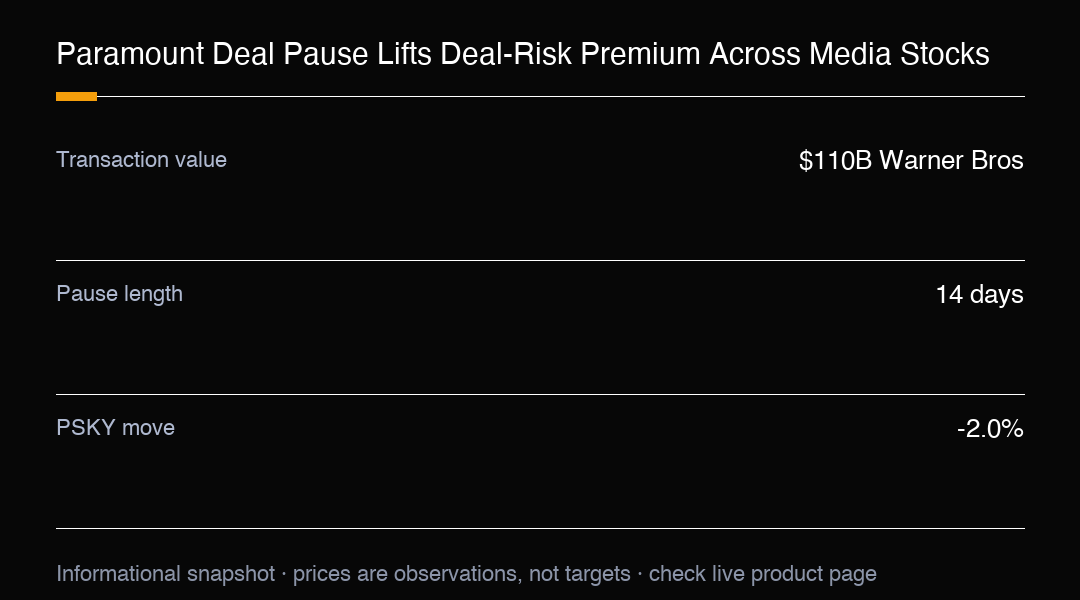
Paramount's planned $110B acquisition of Warner Bros. Discovery hit an unexpected obstacle Monday when a federal judge paused the transaction for at least 14 days. The ruling is not a final rejection, but it is a clear signal that antitrust authorities intend to review whether the combined entity would harm competition across streaming, theatrical release, and content licensing. For traders, the uncertainty alone is enough to move shares.
PSKY fell roughly 2% on the news. That is not a crash, but it is a meaningful move for a large-cap media name on a headline that does not change the company's operating business today. The stock reaction reflects deal-risk premium: investors are repricing the probability that the transaction will close on its original terms, close in a revised form, or be blocked entirely. Each outcome has different implications for Paramount's strategic optionality and balance-sheet math.
The pause also revives attention on the broader media landscape. If regulators are willing to slow a deal of this size, other consolidation plays in entertainment, cable networks, and streaming may face similar scrutiny. Leveraged media names with pending mergers or joint ventures are now in the spotlight. Traders who have been ignoring the regulatory backdrop may need to bring it back into their models.
From a positioning standpoint, the next two weeks matter. The court will examine whether the merger would reduce competition in ways that harm consumers or creators. If the judge signals an intent to block, the stock could drift lower on deal-arbitrage selling. If the pause is procedural and the court ultimately approves, the dip may be viewed as a buying opportunity. Until then, volatility is likely to remain elevated.
For shareholders, the key question is whether the deal adds long-term value or destroys it through integration risk, regulatory overhang, and elevated costs. Paramount has bet its future on streaming profitability, and Warner Bros. Discovery brings its own streaming challenges. Combining two direct-to-consumer services while negotiating carriage fees with cable providers and satellite distributors is a complicated balancing act even without antitrust scrutiny.
Traders watching PSKY should monitor two things in the next two weeks. First, any statement from the Department of Justice or the judge's court indicating a leaning toward approval or blockage. Second, the stock's ability to hold above the pre-deal levels. If PSKY holds firm during the pause, it signals that the market is confident in a positive resolution. If it drifts lower, the deal-risk premium is rising and the stock should be treated as a higher-risk holding until clarity emerges.
The Paramount-Warner Bros. Discovery transaction is not just a media story; it is also a proxy for how antitrust policy is evolving under the current administration. The pause reflects a broader willingness to scrutinize large mergers across sectors, from tech to health care to entertainment. Investors who had grown accustomed to quick approvals for mega deals must now adjust to a longer timeline and greater uncertainty. That adjustment affects not only PSKY, but also any company considering a transformative acquisition.
From a balance-sheet perspective, Paramount has committed significant capital to the deal. If the transaction is blocked or materially restructured, the company will need to redeploy those resources. That could mean accelerating standalone streaming investments, pursuing smaller acquisitions, or returning capital to shareholders through buybacks. Each path has different implications for PSKY's valuation multiple and for the competitive dynamics of the streaming market.
The content industry is in the middle of a structural shift. Traditional cable revenue is declining, streaming profitability remains elusive for many players, and advertising-supported models are gaining ground. A combined Paramount and Warner Bros. Discovery would have scale to compete with Netflix and Disney, but only if regulators allow it. The 14-day pause is the first real test of whether that scale is achievable or whether antitrust concerns will force the companies to stay separate.
Traders should also consider the positioning in PSKY options ahead of the court decision. Implied volatility has risen, which is expected, but the skew suggests that downside protection is in demand. If the judge rules in favor of the deal, the volatility collapse could lead to a sharp rally as hedges are unwound. If the ruling is negative, the opposite is likely. The next two weeks present a high-risk, high-reward setup for traders willing to navigate headline volatility.
The antitrust argument centers on market concentration. Combining Paramount's content library with Warner Bros.' franchises would give the merged company an outsized share of premium content. Regulators worry that this could lead to higher subscription prices, fewer choices for consumers, and tougher terms for competing streaming services. The pause gives opponents of the deal time to make those arguments in court, and it gives Paramount time to prepare its defense.
For traders watching PSKY, the key is to separate the stock reaction from the business reaction. The company's operations are unchanged today, but the stock is moving because the timeline for a transformative deal has become uncertain. In such environments, options strategies such as buying volatility or constructing calendar spreads can be more effective than outright directional bets. The goal is to position for the outcome rather than the underlying business performance, because the headline, not the earnings, will drive the near-term price.
The pause also underscores how legal timing can dominate stock-specific fundamentals. PSKY's business operations are unchanged today, yet the stock moved because the timeline for a transformative deal has become uncertain. In such environments, options strategies such as buying volatility or constructing calendar spreads can be more effective than outright directional bets. The goal is to position for the outcome rather than the underlying business performance, because the headline, not the earnings, will drive the near-term price.
On the regulatory side, the outcome of this case could set a template for how future media mergers are evaluated. If the court ultimately blocks the deal, other large transactions in the sector may be reconsidered or redesigned to avoid similar antitrust concerns. If the deal is approved with conditions, those conditions will become the new negotiating framework. Either way, the pause is an inflection point for media strategy and for how PSKY's management team approaches future growth options.
The media industry's economics have also changed in ways that affect the deal's rationale. Streaming growth is slowing, advertising-supported tiers are rising, and cable-cutting continues to erode traditional distribution margins. A combined Paramount-Warner Bros. entity would need to realize cost synergies quickly to justify the purchase price. If the regulatory delay pushes the closing timeline beyond the current fiscal year, the strategic rationale may weaken if market conditions or consumer preferences shift.
Traders should monitor two specific catalysts in the next two weeks. First, any statement from the Department of Justice or the judge indicating a leaning toward approval or blockage. Second, PSKY's ability to hold above pre-deal levels. If the stock holds firm during the pause, it signals confidence in a positive resolution. If it drifts lower, the deal-risk premium is rising and the stock should be treated as a higher-risk holding until clarity emerges.
Trading Insight
A 14-day judicial pause on a mega media merger raises deal-risk premium and sector uncertainty. PSKY’s move is modest but signals that investors are discounting deal certainty until antitrust clarity arrives.