


Global equities snapped back into risk-on mode this week as a wave of strong technology earnings reignited enthusiasm for the artificial intelligence trade, just days after a sharp selloff had investors questioning whether AI spending could keep justifying its valuations. US stock futures were modestly higher early Friday, with Nasdaq futures up about 1%, Dow futures adding roughly 0.4% and S&P 500 futures gaining around 0.5%, building on a powerful rebound in Thursday's regular session.
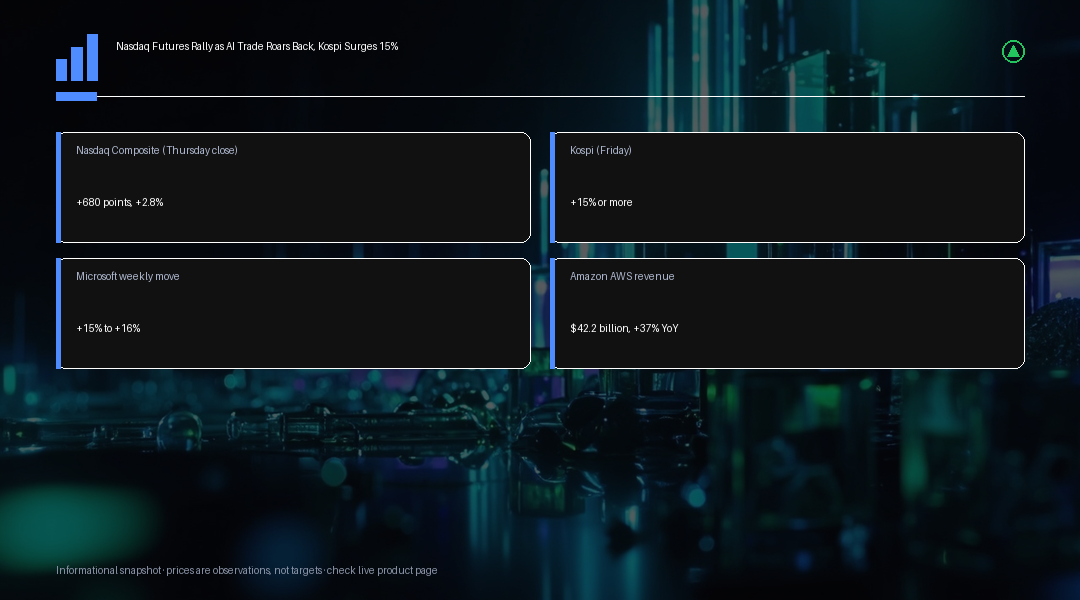
Microsoft did much of the heavy lifting. The stock rocketed roughly 15% to 16% in Thursday trading after stronger-than-expected growth in its Azure cloud division revived confidence that heavy AI infrastructure spending is starting to translate into real revenue rather than just capital expenditure. The result set off a broad rally across chipmakers and infrastructure-adjacent names, turning what had been a punishing stretch for semiconductor stocks into one of the sector's best sessions in months.
Amazon added to the momentum, surging more than 9% after hours on a second-quarter revenue beat powered by its cloud-computing division. The company reported net sales of $200.6 billion for the quarter, with Amazon Web Services revenue reaching $42.2 billion, up 37% year over year. Combined with Microsoft's cloud strength, the results reinforced the market's core bullish thesis for this AI cycle: that the companies spending the most on data centers and specialized chips are also the ones best positioned to monetize that spending through cloud services.
Apple's report landed with a more mixed reception. iPhone revenue climbed roughly 22% and overall fiscal third-quarter revenue beat expectations, but shares gave back ground after hours as investors focused on a more cautious growth outlook tied to currency headwinds and a memory-chip shortage. The contrast between Apple's guidance-driven pullback and the cloud-fueled enthusiasm around Microsoft and Amazon captures the market's current mood well: strong current-quarter execution is being rewarded, but any sign of a cautious forward outlook is being punished just as sharply, regardless of the underlying quality of the results.
The rally in chip and AI-infrastructure adjacent stocks was broad on Thursday, with several memory and infrastructure names posting double-digit percentage gains alongside the sector-wide bounce. Some of the larger individual percentage moves circulating in the market that day have not been independently confirmed and should be treated cautiously by traders rather than taken as confirmed figures, but the direction of the move, a sharp, earnings-driven rebound in AI-adjacent hardware names, is well supported by the broader market reaction.
By Thursday's close, the major US averages had put in one of their strongest sessions of the summer. The Dow Jones Industrial Average rebounded 614 points, or 1.2%. The S&P 500 gained 122 points, or 1.7%. The Nasdaq Composite did the heaviest lifting of all, soaring 680 points, or 2.8%, as AI-linked mega-caps led the charge back from the prior week's selloff.
Asia turned the rebound up another notch entirely. South Korea's Kospi index exploded more than 15% on Friday, one of its largest single-day moves in years, as memory-chip giants Samsung Electronics and SK Hynix surged on the same AI-demand optimism rippling out of the US cloud earnings. Japan's Nikkei 225 also jumped more than 3% in sympathy, underscoring how tightly linked global chip and AI-infrastructure sentiment has become across time zones.
Options markets reflected the shift in mood as well, with implied volatility on several AI-linked mega-caps easing from the elevated levels seen during the prior week's selloff, even as absolute volatility remains well above its long-run average for the group. That combination, falling but still-elevated volatility alongside a sharp price rebound, is typically consistent with a market that is relieved rather than fully convinced, and it argues for traders to size positions with the assumption that swings of this magnitude could resurface quickly if the next round of earnings disappoints.
Separately, market chatter this week pointed to steep losses at a prominent AI-focused hedge fund after a period of aggressive, leveraged bets on AI-adjacent stocks unwound sharply during July's selloff. Reports suggest the fund, associated with AI researcher and investor Leopold Aschenbrenner, was forced into a large liquidation of its public equity holdings after margin calls from lenders. The exact scale of those losses has not been independently confirmed and should be treated as unverified market color rather than settled fact, but the episode is a useful reminder of how much leverage had built up around the AI trade heading into this month's volatility.
For traders, the whiplash between last week's AI selloff and this week's sharp rebound highlights just how sentiment-driven this cycle has become. Fundamentals, real cloud revenue growth at Microsoft and Amazon, are clearly present and provide genuine support for the rally. But the speed and size of the swings, both down during the selloff and up during this rebound, suggest positioning and leverage are amplifying moves well beyond what the underlying earnings alone would justify.
The path forward likely hinges on whether upcoming earnings from other major cloud and chip names can confirm the demand signal Microsoft and Amazon just delivered. A pattern of continued cloud-revenue beats would support the idea that this rebound has real legs, while any disappointment from the next round of AI-linked reports could just as quickly reignite the kind of leverage-driven unwind that hit Aschenbrenner's fund and other highly positioned players this past month.
Trading Insight
This rebound is being led by confirmed cloud-revenue strength at Microsoft and Amazon rather than speculative positioning alone, which gives it more credibility than a purely sentiment-driven bounce. Traders should watch upcoming reports from other major cloud and chip names to see whether the demand signal broadens, since a Nasdaq recovery built on just two or three mega-cap reports remains vulnerable to reversal. The Kospi's 15%-plus surge is a useful real-time gauge of how quickly AI-chip sentiment can swing in either direction, given how sharply the same names sold off just weeks earlier. Given the reported leverage unwind at one prominent AI-focused fund, expect continued outsized volatility around any AI-adjacent earnings surprise, and size positions accordingly rather than assuming this week's rebound removes the risk of another sharp swing.