


Meta Platforms delivered a mixed second-quarter report on Wednesday, July 29, and the market reaction was unambiguous: shares fell sharply in after-hours trading as investors weighed a solid top-line beat against a profit shortfall and yet another increase in the company's already enormous artificial intelligence spending plans. The stock, which had already lagged the broader market this year, extended its slide as traders digested a quarter that underscored just how expensive the AI buildout has become for even the largest technology companies.
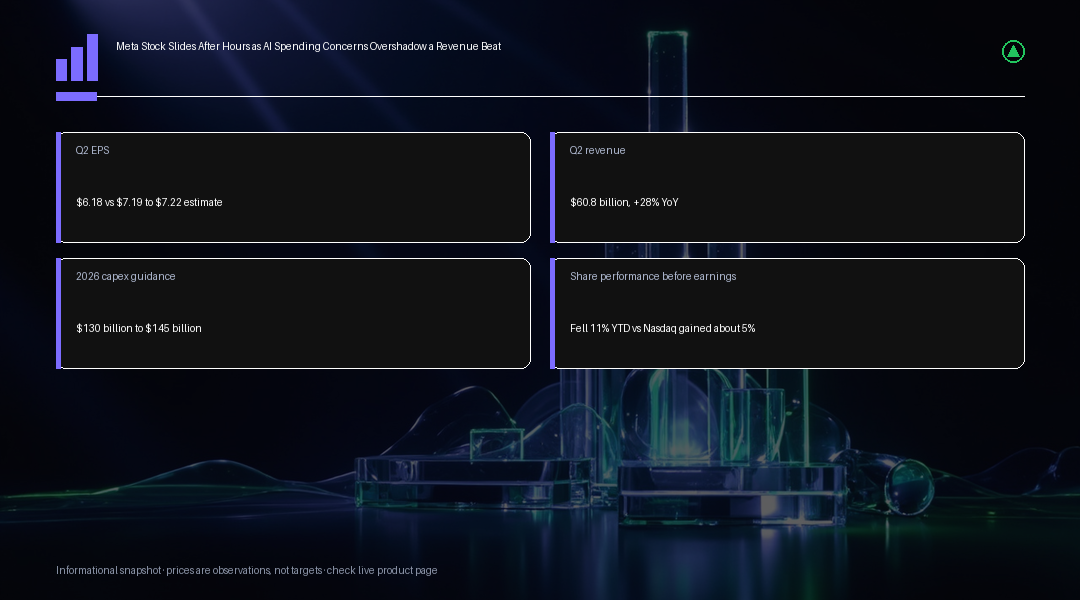
On the surface, the numbers told a story of continued strength in Meta's core advertising business. Revenue climbed 28% year over year to a record $60.8 billion, comfortably ahead of Wall Street's forecast near $60.2 billion, as artificial intelligence tools kept improving ad targeting and engagement across Facebook, Instagram and the company's other properties. Advertising remains Meta's primary cash engine, and that engine kept running well through the second quarter.
The trouble was on the bottom line. Diluted earnings per share came in at $6.18, well short of the roughly $7.19 to $7.22 that analysts had penciled in, and down from $7.14 a year earlier. Net income is estimated to have fallen by a double-digit percentage from the year-ago period to somewhere in the neighborhood of $15.85 billion, as costs climbed faster than revenue. Several one-off items weighed on the result, including a $2.4 billion legal charge and $1.2 billion in severance-related costs, on top of a 67% jump in research and development spending as Meta poured more capital into its AI efforts.
Perhaps more unsettling for investors than the quarter itself was what it implied about the road ahead. Meta raised the low end of its 2026 capital expenditure forecast to a range of $130 billion to $145 billion, up from a prior range of $125 billion to $145 billion. Capital expenditure covers long-term investments such as data centers, servers and networking equipment. Those outlays can support future growth, but they also weigh on profitability and free cash flow in the near term, and investors have grown increasingly impatient for evidence that the spending is translating into durable earnings power rather than just a bigger infrastructure bill.
Chief Executive Mark Zuckerberg used the earnings call to defend the strategy, arguing that personalized AI assistants capable of handling tasks around the clock will become central to Meta's future products and business model. It is a vision Zuckerberg has pushed consistently for several quarters, but Wall Street's patience appears to be thinning. Investors increasingly want to see AI investment convert into higher earnings, not simply larger balance-sheet commitments, and Wednesday's reaction suggests that bar is getting harder to clear.
The share-price reaction also has to be read in the context of Meta's year so far. The stock had already fallen 11% in 2026 heading into the report, even as the Nasdaq Composite gained about 5% over the same stretch, meaning Meta was underperforming the broader market well before this print. That divergence highlights how selective investors have become within the AI trade: strong revenue growth is no longer enough on its own, and companies that raise spending without a clear near-term payoff are being punished more severely than in prior quarters.
The result lands in the middle of a broader test for the AI-linked megacap cohort, with peers reporting in the same window and providing a running scorecard of how markets are rewarding, or punishing, big AI bets. For Meta specifically, the next checkpoints will be whether advertising growth can keep outrunning cost inflation, whether the elevated capex range holds through the rest of the year, and whether management can point to concrete monetization milestones from its AI assistant push rather than just aspirational framing.
The read-through from other megacap results the same week only sharpened the contrast for Meta. Microsoft, which also reported after Wednesday's close, delivered a quarter that investors treated as clear evidence that AI infrastructure spending was starting to convert into cloud revenue growth, sending its shares sharply higher in after-hours trading even as its own capital spending stayed elevated. That divergence, one AI-heavy spender rewarded and another punished in the same session, illustrates how selective the market has become: it is no longer capex itself that decides the stock reaction, but whether that capex is accompanied by visible, monetizable growth in the same reporting period. Meta's advertising beat was not enough to offset the perception that its AI payoff remains further out on the horizon than some of its peers'.
From a risk-management standpoint, the key invalidation point for the bearish post-earnings reaction would be a swift recovery back above the pre-earnings share price, which would suggest the market is willing to look past the near-term profit miss and elevated spending in favor of the underlying advertising strength. Conversely, a failure to reclaim that level within the next few sessions, especially if paired with continued weakness in other AI-heavy names, would reinforce the view that investors are actively repricing the entire capex-heavy corner of the AI trade rather than reacting to Meta in isolation.
Trading Insight
For traders, the setup around Meta has shifted from a straightforward growth story to a spending-discipline story. As long as the market keeps discounting Meta's capex guidance more heavily than its revenue growth, rallies are likely to face selling pressure from investors rotating toward AI names seen as showing clearer near-term monetization. A stabilization in the shares would likely require either a moderation in forward capex commentary or a clearer articulation of how AI assistants and ad-targeting gains will lift margins in coming quarters. Until then, expect elevated volatility around each earnings print and any incremental guidance on 2026 spending plans, with downside risk skewed toward further multiple compression if peers also guide spending higher without matching profit growth. Cross-asset positioning also matters here: with the stock already underperforming the Nasdaq by a wide margin year to date, any relief rally is likely to be met with profit-taking from investors who rotated into Meta as a value-within-AI trade only to be disappointed again.