


Meta shares rose 4% after hours on Wednesday as third-quarter revenue increased 26% to $64.6 billion, beating expectations and offering encouragement that the core business can keep growing rapidly. The results arrived while Mark Zuckerberg pursues a much broader AI strategy, increasingly focused on the Muse personal assistant. The market read the combination of strong advertising growth and a new financing structure as a net positive for the shares, and the post-earnings move suggested investors were willing to look past the cash consumption for now.
Advertising benefited from both more impressions and higher prices. The number of ads delivered increased 10%, while the average price per ad rose 14%, which together drove the revenue beat. The dual improvement is notable because it shows demand is strengthening on both sides of the market, rather than relying on volume growth alone to lift revenue. It also indicates that advertisers continue to see value in the platform's reach, even as they face pressure on their own marketing budgets.
Capital expenditure reached $34.91 billion, pushing free cash flow to negative $2.12 billion. Meta narrowed its annual investment forecast to $135 billion-$145 billion from $130 billion-$145 billion, a change that signals a higher expected floor for spending rather than a reduction in the overall programme. The negative free cash flow is the clearest sign of how much the AI buildout is costing, and it is the number most likely to concern investors focused on capital discipline. The company has not indicated how much of the spending will be directed toward the assistant versus its broader infrastructure programme, leaving the allocation to be clarified in future reports.
Meta plans to establish publicly listed, non-voting Class C shares effective January 19, 2027. Existing investors will receive one Class C share for every Class A or Class B share owned, with distribution dates still to be determined. The structure gives the company a new instrument it can use to raise capital in future without diluting voting control, which matters for a business planning multi-year infrastructure spending. It also creates a currency the company could use for acquisitions or strategic partnerships without issuing voting stock.
The initial share distribution raises no new capital, because existing holders receive the additional stock proportionately. Its strategic value is the ability to use non-voting shares for future fundraising, without reducing Zuckerberg's voting control. That distinction is important, because it separates the mechanics of the distribution from the financial benefit, which will only be realised if and when the company issues new shares. Investors should therefore treat the announcement as an option rather than an immediate source of funding.
The structure also has a personal dimension for the Meta CEO. The arrangement addresses his concerns about a proposed California billionaire tax by allowing some share sales without sacrificing voting power. The report adds a governance angle to a financial decision, and it illustrates how closely the company's capital structure is tied to the preferences of its controlling shareholder. Whether that alignment helps or hinders long-term value creation is a question shareholders will continue to debate.
More than 10 million people in the US and Canada have set up a Muse agent, Zuckerberg said. Shopping and personal productivity are prominent uses, including assistance with calendars and email. The adoption figure gives the market a concrete measure of early traction for the assistant, though it does not yet translate into revenue and the cost of serving those users is likely to weigh on margins in the near term. The key question is whether that engagement can be converted into paying users faster than the service costs to run.
Meta intends to monetize Muse earlier than its traditional social products, reflecting the higher cost of providing the service. Subscriptions and transaction fees offer potential income beyond advertising, while CFO Susan Li expects AI to contribute meaningful revenue in 2027. The shift is significant because it suggests management sees a path to recovering the cost of the AI investment rather than treating it as a permanent drag on profitability. The credibility of that timeline will depend on execution over the next several quarters.
The immediate outlook remains upheld by advertising. Meta forecasts fourth-quarter revenue of $73 billion to $76 billion, with the $74.5 billion midpoint above the $73.8 billion analyst estimate. The guidance suggests the core business continues to accelerate, which gives the company room to keep spending on AI while still delivering growth that supports the current valuation. It also means that a slowdown in advertising would leave the company with fewer resources to fund its infrastructure ambitions.
The combination of a revenue beat, a new share class and a higher spending floor leaves investors balancing two competing narratives. One is a company whose advertising engine is strengthening and whose new products are gaining users quickly. The other is a business consuming cash at an accelerating rate to fund infrastructure whose returns remain uncertain. The shares will likely stay sensitive to any update on either side of that balance, and the market's initial positive reaction may not survive a period of weaker advertising data.
From a technical perspective, Meta is holding above its recent range after the post-earnings gain, though the move has yet to confirm a breakout. A decisive close above $760 could attract further buying, while a break below $720 might signal that the market is refocusing on the negative free cash flow. The options market is likely to price elevated volatility around the next update on AI monetization, which could create sharp moves in either direction depending on what management reveals. Investors will also be watching whether the new share class attracts institutional interest once it begins trading.
Overall, Meta delivered a strong revenue beat and a credible plan to fund its AI ambitions, but free cash flow turned negative and the spending floor moved higher. The new share class gives management flexibility without giving up control, while early Muse adoption and advertising strength support the growth story. The coming quarters will determine whether the AI investment begins to generate revenue quickly enough to justify the cash it is consuming, and that judgement will likely define the shares for the rest of the year. The balance between growth and cash consumption is therefore likely to remain the dominant theme for the shares.
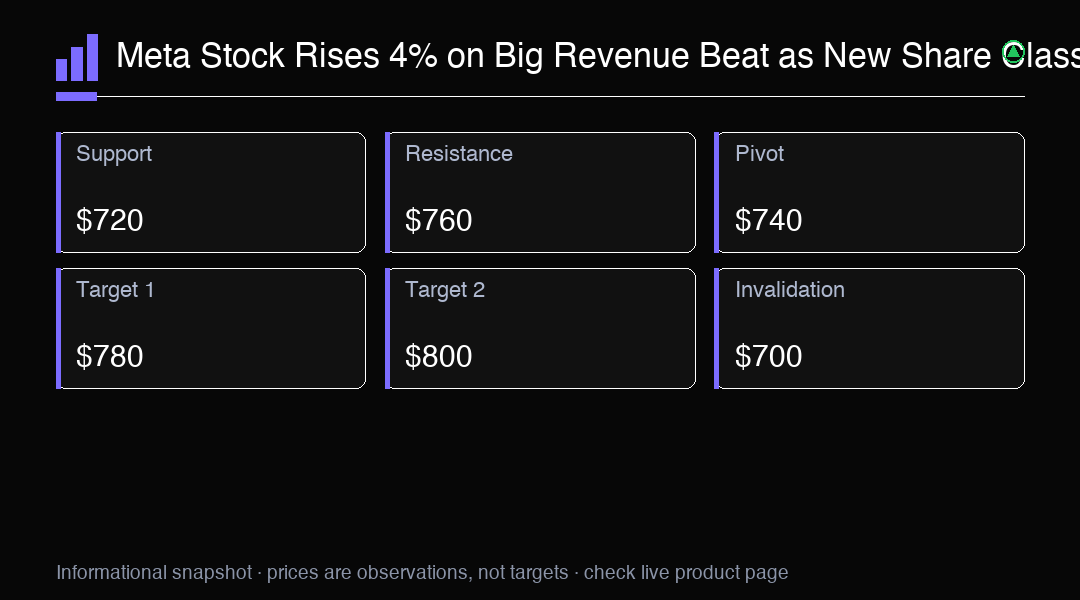
Trading Insight
Meta rose 4% after a 26% revenue jump to $64.6 billion and the creation of non-voting Class C shares to fund AI. Key resistance at $760. Watch AI monetization and free cash flow.