


Netflix shares fell nearly 6% to $64.60 after hours on Tuesday, extending a difficult year for the stock and leaving investors to weigh a profitable business against a slowing growth trajectory. Shares had already lost around 27% this year before the announcement, and the results confirmed a highly cash generative company that still offers little reassurance its growth problems are easing. The reaction reflected disappointment rather than alarm about the company's financial health.
Third-quarter revenue increased 11.8% to $12.87 billion, while net income rose 44% to $3.66 billion, both figures pointing to a business that is still compounding even as its rate of expansion moderates. Earnings of 87 cents per share exceeded expectations of 82 cents, and revenue broadly matched forecasts, so the quarter was a clear operational beat. The catch is that growth was the slowest in nearly three years, which kept the focus on momentum rather than profitability, because a company valued on its future expansion cannot afford to see that expansion decelerate without a clear explanation for how it will resume.
The fourth-quarter forecast disappointed on both sales and earnings, the detail that ultimately moved the shares. Netflix expects revenue of $13.44 billion against Wall Street estimates of $13.51 billion, with earnings of 67 cents per share versus 73 cents expected, a shortfall on the bottom line that is considerably larger in percentage terms than the revenue miss. That combination outweighed the quarterly beat almost entirely, as investors looked for evidence that the business could accelerate heading into next year rather than continue to decelerate.
Netflix cut its advertising revenue forecast to $2.7 billion from $3 billion, a 10% reduction that lands directly on the part of the story investors had been counting on for future growth. Management blamed a slower-than-expected rollout of some advertising capabilities, which suggests the problem is execution rather than demand, since the audience and the pricing environment have not deteriorated in any obvious way. The cut matters because advertising was supposed to become a second growth engine that could eventually reduce the company's dependence on subscription income, and its underperformance leaves the subscription business carrying the load on its own. Investors will watch closely for signs the shortfall proves temporary.
The earnings beat also benefited from expense timing, a detail that often gets lost in the headline reaction but deserves scrutiny. Operating profitability reached 34.6%, up from 28.2% a year earlier, partly because costs arrived later than expected rather than because the underlying cost base shrank in any meaningful way. Guidance for the final quarter points to 26%, including a 1.2-percentage-point hit from workforce reductions, which indicates that some expenses deferred out of the third quarter will land with full force later. Some of the quarterly strength therefore reflects when expenses are recognized rather than a permanent improvement in profitability.
The broader annual outlook remains comparatively steady, and that stability is the main reason the shares fell rather than collapsed. Netflix expects $51.1 billion in revenue, representing 13% growth, and an operating profitability rate of 31.5%, both of which describe a large and well-managed business rather than one in difficulty. Subscription revenue has exceeded its expectations, cushioning the advertising shortfall and showing that the core product continues to attract and retain paying members. The market's concern is whether those solid annual figures provide a foundation for faster growth or simply confirm a business that has settled into a slower trajectory.
Cash generation remains substantial, although its forecast edged lower, and the reduction is modest enough that it should not on its own justify the size of the share price move. Quarterly free cash flow reached approximately $2.9 billion, and Netflix reduced its annual projection to $12 billion from $12.5 billion, primarily because of an expected fourth-quarter property transaction that pulls spending forward rather than signalling any deterioration in the underlying business. The reduction is small relative to the company's overall cash generation, but it removes one source of support at exactly the moment when the growth story needs help.
The report follows around 1,000 job cuts, equivalent to 6% of the workforce, and changes at the top of the programming business that suggest management is pressing for a different approach to content. Former Disney and Fox executive Peter Rice is replacing Bela Bajaria, while film chief Dan Lin is departing, and the reshuffle raises expectations for a more effective content strategy after several high-profile releases failed to generate the viewing their budgets implied. Leadership changes of this scale typically take several quarters to show results, because the slate already in production reflects decisions made long before the new team arrived.
Engagement remains an important pressure point, and it is arguably the most significant number in the entire report because it sits upstream of every part of the model. Netflix recorded 97 billion viewing hours in the first half, up just 2% from a year earlier, which means the audience is barely growing even as the subscriber base expands. Viewing growth is key for subscriber retention and the advertising opportunity: attracting paying members is valuable, but advertisers also need those members to spend time watching for the ad business to reach its potential, and flat viewing limits the pricing power that advertising can eventually command. The company has argued that engagement per member is healthy, yet the aggregate figure is the one advertisers measure, and a single-digit increase leaves little room to build the ad revenue the company had projected.
Management is putting renewed emphasis on compelling television and films, alongside more licensed programming, the most direct response available to a company whose growth has slowed because its content is not being watched as widely as its audience numbers suggest it should be. The next evidence to watch is stronger viewing, improved advertising execution and whether the fourth quarter delivers against the revised outlook, because those are the variables that will determine whether the shares can stabilise. Investors will want to see the advertising business stabilise before re-rating the stock on its long-term potential, and until it does, the burden of proof sits with management.
From a technical perspective, Netflix is holding above its recent lows but remains in a clear downtrend after the decline recorded this year, which is the context in which every future release will be judged. A decisive break above the area near seventy dollars could signal that the selling pressure is exhausted, while a break below the low sixties might open the door to a retest of the year's lows. The options market is likely to price elevated volatility around the next earnings event, which means the shares could move sharply in either direction depending on whether guidance is upgraded or trimmed again.
Overall, Netflix delivered a profit beat but a guidance miss, and the market chose to focus on the outlook rather than the quarter that had just been reported. The company remains highly cash generative with a strong subscription base and an audience that few rivals can match, but slower growth, a weaker advertising forecast and a content leadership reset leave the shares without a clear near-term catalyst. The next quarter will be a key test of whether the advertising business can recover and whether viewing growth can reaccelerate, and until one of those two things happens the burden of proof remains on management. For now, the results point to a business that is stable and profitable rather than one that is broken.
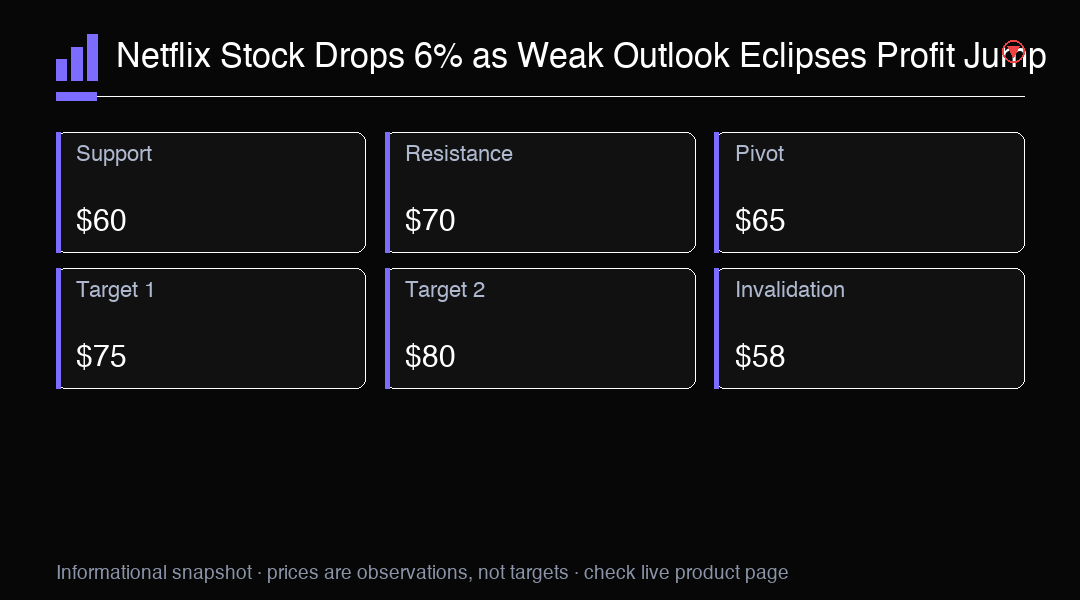
Trading Insight
Netflix fell nearly 6% to $64.60 after a Q4 outlook miss and a cut to its 2026 advertising forecast. Key support at $60. Watch viewing growth and ad execution.