


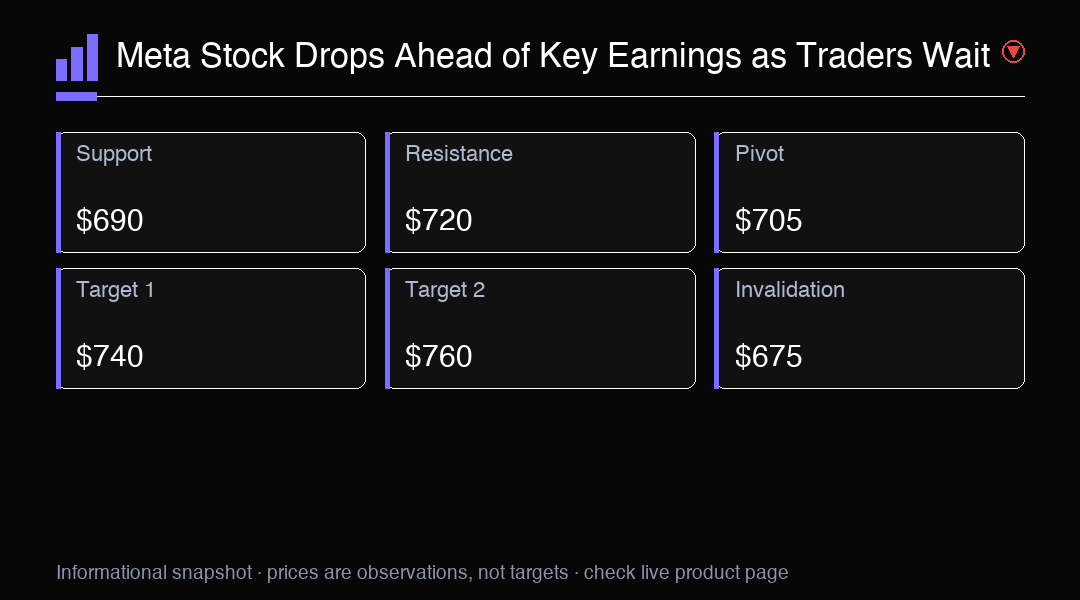
Meta shares fell 0.6% to $705.44 on Monday, extending their decline to four consecutive sessions even as the Nasdaq Composite gained 1.1% on the same day. The divergence between the single stock and the broader technology benchmark is the story heading into Wednesday's report: investors are prepared to reward the index for growth, but they are not yet prepared to extend that benefit to a company carrying a heavy investment programme. The market wants evidence that the spending converts into revenue and cash flow, and the next catalyst arrives after the close on Wednesday.
Third-quarter results arrive Wednesday after the close, with management's call scheduled for 4:30 p.m. ET and a webcast open to analysts and investors. Consensus points to revenue of $63.3 billion, representing growth of around 24% on a year-over-year basis, a pace that would confirm Meta as one of the fastest-growing large technology companies. The more important follow-through is how much of that growth reaches operating profit and free cash flow, because revenue alone will not settle the valuation debate that has been running since the investment plans were first laid out.
Morgan Stanley offered a more optimistic assessment, raising its price target to $820 from $775 while maintaining an Overweight rating on the shares. The bank's thesis combines improving advertising returns with the potential revenue from Muse and business AI subscriptions, which it sees as a meaningful long-term opportunity rather than a short-term driver. The upgrade matters because it shows that at least part of the sell-side still believes the spending can be absorbed by growth, a view that Wednesday's numbers will either reinforce or challenge.
Meta introduced Muse Wonder and Muse Wonder Full on October 12, describing them as its most capable models for personal and professional tasks. The timing of the launch is the critical detail: Wonder arrived after the third quarter closed, so Wednesday's reported revenue cannot capture its commercial performance, and the first read on adoption will have to come from management's commentary. That makes the call itself as important as the numbers, particularly for investors trying to gauge whether the new models can move from product announcements into recurring subscription revenue.
Management's commentary on adoption, subscriptions and the fourth-quarter outlook will be especially useful for investors trying to gauge whether the AI push can translate into durable revenue growth. The company has invested heavily in the platform, and traders want to see evidence that the spending is producing returns rather than simply lifting costs. Watch for any colour on pricing, enterprise uptake and the pace at which business customers are converting from trials into paid plans, because those details matter more to the narrative than another headline revenue beat.
The wider strategy includes Muse Charm, a pocket-sized voice device, and integration with AI glasses, both of which extend Meta's reach beyond the core advertising business. These initiatives expand the company's presence into new hardware and subscription categories that could diversify revenue over time, reducing the dependence on a single income stream. Whether they become meaningful contributors is a question for 2027 and beyond, but they are already part of the story investors are paying for when they value the company today.
Meta's existing 2026 capital-spending guidance is $130 billion to $145 billion, including finance-lease principal payments, a range that frames the scale of the commitment. Watch whether that range holds on Wednesday and what management signals for 2027, because the trajectory of spending will shape the investment narrative for months rather than days. A confirmation would suggest discipline, while any drift higher would raise fresh questions about how long the buildout can run before returns have to show up in the reported numbers.
Spending on servers and data centers builds capacity, while depreciation and operating expenses continue affecting earnings long after the initial purchases are made. That lag is the mechanical reason the earnings impact of the buildout keeps building even as the balance sheet absorbs the upfront cost. Investors are focused on whether the buildout is generating returns or simply weighing on the bottom line, and Wednesday's call should provide some clarity on the timeline management expects before the two move back into balance.
Last quarter's advertising generated $59.4 billion of Meta's $60.8 billion in quarterly revenue, making it the business that currently finances the entire expansion. That concentration is the central structural risk in the story: the company is asking investors to fund a multi-year infrastructure programme out of an advertising base that is exposed to the economic cycle. Any slowdown in ad spending would limit the company's ability to fund its AI ambitions without turning to external financing, which is why the health of the core business matters as much as the new product launches.
Perhaps the most useful combination would be resilient advertising, clearer Muse monetization and spending supported by improving cash flow, delivered together rather than in pieces. That mix would reassure investors that Meta can grow without sacrificing profitability, which is the central question heading into the report and the one that has kept the shares on the back foot relative to the wider technology rebound. Investors do not need perfection; they need a credible path, and the evidence for it is scattered across the income statement, the cash-flow statement and the call.
The options market is pricing a notable move around the earnings event, reflecting uncertainty about how the market will react to the results. Traders are positioning for a potentially sharp move in either direction, depending on whether the numbers and the guidance meet expectations. That implied move is best read as a measure of volatility rather than a prediction of direction, and it suggests the report could be a catalyst for a sustained trend in the weeks that follow rather than a one-day reaction.
Overall, Meta enters Wednesday's report at a crossroads. The stock has lagged the broader technology rebound, and investors are looking for evidence that the AI investment cycle can deliver returns rather than simply consume capital. The company's ability to demonstrate progress on monetization and cash flow will likely determine the stock's direction in the weeks ahead, and the price action immediately after the report should be treated as the market's verdict on whether management has made that case convincingly. The report itself is unlikely to settle the debate in full, but it will set the tone.
Trading Insight
Meta stock fell 0.6% to $705.44 ahead of Wednesday's Q3 earnings, lagging the Nasdaq rebound. Key resistance at $720. Watch earnings and guidance for direction.