


Hyperscale Data is putting its Bitcoin treasury to work. The company, which trades on the NYSE American under the ticker GPUS, said in a press release that it is redirecting a portion of its Bitcoin holdings to help fund construction of its Michigan artificial intelligence data center campus, marking one of the clearer examples yet of a company treating its crypto balance sheet as an active financing tool rather than a passive store of value.
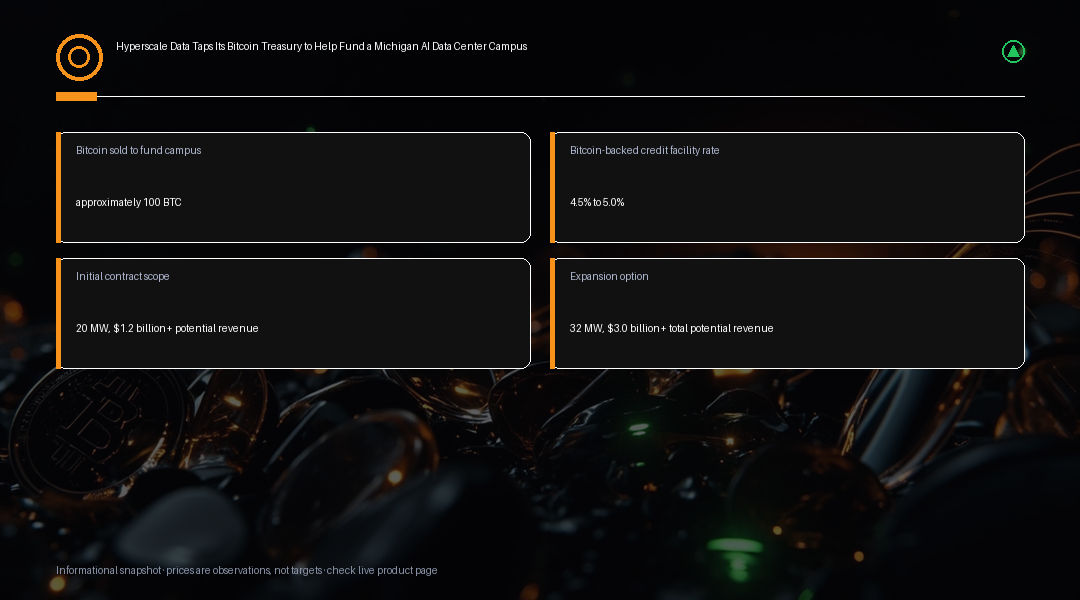
According to the release, Hyperscale Data has sold approximately 100 Bitcoin, with the proceeds going directly toward the Michigan campus buildout. The company has also established a new Bitcoin-backed credit facility, with variable interest rates expected to range from roughly 4.5% to 5.0%, using its remaining Bitcoin holdings as collateral. That structure allows Hyperscale to access financing without selling down its entire crypto position, preserving upside exposure to Bitcoin while still generating cash for near-term capital needs.
The Michigan campus itself is tied to a previously announced master services agreement with a neo-cloud AI infrastructure provider. That agreement runs for an initial 10-year term, with two additional five-year extension options that the customer can exercise. The initial scope covers approximately 20 megawatts of AI compute capacity and is expected to generate more than $1.2 billion in revenue if the full term is exercised. The customer also holds an option for an additional 32 megawatts of capacity; if that option is exercised within the first two years and extended through both five-year renewal periods, total expected contract revenue from the relationship could climb above $3.0 billion.
Executive Chairman Milton "Todd" Ault III framed the company's Bitcoin position as a strategic asset rather than a speculative side bet, saying Hyperscale had accumulated roughly $71 million worth of Bitcoin through a combination of mining operations and treasury management, and describing the holding as "a significant source of financial flexibility." That framing lines up with separate disclosures indicating the company's Bitcoin treasury has grown to roughly 1,087.4527 BTC, with a recent addition of roughly 51.5 Bitcoin purchased on the open market by a wholly owned subsidiary, Ault Capital Group, as the treasury built toward a value near $70.3 million based on recent Bitcoin pricing.
Chief Executive William Horne said the strategy behind selling and financing against part of the Bitcoin treasury is to reduce reliance on equity financing, which would otherwise dilute existing shareholders. "By selectively monetizing and financing against a portion of our Bitcoin holdings, we are shifting one balance sheet asset for another," Horne said, framing the move as a swap between crypto exposure and near-term liquidity rather than a retreat from Bitcoin as a long-term holding. The company has separately referenced a Michigan AI development reserve account intended to help fund infrastructure improvements such as cooling and networking equipment for the campus, suggesting Bitcoin sales are one of several funding channels being layered together rather than the sole capital contribution.
The move places Hyperscale Data alongside a small but growing group of public companies experimenting with using Bitcoin treasuries as an active financing lever for capital-intensive AI infrastructure projects, rather than simply holding the asset on the balance sheet. For a company positioning itself at the intersection of Bitcoin mining, AI compute and data-center hosting, the ability to monetize crypto holdings without a full liquidation event could prove to be an important flexibility tool as AI infrastructure buildouts continue to require large, front-loaded capital commitments well ahead of the multi-year revenue those contracts are designed to generate.
The structure also carries risks that traders should weigh alongside the growth narrative. A Bitcoin-backed credit facility ties the company's borrowing capacity directly to a volatile underlying asset: a sharp drawdown in Bitcoin's price could reduce the value of the collateral securing the facility, potentially triggering margin-style pressure or forcing the company to post additional collateral at an inconvenient time. On the other side of the ledger, execution risk sits with the Michigan campus itself. The higher end of the contract value, above $3.0 billion, depends on the customer exercising its expansion option within the first two years and then renewing through both five-year extension periods, a multi-year chain of decisions that is far from guaranteed even if the initial 20-megawatt phase proceeds on schedule.
For a company still relatively early in scaling its AI hosting business, the Michigan announcement functions as much as a signal to the market as a financing mechanic. It tells investors that management is willing to actively trade Bitcoin upside for construction certainty now, betting that the AI compute demand backing the master services agreement will be durable enough to justify giving up some crypto exposure today in exchange for a funded, on-schedule buildout. For traders, that willingness to swap part of an appreciating digital asset for a fixed-cost, contracted buildout says something about how confident management is in the demand backing the deal, and it sets a template other small-cap crypto-adjacent infrastructure names may look to follow if financing conditions stay tight.
Trading Insight
For traders watching GPUS and the broader intersection of Bitcoin treasuries and AI infrastructure spending, the key signal here is optionality rather than distress. A company selling a relatively small slice of its Bitcoin holdings, while simultaneously opening a Bitcoin-backed credit line against the remainder, points to a treasury being actively managed for funding flexibility rather than liquidated under pressure. The bigger swing factor for the stock over time will be execution on the Michigan campus and whether the customer exercises its expansion option toward the higher end of the $3.0 billion contract value, since that would materially change the company's revenue trajectory. Bitcoin's own price path also matters here: further weakness in BTC could pressure the value of the remaining collateral backing the credit facility, while a sustained rally would strengthen Hyperscale's balance sheet and could reduce the need for additional dilutive financing down the road. A reasonable invalidation point for the bullish read on this story would be any sign that the Michigan buildout timeline is slipping, since that would undercut the entire rationale for trading crypto upside for construction funding today.