


Dow futures dipped 0.02% in early Asia-Pacific trading on Monday, but the number was too small and too early to carry a directional conclusion by itself. The useful signal was the speed of the change: five minutes earlier, another timestamped update had Dow futures up 0.03%, so the market crossed from green to red inside a 0.05-percentage-point range.
That is normal price discovery near a weekly open, not evidence that the next Wall Street session has already been decided. CME Group says Dow-linked futures trade nearly 24 hours a day, allowing global events to reach the benchmark while the US cash market is closed. The practical task is to see whether the first print survives the Asia, Europe and New York handoffs.
Key takeaways
- Dow futures moved from +0.03% at 06:27 to −0.02% at 06:32 UTC+8.
- Nasdaq-100 futures held +0.10%, so the tiny Dow dip was not a broad risk-off signal.
- Confirmation comes from later session handoffs, index breadth and macro markets—not the opening headline alone.
What happened at the early Asia-Pacific open?
The opening tape was nearly flat and changed sign within minutes. At 06:32 UTC+8 on Aug. 17, Alpha Wire reported Dow Jones Industrial Average futures down 0.02%, S&P 500 futures flat and Nasdaq-100 futures up 0.10%. A separate 10XINVESTOR update timestamped 06:27 had shown Dow futures up 0.03%, S&P 500 futures up 0.07% and Nasdaq futures up 0.10%.
Both updates describe the same early weekly-open window, yet the Dow changed sign over five minutes while the Nasdaq reading did not. That makes the difference between a print and a signal visible. A print records where the market traded at one moment. A signal requires persistence, participation and a plausible driver.
| Snapshot | Dow futures | S&P 500 futures | Nasdaq futures | Best read |
|---|---|---|---|---|
| 06:27 UTC+8 | +0.03% | +0.07% | +0.10% | Small positive weekly open |
| 06:32 UTC+8 | −0.02% | Flat | +0.10% | Dow-specific softness inside a mixed, near-flat tape |
| Five-minute change | −0.05 percentage point | −0.07 percentage point | Unchanged | No broad confirmation yet |
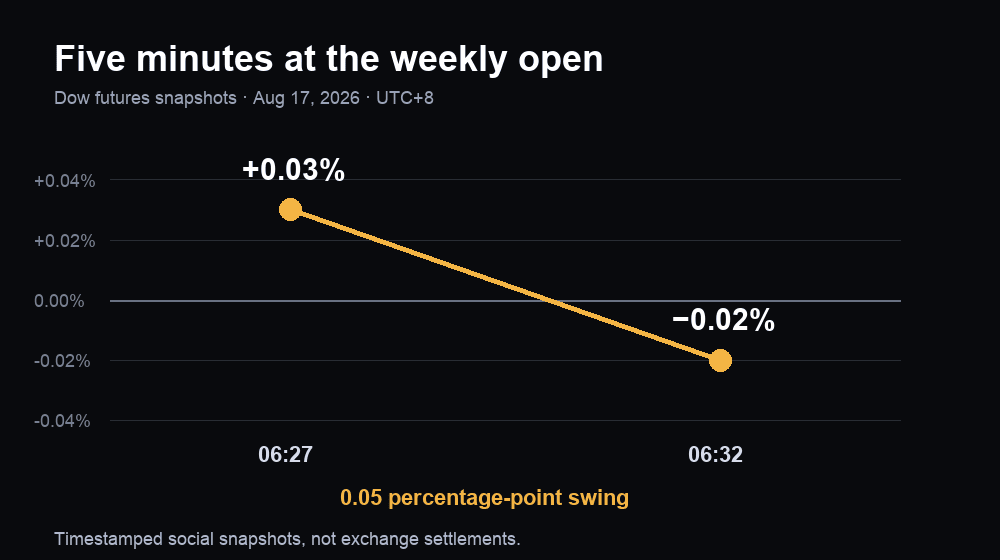
The chart compares two timestamped social updates. The figures are observations, not exchange settlements or live quotes.
Why can a 0.02% move change sign so quickly?
Because the first part of the weekly session is a handoff into continuous trading, and small orders or changing quotes can move a market that has not yet built broad participation. The move does not need a major news catalyst. It can reflect the reopening of positions, adjustments to Friday’s close, currency moves or the first response to weekend information.
Fidelity’s global-session framework divides the futures day into Asia, Europe and the US. That sequence matters more than the label “down” attached to one early print. A move that persists as regional cash markets open, deepens when Europe arrives and then earns confirmation at the US cash open is carrying more information than a sign flip in the first half-hour.
The size provides its own warning. A 0.02% change is 2 basis points. It is much smaller than the hard non-US trading limits CME applies to US equity-index futures, and it sits inside the five-minute range observed here. The comparison does not make the move irrelevant; it keeps the scale honest.
What does Dow structure add to the read?
The Dow is a narrow, price-weighted basket, so it can diverge from the S&P 500 and Nasdaq-100 without signalling a market-wide turn. S&P Dow Jones Indices defines the Dow as a price-weighted measure of 30 US blue-chip companies. Higher-priced components exert more influence than lower-priced components, regardless of market capitalisation.
That structure helps explain why traders should compare the three major futures benchmarks. In the 06:32 snapshot, Nasdaq-100 futures remained up 0.10% while Dow futures slipped 0.02%. The gap suggests relative index positioning, not synchronized risk reduction. A broad risk-off interpretation would become stronger only if the S&P and Nasdaq complexes weakened as well, ideally alongside corroborating moves in yields, the dollar or volatility.
For the Dow-linked market on MC Markets, see the US30 product page. The platform page was checked before publication and rendered the symbol US30. The growth-heavy comparison is available on the NAS100 product page.
Which session handoffs can confirm the move?
Use three handoffs: Asia cash markets, Europe, then New York. Each adds participants, local information and a different set of cross-asset inputs.
| Handoff | What strengthens the Dow signal | What weakens it |
|---|---|---|
| Asia cash open | Regional equities soften and S&P/Nasdaq futures turn lower | Asian breadth firms while Dow futures reclaim flat |
| Europe open | The decline persists as liquidity and macro inputs broaden | European buyers absorb the move and cross-index breadth improves |
| New York cash open | Dow components and broad sectors confirm futures weakness | The cash market fades the overnight move |
S&P Dow Jones Indices defines Asian trading hours in its regional futures research as 08:00–17:00 Singapore/Hong Kong time. The two radar posts arrived before that research window began. That timing reinforces the core distinction: the headline captured the weekly futures reopen, not a completed Asia session.
How should crypto and global traders use this signal?
Use it as a cross-asset alert, not a direct Bitcoin or global-equity forecast. A tiny Dow move becomes more useful when several markets agree on the reason. Rising Treasury yields and a stronger dollar can point to tighter financial conditions; falling yields and a softer dollar can signal relief. Oil can matter when inflation or geopolitical risk is the driver. Crypto adds a continuously traded risk-appetite check, but it can also move on asset-specific flows.
The cleanest sequence is driver, breadth, persistence. First identify what changed. Then ask whether the S&P 500, Nasdaq-100 and regional cash markets agree. Finally, wait to see whether the move survives the next liquidity handoff. This is the same breadth discipline used in the related US30 breadth test, applied here to a much smaller opening move.
Final thoughts
The 0.02% Dow futures dip was real at 06:32 UTC+8, but its meaning was limited by scale and timing. Five minutes of data had already moved the Dow from a slight gain to a slight loss while Nasdaq futures held positive. That is a useful reminder that overnight futures are valuable precisely because they update continuously—and that the first update is rarely the last word. Let Asia, Europe and New York decide whether the opening print becomes a market signal.