


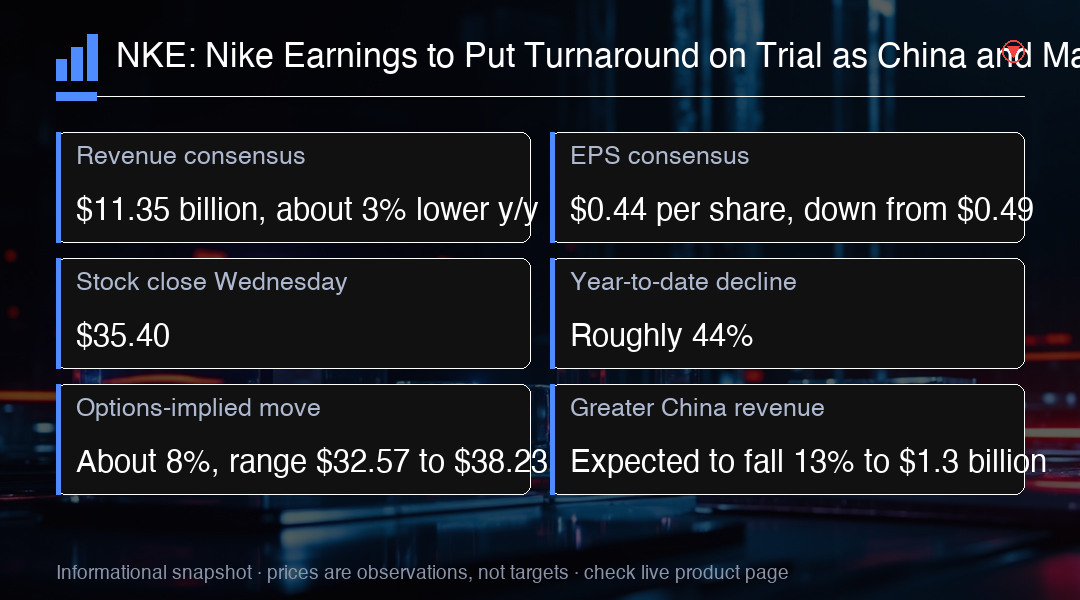
Nike NKE reports fiscal first-quarter results after Thursday's closing bell, with Wall Street expecting revenue of $11.35 billion, about 3% lower year over year, and earnings of $0.44 per share, down from $0.49. For a brand of this scale, a 3% revenue decline is a meaningful amount of absolute sales rather than a rounding error, and the lower earnings figure shows the pressure is expected to reach the bottom line as well as the top one. Consensus therefore frames the print as a stabilization test rather than a growth event.
The stock closed Wednesday at $35.40 and has lost roughly 44% this year, leaving it near levels last seen around a decade ago. Options imply an earnings-day move of around 8%, placing the immediate post-report range near $32.57 to $38.23. That implied band is the market's own estimate of how far the shares are expected to travel on the announcement, and it frames the debate before the numbers are parsed: a move inside the band reads as noise, while a move beyond it indicates the market view has genuinely changed.
A modest headline beat may therefore be insufficient. Investors want evidence that CEO Elliott Hill's Win Now turnaround is stabilizing demand, clearing excess inventory and rebuilding Nike's product pipeline after nearly two years of uneven progress. The strategy has to prove itself on execution rather than intent, which means product arriving on schedule, promotions that support price rather than erode it, and inventory that clears without deeper markdowns than the prior period. The gap between a beat and a turnaround matters here: a consensus beat only says the quarter matched a lowered bar.
Greater China revenue is expected to fall 13% to $1.3 billion, following another double-digit decline last quarter. Nike has struggled with heavy discounting, aging product assortments and stronger domestic competitors such as Anta and Li Ning. A second consecutive steep decline matters because it removes one of the few engines large enough to offset weakness elsewhere, and it suggests the regional reset is running on a longer clock than the rest of the turnaround. Investors have repeatedly treated the China decline as structural rather than cyclical.
North America and wholesale offer a more encouraging comparison. North American revenue rose 3% last quarter, while wholesale sales increased as Nike repaired relationships with retailers that were previously deprioritized during its direct-to-consumer push. Wholesale matters here precisely because the owned channels are shrinking: putting product back into partner doors restores reach without Nike carrying the full inventory and markdown risk itself, and healthier shelf space elsewhere can offset a weaker owned-channel result. Wholesale shipments also carry a different margin profile from Nike's own channels.
Nike Direct remains the awkward side of the strategy. Direct revenue fell 7% in the previous quarter and digital sales declined 12%, showing that selling more merchandise through Nike's own channels has not automatically created stronger consumer demand. The digital figure is the sharper signal of the two, since online was expected to be the channel that scaled most easily. It also narrows the logic of the pivot, because a weaker direct relationship removes the pricing and customer data advantages that justified the shift. That tension is why the Direct figures matter more this quarter than headline revenue does.
Nike previously guided for first-quarter gross margin to improve slightly after seven consecutive quarters of year-over-year pressure on an underlying basis. That makes margin performance the cleanest test of whether reduced discounting, inventory discipline and cost control are beginning to work. Seven quarters is long enough to establish a trend rather than a single soft period, and a guide to slight improvement sets a low bar, so the underlying direction of the line carries more information than a beat or miss on the revenue headline. Inventory discipline is the slowest of the three to appear in a print, because clearance delays the revenue that would replace it.
Comparisons require some care. Last quarter's reported gross margin jumped to 49.2%, up 890 basis points year over year, but nearly all of that improvement came from a roughly $986 million tariff refund. Excluding that one-off benefit, margin was 40.2%, down about 10 basis points year over year. A refund returns money already paid rather than money earned on product sold, so it lifts the reported figure without describing the economics of the quarter. Removing it shows an underlying line close to flat, which is a different story from the headline suggests.
The next big catalyst may be Nike's investor day in mid-November, when new CFO Dave Denton and the wider management team are expected to provide a clearer recovery timetable. The exact dates have not yet been confirmed by Nike's investor-relations calendar. That event matters because it forces specificity: a turnaround presented as a sequence of priorities is more persuasive when paired with the order in which those priorities are expected to appear in the numbers. It is also the first occasion on which the recovery timetable is set in front of investors rather than described in general terms.
Expectations are already low after a 44% share-price slump. Thursday's report must show that Nike's recovery is becoming measurable. China remains the most difficult part of the race. A depressed starting price changes how the print is received, since it narrows the amount of good news required to move the shares, but it also leaves the burden of evidence on the company rather than on expectations. Nothing in the current setup removes the requirement that the underlying figures improve. The evidence investors want is operational rather than financial: full-price sell-through and channel inventory speak earlier than reported margin.
The earnings consensus, China revenue, stock-price decline and tariff-refund figures are supportable. The key fix is the implied-move arithmetic: an 8% move from $35.40 is about $32.57 to $38.23, not the wider $33 to $39 range that was initially quoted. The distinction is not cosmetic, because the band serves as the reference for judging whether the reaction was contained or outsized, and a band built on rounded figures makes that comparison harder to defend afterwards. Getting the arithmetic right matters because the range is often quoted as if it were a forecast rather than a derivation.
For traders, the setup is a low-expectations event with a binary outcome. A margin beat ex-tariff and a stabilizing China trend could drive a sharp relief rally, while another quarter of underlying margin pressure would likely extend the decline and put the broken $32.57 floor back in play. Positioning into a print like this tends to lean on the easier narrative, and the risk sits in the gap: a market priced for contained movement can still open beyond the implied band, which is why the underlying margin line deserves more attention than the headline beat.
Trading Insight
Watch the gross margin ex-tariff rather than the headline number. The $986 million refund distorts the comparison, so the underlying margin trend is the real signal. A close back above $38.23 would confirm the turnaround thesis, while a break below $32.57 would extend the decline. Size for gap risk around the print.