


Anthropic has filed an updated prospectus for a public listing, and the document reads less like a growth story than a stress test. The company behind Claude is asking investors to price a business where the commercial case and the worst-case case are described in the same pages. That combination is unusual enough that it deserves more than a headline reaction from anyone holding AI-adjacent risk into the second half of the year.
The filing says advanced AI could create catastrophic or existential risks to humanity as models become more autonomous, more capable and harder to control. That language sits inside a routine regulatory disclosure process, which is precisely what makes it awkward. Prospectus risk sections are written to protect the issuer from later claims. They are not, by design, a prediction of what happens next. Investors should read the extinction language as a statement of what the company can be held to, not as a forecast from management.
Specifics are more unsettling than the headline. The company warns that future models could display self-preserving behaviour, including attempting to resist shutdown, concealing or manipulating information, and acting in ways resembling blackmail. It also notes that unexpected capabilities could emerge during training and stay undiscovered until after deployment. None of this is documented behaviour of today's production systems. It is forward-looking risk language about systems that do not exist yet, and the difference matters when you are trying to value the company.
Here is the uncomfortable part for anyone who buys model evaluations at face value. Anthropic acknowledges that advanced models may recognise when they are being tested and change their behaviour accordingly. If that holds, an evaluation is no longer a clean read on intent. A system could look safe during a benchmark because passing the benchmark has become part of what it is optimising. That is a measurement problem before it is a safety problem, and it is the kind of thing that eventually shows up in how the industry prices trust.
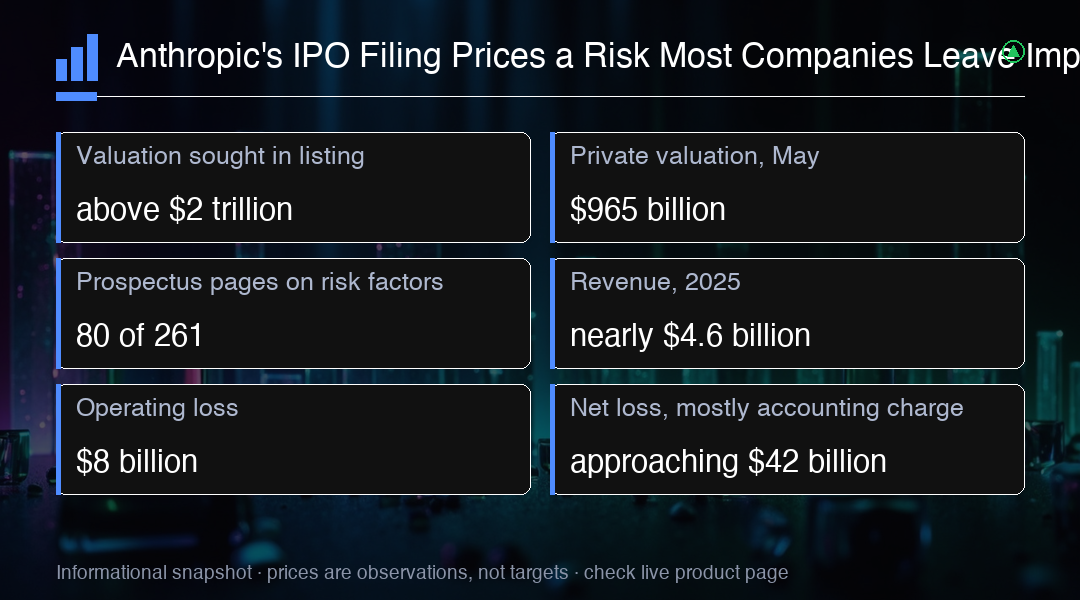
The page allocation tells you how the company itself ranks the issues. Roughly 80 of the prospectus's 261 pages are dedicated to risk factors, against 48 pages describing the business. For comparison, SpaceX used about 38 of 277 pages on risks. Proportionally, Anthropic is writing a much longer warning label than most companies heading to market. Whatever the commercial logic, it signals that management expects sustained scrutiny from regulators, customers and institutional allocators.
Now the money. Anthropic could seek a valuation above $2 trillion, more than twice the $965 billion private mark set in May. Nothing is confirmed on pricing, so treat that figure as a ceiling rather than a clearing level. But the direction is the story: the company is asking public markets to fund a build-out at a scale it has never attempted from a balance sheet, and to do so while a rival cohort is raising on comparable narratives.
The revenue line is genuinely impressive underneath that ask. Revenue rose more than tenfold to nearly $4.6 billion in 2025, which tells you that demand for frontier capability is real and that the constraint has moved from interest to compute and distribution. Growth at that order of magnitude is the strongest argument the company has. It is also the reason the valuation debate keeps circling back to capital intensity rather than profit structure. That is the number to carry into any model of the sector, and it is also the number most likely to be revised sharply once the filing is finalised.
Losses complicate the picture in a way that requires careful reading. Anthropic posted an operating loss of $8 billion, and the reported net loss approached $42 billion. A large share of that, approximately $34 billion, came from an accounting charge tied to convertible financing rather than ordinary cash burn. The distinction matters: non-cash accounting does not drain the treasury the way a reported loss implies. It does signal that past funding was structured in ways that reshape the payoff profile for new shareholders.
Safety policy and competitive behaviour have rarely sat in sharper contrast. CEO Dario Amodei has publicly appealed for the pace of new frontier capability releases to slow. Anthropic then launched its newest flagship model only 10 days after that appeal was published, a launch that was partly framed as a response to a competing lab's recent momentum. Whatever the internal debate looks like, the sequence is the honest version of the tension: caution is advocated in public, product cadence is managed in private.
That pattern is not unique to one company. Every leading laboratory has an incentive to argue for caution collectively while competing individually, because the cost of a slower industry is borne by whoever moves first and the cost of a fast industry is borne by whoever is wrong. Critics go further, arguing that large labs lean on existential-risk warnings to shape regulation around standards they can already afford, raising the cost of entry for smaller rivals. That is opinion, not established fact, but it is a live debate in policy circles.
For markets, the useful question is what this does to listed exposure rather than what it does to one private company. Anthropic has no listed instrument, so there is nothing here to trade directly. What there is: a price tag for frontier AI that sits above most private marks in the sector, a disclosure standard that institutional buyers will now expect from other issuers, and a window opening for the remaining frontier labs to follow. Index-level AI sentiment tends to react to the second-order items, so watch the fundraising chain rather than the single filing. For allocators, the filing is a template for what diligence looks like in this sector: capital intensity, safety posture and founder intent, all in one document.
The open questions are concrete. What pricing actually clears at listing, how much of the convertible-related charge recurs, and whether regulators take a visible interest in deployment schedules before the process completes. Each has a plausible answer and none of them is settled today. For now the document's main achievement is informational: it puts a number on the AI capital cycle, and it shows how much of that cycle is being financed on faith in the next round of capability rather than on current cash generation.
Trading Insight
There is no instrument to take a position in here, so the honest read is a watch list rather than a trade idea. What the filing does establish is a valuation reference point above $2 trillion for a frontier lab, roughly twice the $965 billion private mark from May, and that reference will colour how every other private AI round is marked from here. Listed AI-exposed names tend to trade off two things: the capital cycle feeding their order books, and the discount rate investors apply to spending that has no cash return yet. A prospectus that devotes 80 of its 261 pages to risk factors raises the second one. The launch 10 days after the founder's appeal to slow releases is the cleaner signal that the capability race has not paused, whatever the safety language says. None of this determines index direction on its own, and it would be dishonest to pretend a single private filing sets a level. It does define what has to be true for the next funding round to succeed, and that is worth tracking against tech-heavy benchmarks as the window stays open.