


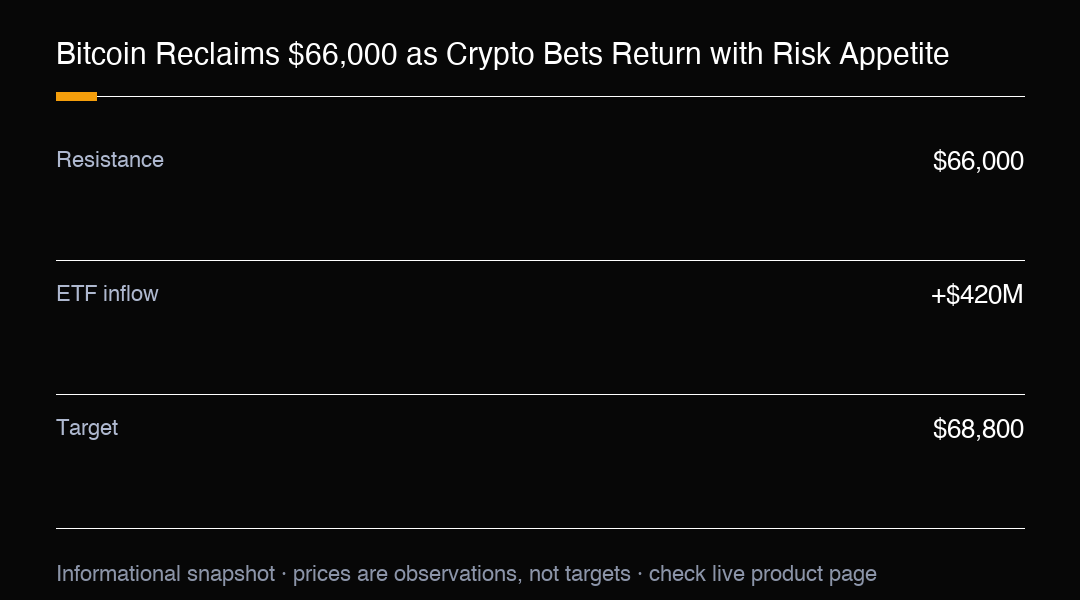
Bitcoin topped $66,000 in early Tuesday trade, extending a sharp rebound that began after last week's liquidation-driven selloff. The speed of the recovery surprised many traders who had grown accustomed to downside acceleration rather than snap-back rallies. BTCUSD popped quickly once the forced selling exhausted itself, suggesting the market was technically oversold before the bounce.
The broader risk-on tone supported the move. US equity futures turned higher, chip stocks recovered in Asia, and macro commentary shifted from defensive to cautiously constructive. Bitcoin benefits from that backdrop because it remains one of the highest-beta assets in the risk-asset universe. When traders are willing to own volatile names again, crypto is often one of the first destinations.
Spot Bitcoin ETFs gathered inflows during the session, showing that institutional interest didn't disappear during last week's choppiness. ETF buying at the $66,000 test is a meaningful technical signal because institutional capital is not supposed to chase intraday noise; it is supposed to build positions on framing dislocations. If ETF buyers were absorbing supply during the test, it implies the prior week's liquidation overhang is being digested rather than renewed.
The leverage washout last week may have accelerated the rebound. When crowded long positions get cleared quickly, the market can snap back sharply once selling pressure stops. That is the cruel math of leverage in reverse: when trades unwind, price moves can snowball in either direction. Short sellers covering into the squeeze added fuel to the rally.
There are still reasons for caution. The $66,000 level is now resistance until it becomes support, and crypto historically fights hardest at round numbers. The derivative market is healing, but it is not fully repaired. If equities turn lower again on earnings misses or geopolitical headlines, Bitcoin could retest the lower boundary of its recent range.
Traders should watch two things in the next two sessions. First, whether ETF flows continue into any pullback; sustained buying would confirm that institutions see the $66,000 zone as a value area. Second, whether leverage rebuilds too quickly; a fresh surge in open interest without corresponding price gains would warn that speculative positioning is getting crowded again on the long side.
Bitcoin's journey back above $66,000 is not just about reclaiming a technical level. It reflects a shift in speculative posture after weeks of forced deleveraging. The liquidation cascade removed some of the weakest long positions, leaving behind a market with fewer panic sellers. That thinner long base means the remaining holders are likely to be more patient and less reactive to noise, which can compress downside volatility even if upside momentum remains uneven.
Crypto options markets are pricing in higher probability of continued drift higher. The skew in Bitcoin options has flipped from put-heavy to call-heavy, suggesting traders are buying protection against rallies rather than crashes. That change in sentiment is forward-looking and often precedes spot price gains, because options dealers hedge exposure by buying the underlying asset. When call buying dominates, it can create a feedback loop that lifts Bitcoin independently of spot demand.
Spot ETF flows are another reason to take the bounce seriously. The daily net inflow numbers, while modest compared with peak institutional interest, are positive at a time when outflows would have been easy to justify. ETF buyers are not momentum chasers; they are allocators building positions based on medium-term conviction. Their continued buying during a rebound is a sign that the $66,000 zone is viewed as attractive, not speculative.
For traders who missed the move, the question is whether chasing is wise. In crypto, chasing breakouts can be rewarding in the short term but expensive if the breakout fails. A better approach is to wait for a pullback into the $66,000 support area and watch whether ETF flows continue. If they do, the probability of a test of higher resistance rises. If they do not, the breakout should be treated with skepticism. The next 48 hours will be telling.
Bitcoin's rebound is also notable because it comes at a time when macro liquidity is not expanding aggressively. With the Fed in pre-meeting blackout and Treasury yields elevated, risk assets are competing with fixed-income yield rather than enjoying a free-liquidity tailwind. That means Bitcoin's gains are more about positioning and sentiment than about monetary support. If sentiment shifts, the reversal can be just as fast as the rally.
Risk management remains essential. Even in a recovering market, drawdowns of meaningful size in a single day are not uncommon for Bitcoin. Traders should size positions accordingly and avoid overconcentration in a single directional bet. The current environment is better suited for tactical entries around support and resistance than for buy-and-hold convictions until a clearer trend emerges.
One factor supporting the rebound is the changing structure of crypto derivatives. Funding rates, which turned deeply negative during the selloff, have stabilized. That means short sellers are no longer being paid to hold bearish bets, reducing the incentive to add to downside pressure. At the same time, open interest has begun to rebuild, but the rebuilding is happening alongside price gains rather than ahead of them, which is a healthier sign. When open interest rises with price, it suggests new longs are entering, not just short covering.
For traders watching from the sidelines, the key signal is whether Bitcoin can hold the $66,000 level through the Asian and European sessions. History suggests that breakouts above round numbers often face a second test within 48 hours. If the test holds, confidence builds and momentum can accelerate. If sellers reappear, the breakout is classified as a failure and Bitcoin may retrace quickly toward the lower boundary of its recent range.
Macro traders are also watching the relationship between Bitcoin and Treasury yields. When real yields rise, the opportunity cost of holding non-yielding assets increases, and Bitcoin can underperform. The 10-year yield around is not extreme, but it is high enough to matter. If yields stabilize or drift lower ahead of the Fed meeting, Bitcoin could benefit from a renewed liquidity bid. If yields spike on stronger-than-expected data, the opposite is likely.
Institutional adoption remains the longer-term tailwind. Bitcoin ETFs have changed the product landscape by giving traditional investors a familiar wrapper around a previously inaccessible asset. As those products grow, they reduce the friction of ownership and make portfolio allocation decisions easier for wealth managers who were previously on the sidelines. That structural shift is separate from any single session's price action and is one reason why the $66,000 level may hold more significance now than it would have in previous cycles.
Trading Insight
BTC’s reclaim above $66,000 suggests the near-term correction may be exhaustion rather than trend reversal. Watch ETF flow continuity in the next two sessions.