


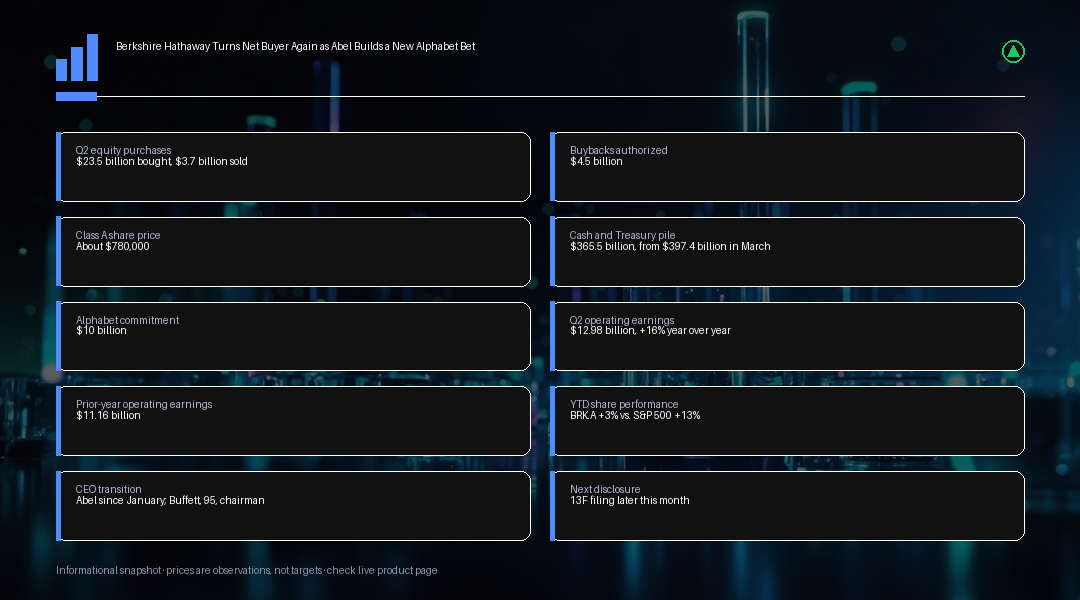
Berkshire Hathaway became a net buyer of stocks for the first time since 2022 last quarter, closing out 14 consecutive quarters in which the conglomerate had been a net seller. The shift was not subtle: Berkshire purchased roughly $23.5 billion of equities while selling only about $3.7 billion, a gap wide enough to mark a genuine change in posture rather than a rounding blip.
New chief executive Greg Abel also authorized approximately $4.5 billion in share buybacks during the quarter. A buyback is simply a company repurchasing its own stock, which reduces the number of shares outstanding and can support per-share metrics such as earnings and book value over time. Combined with the net equity purchases, the buyback authorization is the clearest signal yet that Berkshire's capital allocation has moved from defense to offense under its new leadership.
Abel took over as chief executive in January, while Warren Buffett, now 95, remains chairman. The succession has been closely watched precisely because Berkshire's investment reputation was built almost entirely around Buffett's personal judgment for more than half a century. Class A shares still trade at roughly $780,000 each, a price Buffett never split because he wanted an investor base of committed long-term owners rather than traders drawn in by a lower per-share price.
The conglomerate's cash and short-term Treasury pile fell to $365.5 billion from a record $397.4 billion in March. That remains an enormous sum by any normal comparison, closer to the assets of a sovereign wealth fund than a typical corporate balance sheet, but the decline itself is the more meaningful data point. For several years Berkshire's growing cash pile had been read as a signal that management saw few attractively priced opportunities. A meaningful drawdown, paired with net buying, suggests that view is changing.
The most closely watched piece of the update is Alphabet. Google's parent company joined Berkshire's five largest listed holdings by market value, alongside long-standing positions in Apple, American Express, Bank of America and Coca-Cola. Berkshire committed roughly $10 billion to Alphabet as part of a stated interest in the company's artificial-intelligence development, a decision Buffett reportedly made only after consulting directly with Abel. A concentrated new position of that size, sitting inside a still-large cash cushion, reads as selective conviction rather than a broad shift toward risk-on positioning.
A conglomerate ending a multi-quarter run of net selling and turning back into a buyer is typically read by professional investors as a signal that management sees more attractively priced opportunities across the market, though a single quarter of buying does not guarantee near-term outperformance for the stock itself. It is also worth separating the buying signal from the buyback signal: buybacks reduce share count and can support per-share metrics, but at $4.5 billion, the buyback authorization is modest relative to Berkshire's overall market capitalization and cash pile, meaning the more significant signal here is the fresh $23.5 billion in outside equity purchases rather than the company simply repurchasing its own stock.
Berkshire also completed its acquisition of homebuilder Taylor Morrison in July, after the quarter had already closed. The deal did not affect the reported quarter-end cash figure, but it reinforces the same broader message: capital that had been sitting idle is now being put to work across both public markets and outright acquisitions.
Underlying operating performance was solid on its own terms. Second-quarter operating earnings, which strip out volatile investment-portfolio swings to isolate profit from Berkshire's actual businesses, rose 16% to $12.98 billion from $11.16 billion a year earlier. Strength in the energy, railroad and manufacturing units outweighed softer results in insurance underwriting, where claims activity weighed on that segment's profit line.
Weakness in insurance underwriting is not new for Berkshire and reflects ordinary claims-cost variability rather than a structural problem; the segment has historically swung between strong and weak quarters depending on catastrophe activity and pricing cycles. What matters more for the current story is that energy, railroad and manufacturing strength was large enough to more than offset that weakness and still deliver double-digit earnings growth, underscoring that the operating businesses remain healthy even as attention focuses on the portfolio-level buying shift.
Despite the improved capital-allocation story, Berkshire shares are up only about 3% so far this year, well behind the S&P 500's roughly 13% advance over the same period. That gap suggests the market has not yet fully credited Abel's early moves, or is simply waiting for more evidence that the shift toward buying is durable rather than a single-quarter data point.
The complete picture of what Berkshire bought and sold during the quarter will not be available until the company files its 13F holdings report with regulators later this month. That filing typically draws outsized attention because Berkshire's disclosed positions are widely tracked and often mirrored by other investors, and this quarter's version carries extra weight given the scale of the reported shift in behavior.
MC Markets does not cite exact source levels without independent market-data verification. Traders should confirm current share prices, index performance and filing dates through their own market-data feeds before acting on any of the figures discussed above.
Trading Insight
The clearest near-term catalyst is Berkshire's 13F filing later this month, which will reveal the full scope of what was bought and sold beyond the headline Alphabet position and should clarify whether the $23.5 billion in purchases was concentrated or broadly spread across sectors. Until then, the stock's roughly 3% year-to-date gain against the S&P 500's 13% leaves room for re-rating if the market comes to see Abel's early capital-allocation choices as durable rather than opportunistic. The size of the remaining $365.5 billion cash pile also matters: a conglomerate still holding that much dry powder after a $23.5 billion buying quarter has considerable room to keep deploying capital if valuations stay attractive, which keeps Berkshire relevant as a read on broader market conditions well beyond its own share price.