


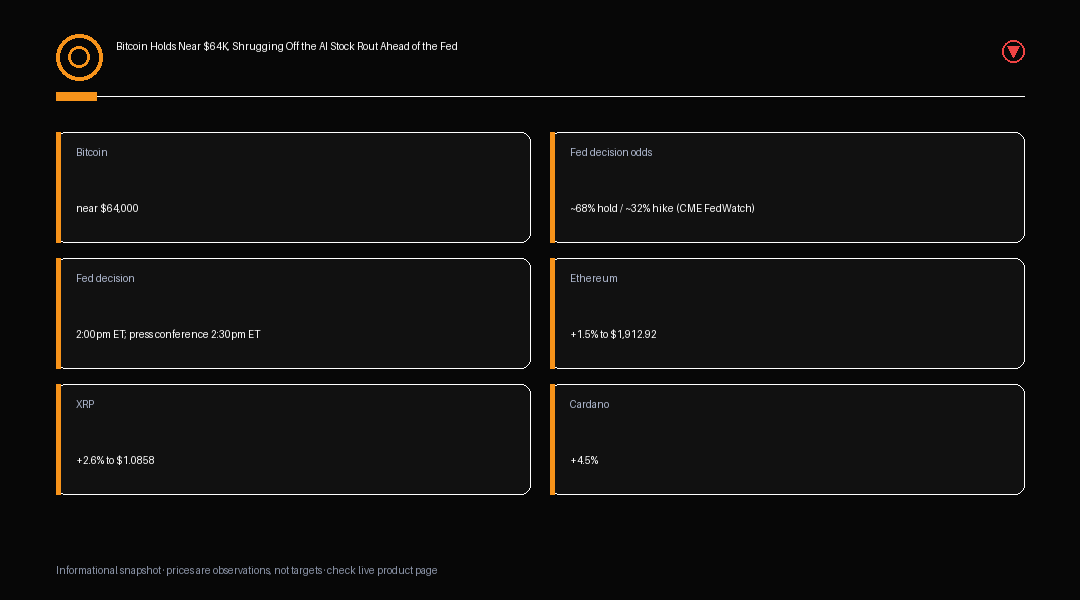
Bitcoin edged higher into Wednesday's session, hovering near the $64,000 level as traders avoided placing large directional bets ahead of the Federal Reserve's closely watched policy decision, even as renewed selling swept through AI-linked technology stocks elsewhere in the market. The world's largest cryptocurrency traded modestly higher on the day, changing hands in the mid-$63,000s to around $64,000, after slipping below $63,000 in the prior session alongside a broader AI-led equity rout.
The relative calm in Bitcoin stands out against a considerably rougher backdrop in equities. South Korea's Kospi came under renewed pressure as a fresh selloff in AI-linked chipmakers intensified, and SK Hynix shares tumbled sharply at points during the week even after the company posted record quarterly earnings, results that nonetheless fell short of Wall Street's elevated expectations. Bitcoin's ability to hold its ground while that selloff unfolded elsewhere suggests, at least for now, a degree of decoupling from the most AI-exposed corners of the stock market.
That decoupling should not be overstated. Bitcoin has increasingly traded in line with broader risk assets over the past year, and its resilience this week looks more like a smaller drawdown than a genuine disconnect from macro sentiment. Still, the fact that its losses have been more contained than those seen in semiconductor and AI-adjacent shares is a meaningful data point for traders trying to gauge how digital assets behave during bouts of equity-market stress.
The dominant catalyst for the day remains the Federal Reserve's policy decision, due later Wednesday at 2:00pm ET with Chair Kevin Warsh's press conference at 2:30pm ET, with market pricing implying roughly a 68% probability that the central bank holds its benchmark rate steady and about a 32% chance of a quarter-point increase. The stakes for crypto are straightforward: a more hawkish-than-expected outcome would tend to weigh on Bitcoin and other risk-sensitive assets, while a dovish tone or a clear hold could support renewed demand for digital assets.
Higher interest rates generally pressure speculative assets like Bitcoin because they make comparatively safer instruments, such as government bonds, more attractive on a risk-adjusted basis. When cash and short-term debt offer higher yields, assets without a cash flow of their own often have to work harder to hold investor attention, which is part of why Wednesday's Fed decision carries outsized importance for crypto markets specifically, not just for equities.
Softer-than-expected inflation data for June had given policymakers some room to maneuver, but many investors view that as a temporary reprieve rather than a durable trend, especially with oil prices climbing again this week on renewed Middle East tensions. That combination leaves Bitcoin caught between two competing forces: gradually improving macro data on one hand, and lingering concern that borrowing costs could stay elevated for longer than markets had hoped on the other.
Institutional positioning in Bitcoin has remained mixed through July. US spot Bitcoin exchange-traded funds have seen inflow days at points during the month even as the overall picture stays mixed, a pattern that suggests institutional investors are not making an aggressive directional bet in either direction ahead of the Fed decision, choosing instead to wait for more clarity before committing meaningfully larger amounts of capital.
Beyond the Fed, crypto traders are also keeping an eye on the same wave of megacap technology earnings weighing on equity markets, with Microsoft and Meta Platforms both scheduled to report after Wednesday's close. Because AI-related capital spending has become such a significant driver of broader risk sentiment this year, the tone of those results could spill over into crypto markets as well, even though neither company has direct digital-asset exposure.
Elsewhere in the crypto market, most major altcoins traded higher in relatively range-bound conditions on Wednesday. Ethereum, the second-largest cryptocurrency by market value, rose 1.5% to $1,912.92. XRP, the third-largest, climbed 2.6% to $1.0858. Solana added about 0.6%, while Cardano was one of the stronger performers, jumping approximately 4.5%. Among meme-linked tokens, Dogecoin ticked up a more modest 0.3%.
Bitcoin's year-to-date behavior offers useful context for today's relative calm. The asset has swung between sharp AI-linked drawdowns and periods of comparative steadiness for much of the past several months, generally taking its cues from the same megacap-tech earnings and Fed-policy signals that drive equities, rather than charting an entirely independent path. Wednesday's session fits that broader pattern: crypto is not immune to the AI-valuation debate playing out in equities, but it is currently expressing that debate with smaller moves than the chip sector itself.
For active traders, Fed decision days have historically produced some of Bitcoin's sharpest short-term volatility, regardless of which direction the rate decision ultimately breaks. Liquidity around the 2:00pm ET announcement and Chair Warsh's 2:30pm ET remarks tends to thin out beforehand as participants wait for clarity, and swings can widen quickly once the statement and press conference are digested. That pattern argues for caution around position sizing into the announcement itself, independent of any directional view on where Bitcoin heads once the decision is known.
Taken together, Wednesday's session paints a picture of a crypto market that is neither ignoring the broader macro backdrop nor being dragged down by it in lockstep with the more battered corners of the AI-linked equity trade. That relative stability may prove temporary once the Fed's decision and the after-hours earnings from Microsoft and Meta are known, but for now Bitcoin's ability to hold near $64,000 through a genuinely turbulent day elsewhere in markets is itself a notable data point for traders positioning around the rate decision.
Trading Insight
Bitcoin's resilience through today's AI-linked equity selloff suggests the market is treating the 2:00pm ET Fed decision, not chip-sector earnings, as the dominant catalyst for digital assets this week. A steady hold would likely reinforce that relative strength, while a hawkish surprise could quickly erase the gap between Bitcoin's contained losses and the sharper drawdowns seen in AI-exposed equities.