


A circulating social line puts the whole cycle in one joke: in seven years Bitcoin could “crash” from $1,000,000 to $750,000 — and people will still say BTC is dead. The useful read is not a price target. It is a reminder that “Bitcoin is dead” is a stress headline that reappears whenever drawdowns hurt in absolute dollars, even when the percentage move would look ordinary on a longer chart.
For live core-crypto pricing while that narrative plays out, see the BTC product page and the ETH product page.
Key takeaways
- “Bitcoin is dead” is a recurring stress headline — trackers log on the order of ~470+ public obituaries since 2010.
- The $1M → $750k joke is a 25% drawdown: absolute dollar pain rises with the price base; percentage is the portable metric.
- Watch two paths: loud obituaries with a holding bid (sentiment gauge) vs failed reclaims and expanding forced flow (structure stress).
Why do people keep saying Bitcoin is dead?
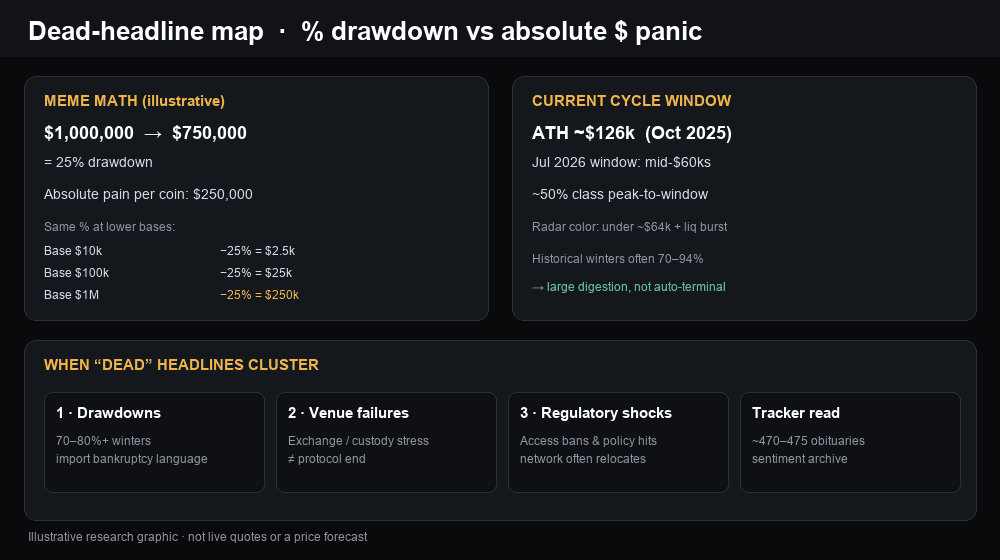
Because large drawdowns feel terminal in the moment — and financial media has a vocabulary for terminal. Trackers that compile public obituaries (BitcoinDeaths, Newhedge’s “Bitcoin Is Dead” series, and similar archives) put the running total in the ~470–475 range as of mid-2026 windows — Motley Fool’s March 2026 recap cited 471 separate declarations from pundits, CEOs, and outlets. The exact count moves; the pattern does not: death language clusters when price is already down hard.
That pattern fits the current cycle’s digestion. Public market data widely place Bitcoin’s October 2025 all-time high near ~$126,000. Into mid- and late-July 2026, spot has often traded in the mid-$60,000s — a roughly ~50% peak-to-window drawdown class. In the same late-July social tape, posts also noted Bitcoin slipping back under ~$64,000 while crypto liquidations spiked and Asian risk assets sold off sharply. That mix — multi-month percentage pain plus a fresh liquidation burst — is exactly when “dead again” posts travel.
History’s winter drawdowns were larger still. Cycle recaps compiled on desks such as Newhedge’s death-chart notes put the rough peak-to-trough classes near ~94% (2011), ~85% (2014–15), ~84% (2018), and ~77% (2022). Motley Fool’s March 2026 piece also highlighted year clusters: 2017 (~93 obituaries) and 2018 (~74) dwarfed quieter years, while 2025 (~34) and an already-active 2026 print show the reflex is alive whenever the tape cools. For a related structure debate on whether this cycle’s chart merely rhymes with 2021, see Does Bitcoin look like late 2021?.
What does the $1M to $750k joke actually teach?
It teaches drawdown literacy: the same percentage move creates larger absolute-dollar pain as the price base rises — and absolute dollars are what headlines and late buyers feel. A fall from $1,000,000 to $750,000 is a clean 25% drawdown. At a $10,000 base, 25% is $2,500 of paper pain per coin. At a $100,000 base, it is $25,000. At a million-dollar base, it is $250,000. The percentage is identical; the emotional and balance-sheet impact is not.
That is why the meme works even if you never believe a million-dollar print is “due.” It separates two languages traders mix constantly: percentage structure (what cycles and risk models use) and absolute panic (what social feeds and first-time buyers broadcast). A 50% move from ~$126,000 toward the low-$60,000s is already a life-changing paper loss for anyone who bought the high — and still a smaller percentage winter than several prior Bitcoin cycles printed peak-to-trough.
None of this is a forecast that Bitcoin will trade at $1,000,000, $750,000, or any other future print. It is a portable habit: when someone says “crash,” ask percent from which base before you accept the funeral tone.
When do “Bitcoin is dead” headlines usually appear?
They usually appear in three stress clusters: major price drawdowns, infrastructure failures around Bitcoin, and sharp regulatory shocks — not on calm green weeks. Newhedge’s explainer on the death chart frames those three triggers cleanly. Deep 70–80%+ winters invite bankruptcy-style language imported from equity markets. Exchange or custody collapses (historical examples include Mt. Gox in 2014 and FTX in 2022) invite “the industry is over” language even when the base protocol keeps producing blocks. Mining or access bans invite “they killed it” language that often confuses jurisdiction policy with network finality.
The trader distinction that matters is simple: venue risk is not the same as protocol risk, and price pain is not the same as a settled structural end. Venues can fail while settlement continues. Prices can halve while hash and settlement continuity look routine. Obituaries that collapse those layers into one word — “dead” — travel because they are short, not because they are complete models.
A second social layer, also loud in the same radar window, retells veteran hold-versus-trade mistakes after local peaks. That color is useful only as a caution against confusing a narrative climax with a finished market map. Long-horizon product rails also differ from prior winters — spot Bitcoin exchange-traded products and deeper institutional custody change who can re-enter after a shock — which is structure context, not a promise that drawdowns are finished. For how regulated multi-token product rules reshaped access debates, see SEC crypto ETF 85% rule and multi-token products.
What should traders watch next?
Treat “dead” as a sentiment gauge first — then check whether market structure is confirming real stress.
Scenario A — sentiment flush. Obituaries and “BTC is dead” posts spike, liquidations cool after a burst, long-horizon bid zones are defended on retests, and correlated risk assets stop making fresh lows together. In that path, death headlines are mostly measuring fear after a large percentage drawdown. They do not, by themselves, invent a second leg lower.
Scenario B — structure stress. Reclaims of the averages and ranges traders watch fail quickly, forced-flow / liquidation pulses keep expanding, bid depth stays thin, and risk-off in equities or other high-beta assets deepens in the same windows. In that path, “dead” language is still not a protocol verdict — but the tape is warning that digestion can extend and volatility can reprice lower ranges before any narrative heals.
Scenario A fails quickly if death-headline noise is paired with expanding forced selling and successive lower lows that refuse to stabilize. Scenario B fails quickly if liquidations fade, reclaims start to hold, and breadth in related risk markets improves instead of confirming a cascade. In both cases, skip the countdown clock: update the map from structure and flow, not from the loudest funeral post.
Dead-headline dashboard
| Lens | Window / figure | Trader read |
|---|---|---|
| Public “dead” obituaries | ~470–475 class since ~2010 (trackers; Motley Fool cited 471 in Mar 2026) | Sentiment archive, not a protocol status board |
| Death-year clusters | 2017 ~93; 2018 ~74; 2025 ~34; 2026 already active (Mar 2026 recap) | Headlines thicken in stress years |
| Current cycle high | ~$126k (Oct 2025 public ATH prints) | Absolute peak for this cycle’s drawdown math |
| Mid/late-Jul 2026 window | Often mid-$60ks; radar notes under ~$64k with liq bursts | ~50% class off peak — large, not automatically terminal |
| Historical winters (peak-to-trough class) | ~94% / ~85% / ~84% / ~77% (2011 / 2014–15 / 2018 / 2022) | Prior cycles printed deeper % pain than ~50% |
| Meme math: $1M → $750k | 25% drawdown; $250k absolute per coin | % is portable; $ pain scales with base |
| Typical death-headline triggers | Drawdowns · venue failures · regulatory shocks | Separate price pain from protocol end |
Levels and counts are observation windows from public trackers and cycle recaps — not live quotes or forecasts. Live pricing: BTC · ETH.
Final thoughts
People will keep saying Bitcoin is dead whenever the absolute dollar loss feels larger than their patience. The viral million-to-three-quarters joke is useful because it makes that reflex obvious: a 25% move can still sound like a funeral once the base is high enough. The durable habit is simpler than the meme — convert every “crash” into percentage-from-base, check whether structure and forced flow confirm real stress, and treat obituaries as a fear gauge rather than a finished verdict on the market.