


A U.S. spot Bitcoin ETF is closing, two senators have asked the Securities and Exchange Commission to investigate the $TRUMP memecoin, and a new Robinhood Chain project is being pitched on social media as the network’s answer to Jupiter. The three headlines share a crypto label, but they measure different things: institutional product economics, political event risk and onchain distribution.
For Bitcoin traders, the useful question is not whether the morning was “bullish” or “bearish.” It is whether any of these signals is large enough to change Bitcoin’s liquidity regime. Around late morning in Asia on August 5, the BTCUSDC market was trading near $64,100, close to the $63,700 social snapshot from the previous day. That left Bitcoin sensitive to flow confirmation rather than to any one headline.
Key takeaways
- Hashdex DEFI’s closure is a product-level failure, not by itself an institutional exit from Bitcoin.
- The $TRUMP letter creates headline risk for memecoins and U.S. crypto policy, but it is not an SEC finding.
- Robinhood Chain activity broadens distribution; independent projects still carry contract, liquidity and affiliation risk.
Why is the Hashdex Bitcoin ETF closing?
The reported reason is scale: the fund remained too small for its operating costs to make economic sense. Hashdex’s product page showed the Hashdex Bitcoin ETF, ticker DEFI, with $14.64 million in total net assets and 200,000 shares outstanding as of July 15, 2026. Reporting on the planned liquidation said investors could sell through August 17 before liquidation starts on August 18.
DEFI mattered historically because it began as a Bitcoin futures product and shifted to spot Bitcoin exposure in March 2024. SEC filings say the fund later pursued its objective primarily by holding Bitcoin. Its closure therefore closes one route to spot exposure, but it does not close the ETF channel itself.
The distinction is commercial, not semantic. An ETF can track its underlying asset correctly and still fail to attract enough assets, trading volume or distribution to cover fixed costs. Traders should read the closure first as evidence of issuer concentration: scale tends to collect in the largest, most liquid products.
Does one Bitcoin ETF closure signal an institutional exit?
No—not without weakness in aggregate flows and assets across the whole U.S. spot Bitcoin ETF group. CoinDesk reported $80.40 billion in spot Bitcoin ETF assets on June 5 after a record multibillion-dollar outflow streak. Against that reference total, DEFI’s July 15 assets were about 0.0182%. The dates differ, so this is a scale comparison rather than a same-day market-share calculation, but the order of magnitude is the point.
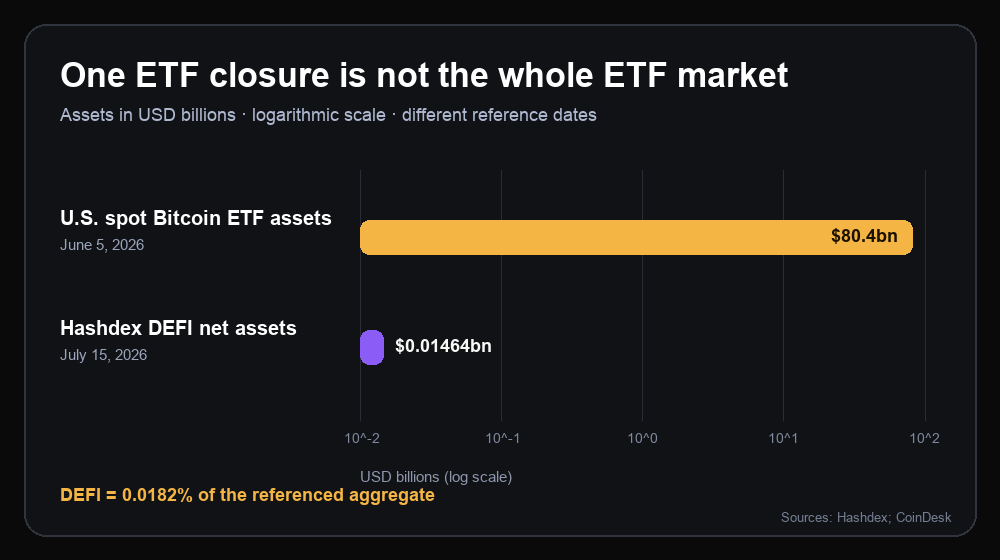
The logarithmic scale keeps the smaller fund visible. Different reference dates are shown on the chart; values can change after those dates.
ETF creations and redemptions can transmit demand into or out of the underlying market, but one liquidation is not the same as a synchronized redemption wave. A stronger bearish read would require several confirmations: persistent aggregate outflows, falling total ETF assets beyond the effect of Bitcoin’s own price, weaker BTC spot depth and price failing to recover when broader risk assets stabilize.
The opposite is also true. One closure does not become bullish simply because it is small. If ETF demand remains weak while Bitcoin trades below prior recovery zones, the institutional bid can still be fragile. The earlier Bitcoin ETF inflow map shows why a multi-day flow trend matters more than one fund headline.
Why does the $TRUMP SEC request matter to crypto traders?
It raises event risk around memecoin governance and U.S. enforcement, not a direct enforcement judgment against Bitcoin. August 4 reporting said Senators Elizabeth Warren and Richard Blumenthal asked SEC Chair Paul Atkins to investigate whether the $TRUMP memecoin involved fraud or unjust enrichment. That is a request by lawmakers; it is not proof that the SEC has opened a case or reached a finding.
The political scrutiny has a measurable retail-loss backdrop. In an April 2026 release, Warren, Adam Schiff and Blumenthal cited reports estimating that $TRUMP and $MELANIA had erased $4.3 billion in retail wealth, with roughly 2 million holders underwater. Those figures were presented by the senators from cited reporting and remain allegations and estimates, not adjudicated losses.
For traders, the transmission channel runs through the highest-beta part of crypto first. A fresh official response, document request or hearing can widen volatility in politically linked tokens, then spill into smaller memecoins and exchange-listed altcoins. Bitcoin usually needs a broader policy change, a liquidity shock or correlated risk reduction before the same headline becomes a durable BTC driver.
What does Robinhood Chain growth actually prove?
It proves that distribution infrastructure is expanding; it does not validate every project using the network. Robinhood says its public chain is a permissionless, EVM-compatible Layer 2 with chain ID 4663, ETH used for gas and support for tokenized real-world assets. It also states that Robinhood Chain operates separately from Robinhood brokerage and crypto accounts.
That last point matters for the approved radar angle. Market Mates described Mancer NFT as the “Jupiter of Robinhood,” but this is social framing for an independent ecosystem play—not an official designation from Robinhood and not evidence that the project will become the chain’s dominant liquidity venue. Permissionless means anyone can deploy contracts. Traders still need to verify the contract, distribution, liquidity, admin controls and any claimed affiliation.
Robinhood launched the chain’s public mainnet on July 1, and OpenSea added support on July 11 for stock tokens, NFTs and community tokens. That sequence is constructive for activity and discovery. It is not the same as deep, durable liquidity. The signal becomes stronger if active users, stablecoin balances and repeat DEX volume grow together after the launch burst.
How should traders separate the three signals?
| Headline | What it measures | What confirms it | What it does not prove |
|---|---|---|---|
| DEFI closure | Issuer economics and product concentration | Aggregate ETF outflows, falling assets and weaker BTC spot depth | That every Bitcoin ETF is losing demand |
| $TRUMP letter | Political and regulatory event risk | SEC response, formal process or wider policy action | That the SEC has found fraud |
| Robinhood Chain projects | Onchain distribution and speculative breadth | Repeat users, stable liquidity and verified contracts | Robinhood endorsement or project quality |
| BTC near $64K | Market’s combined verdict | Price acceptance plus spot/ETF flow follow-through | That one intraday hold has resolved the trend |
What would change the Bitcoin read?
A sustained move in aggregate flows and spot liquidity would matter more than another isolated headline. A constructive sequence would be Bitcoin holding the low-$60,000s, ETF flows stabilizing across several sessions and the market absorbing political headlines without a widening liquidation cascade. That would suggest the closure is mainly issuer consolidation.
A weaker sequence would combine renewed aggregate ETF outflows, Bitcoin losing the recent stress zone, thinning spot depth and high-beta crypto selling after formal regulatory escalation. In that case, the three channels would stop being separate stories and start reinforcing one risk-off regime.
Traders following corporate Bitcoin exposure can also compare the ETF signal with the balance-sheet liquidity questions in the MSTR Bitcoin liquidity test. Different wrappers can transmit the same underlying stress in different ways.
Final thoughts
The day’s crypto headlines sound dramatic because they compress three markets into one sentence. The cleaner read is more restrained: a small ETF is closing, lawmakers are asking questions about a politically linked memecoin, and a new chain is attracting speculative builders. None settles Bitcoin’s direction alone. Watch whether flows, spot liquidity and price begin telling the same story—because that alignment, not the headline count, is what turns noise into a regime change.