


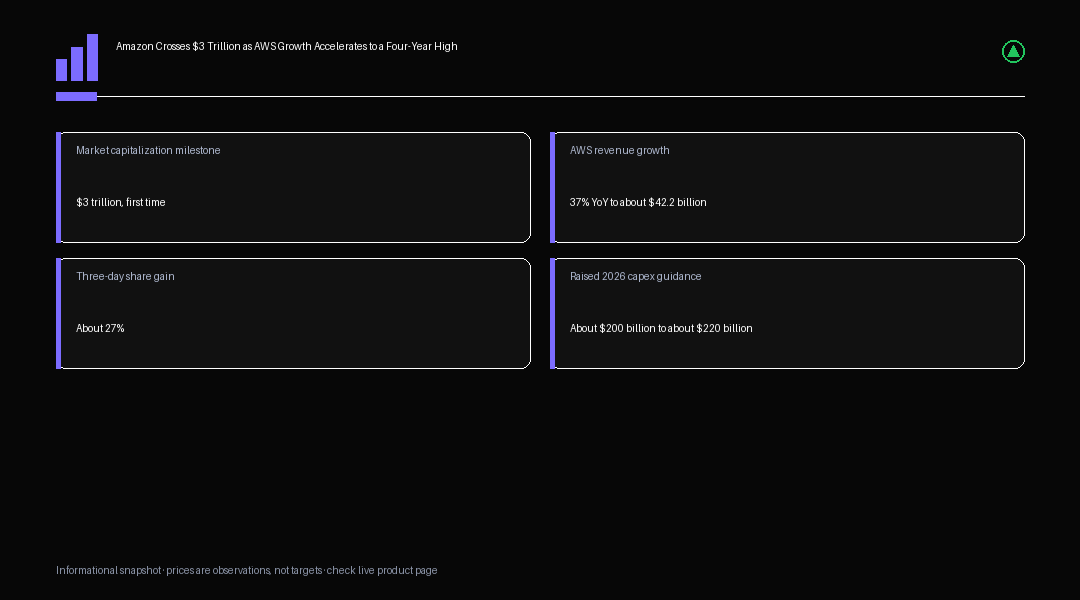
Amazon's market value crossed $3 trillion for the first time on Monday, capping a powerful three-day rally that followed one of the strongest earnings reactions the stock has produced in years. Shares rose about 4.6 percent to a record close, and Friday's roughly 15 percent single-day jump, described as Amazon's largest one-day gain since 2012, means the stock has now added close to 27 percent over three trading sessions since its latest quarterly report.
The milestone puts Amazon in rare company. It becomes the fifth company ever to reach a $3 trillion valuation, joining Apple, Microsoft, Alphabet, and Nvidia, a group whose daily share-price swings can now move by an amount roughly equivalent to the annual economic output of a mid-sized country. Amazon first closed above $1 trillion in February 2020 and reached $2 trillion in June 2024, meaning the pace of this latest trillion-dollar milestone has come noticeably faster than the climb that preceded it.
The real engine behind the rally was Amazon Web Services, the company's cloud computing division. AWS sales climbed about 37 percent year over year to roughly $42.2 billion, comfortably beating expectations for around 31 percent growth and marking the segment's fastest expansion in 18 quarters. AWS lets businesses rent computing power, storage, and AI infrastructure instead of building their own data centers, and its acceleration gives investors concrete evidence that enterprise AI spending is translating into real cloud revenue rather than remaining a story about future potential.
Profitability is where AWS matters most to the investment case. The division represents roughly a fifth of Amazon's quarterly revenue but generates the clear majority of its operating income, meaning cloud growth flows through to the bottom line far more efficiently than growth in Amazon's retail operations. That structural mix is a key reason the market rewarded the earnings beat as aggressively as it did, rather than treating it as a routine quarterly update.
Management also used the report to raise its own spending plans. Amazon lifted its 2026 capital-expenditure forecast to roughly $220 billion from around $200 billion, with the added spending earmarked for data centers, custom chips, and AI infrastructure. Investment on that scale is significant enough that Amazon's trailing 12-month free cash flow moved negative, a detail that matters for how traders weigh the rally: the market is effectively betting that today's spending converts into tomorrow's AWS growth, and the current quarter's results gave that bet fresh supporting evidence.
That framing also explains why leadership commentary about capacity was closely watched. Company executives indicated that demand for cloud and AI computing capacity could outstrip supply into 2028, an unusually long runway for a constraint to persist and a signal that the current investment cycle is unlikely to slow simply because spending has already increased once this year.
Zooming out, Amazon's milestone did not happen in isolation. The move coincided with a broader risk-on session across major US indices, with mega-cap technology and AI-linked names providing much of the lift behind the day's gains, underscoring how closely Amazon's fortunes are now tied to the same AI infrastructure buildout theme running through the rest of the market.
For traders, the combination of a rare valuation milestone, an unusually strong single catalyst in AWS, and a capital-spending plan that assumes years of continued demand creates a setup where near-term price action may remain volatile even if the underlying growth story stays intact. A milestone round number like $3 trillion can also act as a psychological reference point that traders watch for signs of profit-taking after such a rapid three-day advance.
Context helps explain why the market is treating this milestone as more than a symbolic round number. Cloud computing has become the primary battleground for AI infrastructure spending, since companies training and running large models need the kind of computing power that AWS, alongside its two main rivals, is built to provide at scale. An acceleration in AWS growth is therefore read by many investors as a proxy for broader enterprise AI adoption, not just a comment on Amazon's own retail or logistics business, which is part of why the earnings reaction was so much larger than typical quarterly beats.
It is also worth separating the two different signals embedded in this report. One is backward-looking: AWS already grew faster than expected last quarter, and that growth is now locked in. The other is forward-looking and more speculative: management's decision to raise 2026 capital spending guidance further assumes that current demand trends continue or accelerate further. Traders comfortable with the first signal but more cautious on the second may want to distinguish between the two rather than treating the entire move as equally well-supported by hard data.
The rally also arrived alongside broader strength in mega-cap technology and AI-linked names during the same session, a backdrop that likely amplified Amazon's own move beyond what the earnings report alone might have produced in isolation. That cross-asset context is a reminder that even company-specific catalysts like this one are being interpreted within a wider market narrative about AI infrastructure spending, rather than purely on their own terms.
Trading Insight
The scale and speed of this move, roughly 27 percent higher across three sessions, means near-term pullbacks toward the $3 trillion valuation level are plausible even if the medium-term growth narrative remains intact, since round-number milestones after fast rallies often attract profit-taking. Traders should watch AWS growth commentary in the following quarter as the primary confirmation signal: continued acceleration or stable growth in the high-30s percentage range would support the case that this rerating is durable, while any deceleration would raise questions about whether the market has priced in more AI-driven cloud growth than the business can sustain. The negative trailing free cash flow is worth monitoring as well, since it reflects a genuine tradeoff between near-term capital returns and long-term capacity, and any signal that capex plans are being pulled forward further could pressure sentiment even amid strong reported growth. Given that Amazon's capital-spending plans imply years of continued investment rather than a one-off catalyst, traders looking for confirmation beyond the initial rally should watch subsequent AWS growth prints and any commentary on capacity utilization, since a sustained deceleration from the current high-30s percentage growth rate would be the clearest signal that this valuation milestone was priced in too aggressively.