


Apple delivered a fiscal third quarter that beat Wall Street's targets on nearly every headline number, yet shares still fell after hours as investors focused on a more cautious outlook for the current quarter. The disconnect between a clean earnings beat and a negative stock reaction is a familiar pattern for a company priced for near flawless execution, and this quarter was no exception.
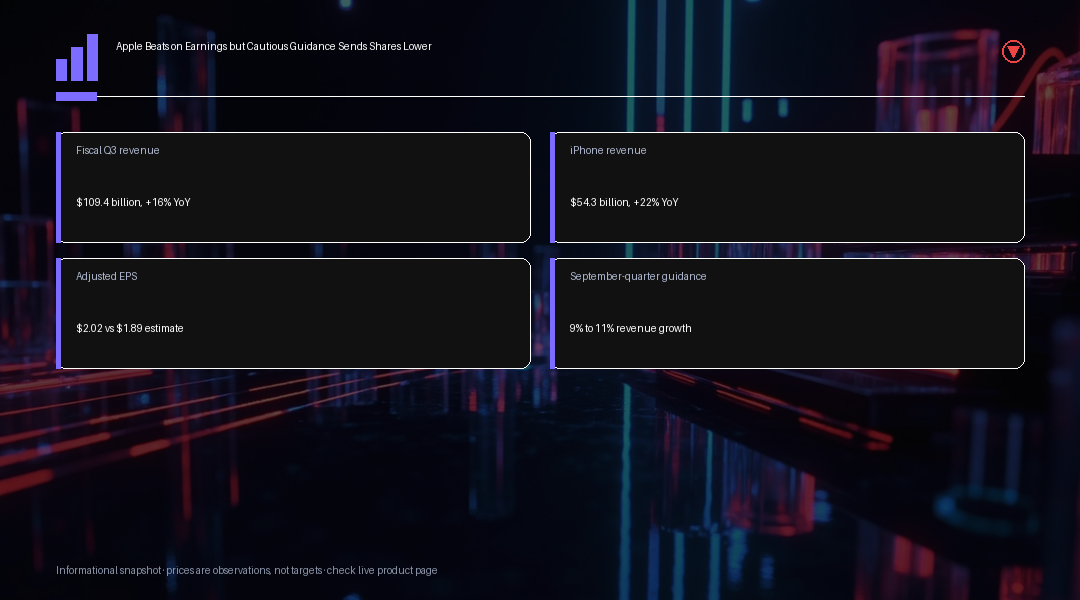
Revenue climbed 16% year over year to $109.4 billion, comfortably ahead of the roughly $108 billion Wall Street had modeled. Adjusted earnings came in at $2.02 per share, well above the $1.89 consensus estimate. iPhone sales were the standout, surging nearly 22% to $54.3 billion and topping forecasts of around $53.1 billion, a figure that alone accounted for roughly half of total company revenue for the quarter. On every historical measure, that is a strong result.
The trouble started with guidance. Apple told investors to expect September-quarter revenue growth of between 9% and 11%, implying roughly $113 billion at the midpoint. That falls short of the Street's prior estimate of around $114.9 billion, or roughly 12% growth. For most companies, high single-digit to low double-digit growth would be a welcome outcome. Apple, however, trades on a valuation that assumes very little room for disappointment, and a guidance number that undercuts consensus is often treated by the market as a warning sign regardless of how strong the quarter that preceded it was.
Management pointed to two familiar culprits. Unfavorable currency movements are expected to shave roughly 2.5 percentage points off annual revenue growth, a meaningful drag for a company that generates the bulk of its sales outside the United States. At the same time, an industry-wide shortage of memory chips is squeezing component availability and cost across the iPhone, Mac and iPad lineup, forcing Apple to compete directly with data center operators for increasingly scarce and expensive silicon.
Services revenue told a more mixed story than the headline hardware numbers suggested. While iPhone, Mac and other product categories generally outperformed, the services segment, which includes the App Store, subscriptions and licensing revenue, grew at a slower pace than analysts had modeled. That is a meaningful detail for a business that has spent years pitching services as its highest-margin, most predictable growth engine. If hardware momentum cools once the memory-chip shortage eases and iPhone comparisons get tougher, a services segment that is also decelerating would leave fewer offsetting growth levers for the stock story going forward.
That shortage is not merely a margin story. It has already shown up in retail prices. Apple raised prices on some MacBook and iPad models by as much as 20% to 25% in late June, a rare and telling move for a company that typically prefers to protect its brand positioning over passing through cost pressure directly to consumers. The fact that Apple chose to raise prices rather than absorb the hit suggests the shortage is expected to persist for some time, even if management offered little clarity on an exact timeline for relief.
Gross margin held up reasonably well given the cost pressures at play, aided in part by one-time tariff-related refunds during the quarter. Stripped of that benefit, underlying margin compression from higher memory-chip costs becomes more visible, reinforcing why management chose to raise device prices rather than absorb the hit. Investors parsing the quarter closely will want to watch whether that refund-adjusted margin trend continues to soften in the September quarter, since it is a cleaner read on how much of the AI-driven component shortage is actually eating into Apple's core profitability rather than being masked by temporary accounting benefits.
The backdrop makes the timing especially notable. Apple briefly touched a $5 trillion market valuation just two days before this earnings report, reclaiming the title of the world's most valuable public company. That milestone reflected months of steady share gains built on a lighter approach to artificial intelligence infrastructure spending compared with peers pouring tens of billions of dollars into proprietary data centers. This week's report is the first real test of whether that valuation can hold once the market starts asking harder questions about margin pressure and slowing growth.
There is also a leadership dimension to this quarter that adds another layer of scrutiny. Tim Cook is stepping down as chief executive, with the transition to incoming CEO John Ternus already underway; Cook is expected to remain involved as executive chairman. Handing over a company with record revenue but a newly cautious outlook and an unresolved supply squeeze is not the cleanest handoff, and investors will be watching closely for how Ternus frames the AI and supply-chain strategy in the quarters ahead.
None of this erases the quality of the quarter itself. Double-digit revenue growth, a comfortable earnings beat and iPhone demand that is clearly outpacing expectations are not the marks of a company in trouble. What changed is the market's tolerance for anything less than a clean acceleration story, particularly with memory-chip costs now functioning as an external tax on margins that management cannot fully control in the near term.
For traders, the setup now hinges on how quickly the memory-chip shortage eases and how the new leadership team communicates through the next two quarters. A stabilization in component costs paired with continued iPhone strength could quickly restore confidence in the growth story, while a prolonged shortage risks compounding margin pressure at exactly the moment Apple is transitioning its top leadership. Either way, the September quarter guidance has effectively reset the bar for what counts as a good result, and the market will be unforgiving if Apple cannot clear it.
Trading Insight
The reaction here is a guidance story, not a demand story. Revenue, EPS and iPhone sales all beat estimates, but a 9% to 11% growth outlook that undercuts the Street's roughly 12% forecast, layered on top of a currency headwind and a memory-chip shortage already showing up in retail price hikes, was enough to outweigh the beat. Traders should watch for supplier commentary on memory-chip supply and any updated pricing action on Mac and iPad lines as leading indicators of whether margin pressure eases or persists into the holiday quarter. The CEO transition to John Ternus adds a layer of uncertainty worth monitoring heading into the next two earnings cycles, particularly around capital allocation and AI infrastructure strategy relative to peers.