


Intervention can only do so much. Until Japan changes its policy stance, speculators will do what they do.
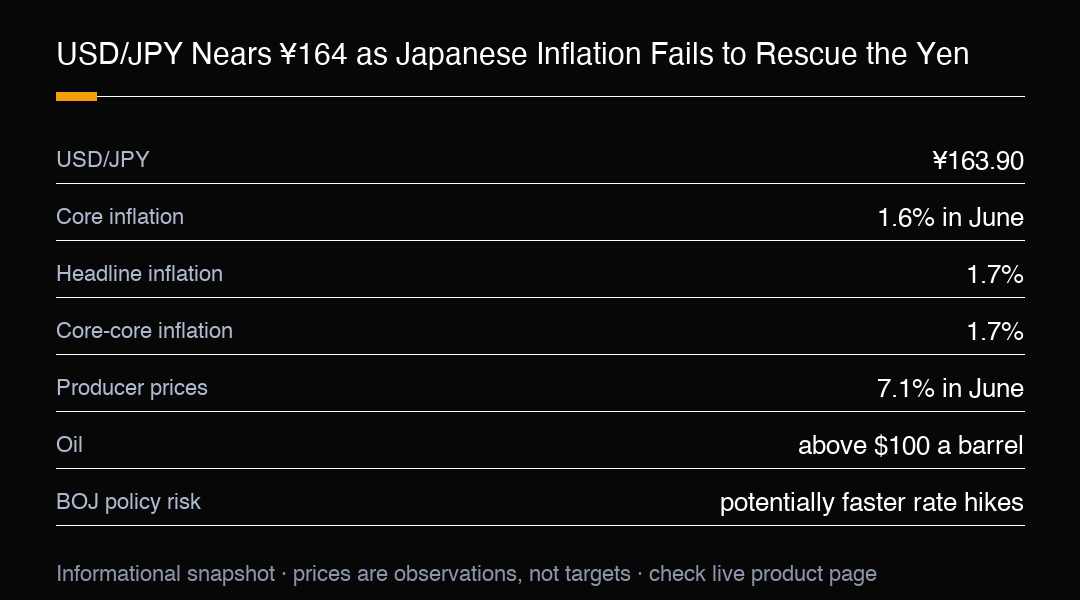
The USD/JPY pushed to ¥163.90 early Friday, marking another 40-year high against the Japanese yen. Japan's latest inflation report gave traders one more reason to keep selling the currency, proving that when speculators smell momentum, they rarely ask for permission. The level itself is less important than what it represents: a market that has stopped fearing Tokyo's threats and started pricing in sustained weakness.
Core inflation, which excludes fresh food prices, rose to 1.6% in June, matching forecasts and marking the first acceleration since March. Headline inflation climbed to 1.7%, while the closely watched core-core measure, excluding food and energy, eased to 1.7%. Rising inflation would normally support a currency, but the yen is not behaving like a normal currency because the underlying monetary policy remains so unusually loose.
Traders remain focused on Japan's ultra-low interest rates, which continue to make the yen one of the world's favorite funding currencies. In practical terms, that means investors borrow cheap yen to buy higher-yielding assets elsewhere, a trade that creates structural selling pressure on the currency regardless of what inflation numbers say. Until that dynamic changes, the yen will struggle to find sustained buyers no matter how high consumer prices climb.
Higher oil prices are making life harder for Japan. Despite government subsidies softening the blow for households, businesses are absorbing much of the pain, with producer prices jumping 7.1% in June, the fastest pace since March 2023. Japan imports most of its energy, so a weaker yen makes every barrel of oil more expensive. The effect is a hidden tax on the entire economy, one that squeezes corporate margins and weakens the trade balance at the same time.
Intervention can slow the fall, but it rarely changes the trend. Without a broader policy shift, markets often view those moves as temporary speed bumps. The lesson from past Japanese interventions is clear: surprise and size can reset positioning for a few days or weeks, but they do not rewrite the fundamental interest-rate differential that is driving the trend. Traders know this, which is why each failed defense in the past has eventually been met with fresh selling.
Reports this week suggested some Bank of Japan officials are becoming increasingly concerned that a weak yen and rising fuel costs could keep inflation hotter for longer, potentially opening the door to faster interest-rate hikes than markets currently expect. That would represent a significant shift from the BOJ's patient approach of the past two years, and it is exactly the kind of repricing that currency traders thrive on.
Higher interest rates generally strengthen a currency by making local assets more attractive. The problem is that Japan has spent decades fighting weak inflation, so tightening policy too aggressively carries risks of its own. A sudden rate hike could strengthen the yen but also damage growth, frighten households and destabilize the very recovery the BOJ has spent years cultivating. Policymakers are walking a narrow line between credibility and stability.
Until the Bank of Japan convinces markets it is ready to meaningfully narrow the interest-rate gap with the US, traders may keep treating every yen rally as an opportunity to hit the sell button one more time. The dollar-yen trade has become a referendum on policy credibility, and Tokyo is currently failing that test in the eyes of the market. Reputation takes years to build and only one data release to damage.
The cross-market implications are significant. A stronger dollar makes raw materials priced in dollars more expensive for everyone else, complicates central banks elsewhere, and tightens financial conditions more broadly. The 163 yen line is a marker for a broader shift in how the world is priced, not just a quote on a screen. Emerging-market currencies, global bond yields and commodity prices all feel the ripple from this pair.
For now, the most likely path is a slow grind rather than a clean break. Expect more verbal warnings from Tokyo, occasional actual intervention, and a dollar that keeps finding a bid on every dip as long as the rate gap holds. The pair has become a live test of how far a structural divergence can run before policy pushes back hard enough to matter. Currency traders will watch BOJ speeches, US inflation data and oil prices for clues about the next leg.
One hidden driver is the seasonal pattern. Yen weakness often accelerates into year-end as institutional flows reallocate toward higher-yielding dollars. If that seasonal tailwind overlaps with a policy-repricing event, the pair can move faster than technical models suggest. Traders who rely only on spot levels may therefore understate the risk of a sharp spike. Adding a seasonal overlay to the fundamental thesis can improve both entry timing and risk placement.
Japanese importers and exporters also provide a behavioral edge. Exporters tend to hedge less aggressively when the yen is falling because their overseas earnings translate into stronger yen eventually. Importers, meanwhile, face margin compression that can become self-reinforcing if they pass costs through to consumers. That pass-through is important because it affects domestic inflation and therefore BOJ policy calculus. The currency market is therefore watching not just Tokyo's words but Japan's corporate behavior.
The path of least resistance remains higher for the pair until the BOJ offers a credible hawkish surprise. For now, the market is pricing policy inertia rather than policy change. That means dips are likely to be bought by trend followers and macro funds, while sellers must hope for an external shock. Without that catalyst, the structural case for a weaker yen remains intact. Traders should monitor BOJ speakers, US Treasury yields, and oil inventory data for the earliest signs that the consensus is shifting.
Trading Insight
The yen is weakening because inflation is not translating into near-term rate-hike certainty fast enough to satisfy markets. Oil above $100 and policy inaction keep the pressure on USD/JPY.