


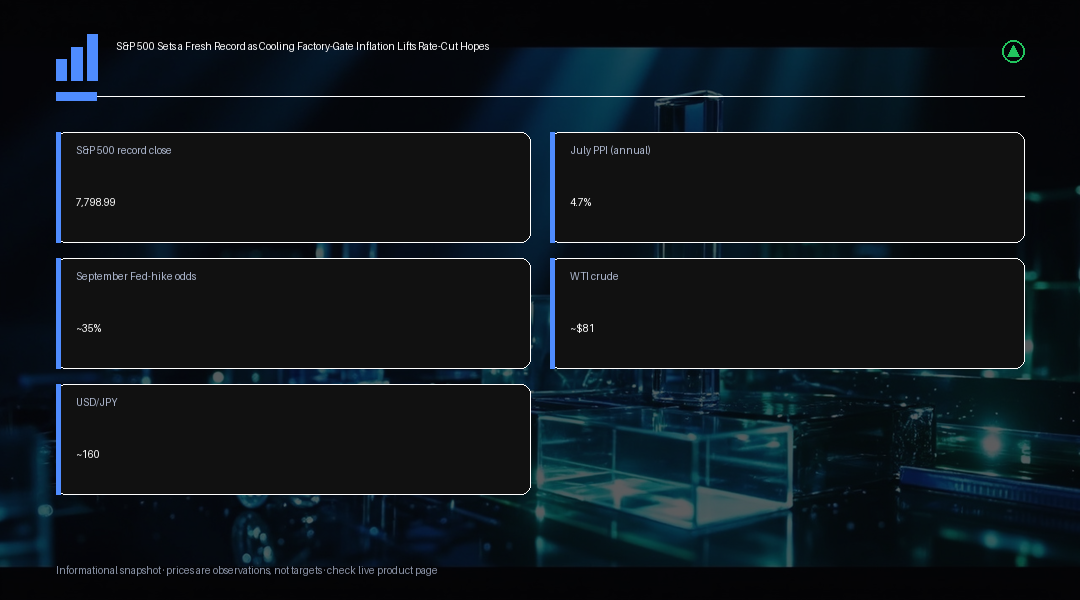
The S&P 500 gained 0.65% Thursday to close at a record 7,798.99, near enough to the psychologically significant 7,800 level for traders to treat it as a genuine milestone. The Nasdaq Composite climbed 0.81% to 26,803.03, and the Dow Jones Industrial Average added 0.13% to finish at 53,839.99, giving all three major US benchmarks a positive session even as the gains were led by different corners of the market on different days this week. The catalyst was unusually specific for a record-setting session: a cooler-than-feared inflation reading at the producer level rather than a single dominant earnings report or policy announcement.
July producer prices were unchanged on a month-over-month basis, while annual producer price inflation slowed to 4.7% from 5.5% in the prior reading. Because producer prices measure what businesses pay before goods reach consumers, a cooling trend there is often read as an early signal that consumer-level inflation pressure could continue to ease in the months ahead. That combination was enough to shift the market's near-term Federal Reserve expectations: odds of a September rate hike fell toward 35%, down from roughly 55% just one week earlier, while Treasury yields declined in response. Lower expected borrowing costs and reduced tightening risk are exactly the kind of backdrop that supports further multiple expansion in equities, which helps explain why the reaction in stocks was so broad-based rather than confined to a single sector.
The producer-price release is one piece of a broader inflation puzzle that the Federal Reserve has been trying to read consistently for months, and Thursday's reaction shows how sensitive risk assets remain to any data that changes the near-term policy outlook. A single soft inflation print does not guarantee a rate cut or even a sustained pause, but it does narrow the range of outcomes markets need to price for the next Fed meeting, which is often enough to justify a rerating in equity valuations even without a change in actual earnings expectations. That dynamic is part of why record index closes driven by macro data, rather than by a single company's results, tend to be treated by professional investors as both meaningful and fragile at the same time: meaningful because they reflect a genuine shift in the policy backdrop, and fragile because the next data point could just as easily reverse the move.
The rally's breadth was itself notable. The S&P 500 and Nasdaq are both showing strong double-digit percentage gains for the year, and small-capitalization stocks have emerged as a surprise leader in the current stretch, with the Russell 2000 also posting a strong double-digit annual gain. A leadership shift toward small-caps alongside continued strength in mega-cap technology names is typically read as a healthy sign for a rally's durability, since it suggests participation is broadening beyond the small handful of dominant growth stocks that have driven much of the market's gains over the past several years.
Asian markets picked up the bullish handoff into Friday, though the regional picture was mixed rather than uniformly positive. South Korea's Kospi and Japan's Nikkei, the region's two technology-heavy benchmarks, both advanced, while Hong Kong, mainland China, Australia, and India each slipped. Even with that split performance, the broader regional index was on pace for its strongest week in roughly two months, underscoring how much of the recent momentum has been tied to the same global technology and AI-linked themes driving Wall Street. US index futures were little changed to modestly higher early Friday, with traders holding back ahead of the July retail sales report due before the opening bell, a release that carries real two-way risk for the rate-cut narrative that has been building all week.
Beneath the index-level story, single-stock moves showed how uneven the current earnings season has been. SanDisk surged 13.7% on bullish long-term forecasts, Micron gained 4.2%, and Workday jumped 18% on takeover speculation, while Netflix climbed 5.4% after Bill Ackman disclosed a new stake in the streaming giant. On the other side of the ledger, Cisco sank 8.4% and Tapestry dropped roughly 16%, a reminder that even in a record-setting broad market, individual earnings misses and guidance disappointments are still being punished sharply. That dispersion is arguably as important for active stock-pickers as the index-level record itself.
Commodities added their own layer of tension to an otherwise risk-on session. Oil steadied near $81 for WTI and $87 for Brent crude after Washington threatened an indefinite blockade of Iran, with both benchmarks on track for weekly gains of roughly 4% as traders weighed the risk of broader supply disruption against otherwise ample global inventories. In currencies, the dollar softened slightly, but USD/JPY stayed close to the 160 level that has repeatedly raised the prospect of official intervention from Japanese authorities. Gold pulled back before rebounding to around $4,325 to $4,380 early Friday, while Bitcoin edged modestly higher even as the SEC canceled a scheduled crypto-rule vote and Congress delayed related legislation, leaving digital-asset regulation in another holding pattern.
Taken together, Thursday's session captured a market that is currently rewarding good macro news with broad, multi-asset participation rather than narrow, single-theme enthusiasm. Cooling factory-gate inflation, falling rate-hike odds, and a small-cap-led rally all point in the same direction, but Friday's retail sales data and the following month's run-up to the actual September Fed decision will determine whether this record close marks the start of a durable next leg higher or another data point in a choppier, more two-sided stretch for risk assets.
Trading Insight
For traders, the key signal from Thursday's session is that the market is currently pricing disinflation as good news for both growth and rate-sensitive assets at the same time, a combination that tends to persist only as long as incoming data keeps cooperating. Friday's retail sales report is the immediate swing factor: a strong print would support the underlying growth story but could revive some of the rate-hike concern that just eased, while a weak print would reinforce the Fed-pause narrative even as it stirs some recession chatter. Given that September Fed-hike odds have already fallen sharply, from around 55% to roughly 35% in a single week, positioning into that Federal Reserve decision carries real event risk in both directions. The breadth of Thursday's rally, with small-caps and the Russell 2000 keeping pace with large-cap technology, is constructive for the durability of the move, but the wide dispersion in single-stock reactions, from Workday's takeover-driven jump to Tapestry's sharp decline, shows that index-level records are not translating into uniform gains underneath the surface. Cross-asset signals are worth monitoring as well: continued proximity of USD/JPY to the 160 area keeps intervention risk alive for currency traders, and the standoff over an Iran blockade threat means oil could reprice quickly if the geopolitical situation escalates, which would complicate the otherwise benign inflation narrative currently supporting equities.