


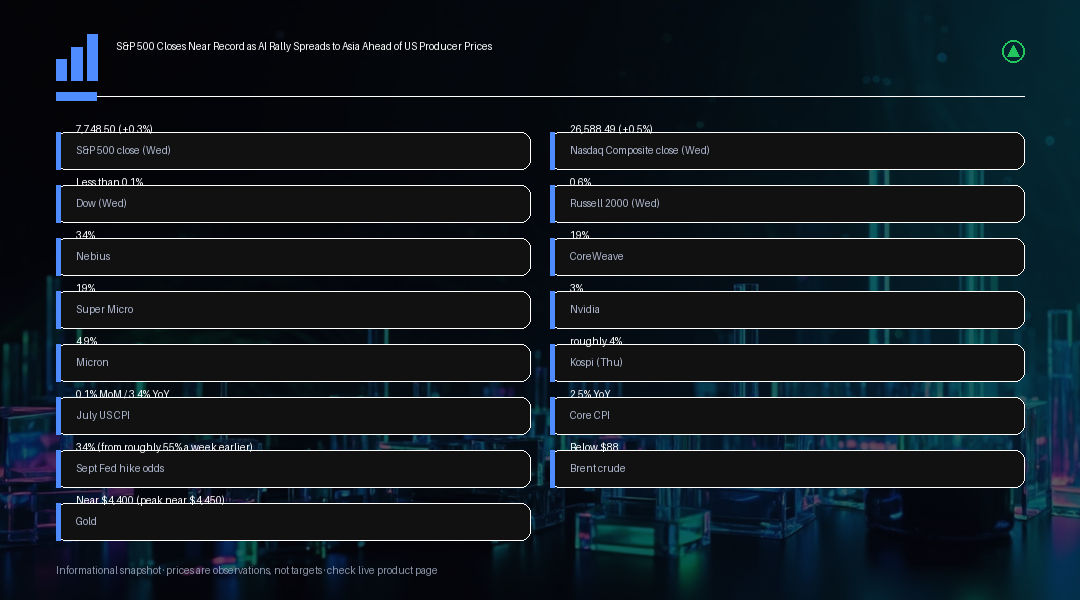
The S&P 500 gained about 0.3% on Wednesday to close at 7,748.50, while the Nasdaq Composite rose about 0.5% to 26,588.49, both landing near record territory as another wave of AI-driven buying swept through US equities. The Dow Jones Industrial Average was essentially flat, slipping less than 0.1%, underscoring how concentrated Wednesday's gains were in technology and AI-infrastructure names rather than the broader blue-chip complex.
AI infrastructure stocks supplied the fireworks. Nebius jumped 34%, CoreWeave rose 19%, and Super Micro gained 19%, while chip bellwether Nvidia advanced 3% and memory maker Micron added 4.9%. The semiconductor index climbed 2.5% as a group. Encouragingly for market breadth, the small-cap Russell 2000 also rose 0.6%, suggesting the rally was not confined only to the largest AI-linked technology names.
That AI-led enthusiasm carried through to Asian trading on Thursday. South Korea's Kospi surged roughly 4%, with Samsung Electronics and SK Hynix both rallying strongly, around 5-6% and around 6% respectively, adding to what has become a broad regional rerating of AI-memory demand. Japan's Nikkei advanced roughly 1.5-1.7%, while Hong Kong and mainland Chinese benchmarks posted smaller but still positive gains. US stock futures edged modestly higher into Thursday, leaving the S&P 500 and Nasdaq positioned to extend Wednesday's advance if the session's next catalyst cooperates.
That catalyst is inflation. July's US Consumer Price Index rose 0.1% on the month and 3.4% year over year, matching forecasts and easing from June's 3.5% annual pace, with core inflation, which excludes food and energy, holding at 2.5%. The in-line, gently cooling print pulled the market's implied probability of a September Federal Reserve rate increase down toward 34%, from roughly 55% just a week earlier, a meaningful repricing that helped clear the way for Wednesday's rally in rate-sensitive growth stocks.
Thursday's producer-price report, released alongside weekly jobless-claims data, is the next test of that narrative. Producer prices measure what businesses pay for goods and services before those costs reach consumers, making the report a leading indicator for where consumer inflation could be headed next. A soft reading would likely reinforce the case for a Fed pause and could extend the AI-led rally; a hot print would revive rate-hike concerns and put renewed pressure on the richly valued growth and technology names that have driven most of this week's gains.
Not every part of the technology trade cooperated after hours. Cisco fell about 4% in after-hours trading despite beating quarterly estimates and issuing strong full-year guidance, as investors focused on margin pressure rather than the headline beat. AI chip designer Cerebras dropped more than 15% after missing revenue expectations, a reminder that even within a hot AI theme, execution and guidance still matter stock by stock.
The breadth argument deserves a closer look because it is central to how sustainable this rally is likely to be. When gains concentrate in a handful of AI-infrastructure names, a single disappointing earnings report or guidance cut can quickly reverse sentiment across the whole group. Wednesday's session showed a healthier pattern: strength in small-caps alongside the AI leaders, plus a rally that has now visibly spread into Asian chipmakers rather than staying confined to a handful of US technology giants. That kind of participation is generally viewed as a more durable setup than a narrow, concentrated advance, though it does not eliminate the risk that a single macro surprise, such as a hot inflation print, could pull everything lower together.
The Federal Reserve's rate path remains the connective tissue running through nearly every asset class discussed here, from equities to oil to gold. A market that has repriced September rate-hike odds lower on softer inflation data is, by definition, a market that has become more sensitive to any data point suggesting that repricing was premature. That sensitivity cuts both ways: it can amplify gains on confirming data just as easily as it can amplify losses on data that surprises to the upside. Traders positioning around Thursday's producer-price report should keep that two-way sensitivity in mind rather than assuming the path of least resistance is automatically higher simply because sentiment has been positive this week.
Elsewhere, Brent crude slipped below $88 a barrel as weak demand forecasts and a large US inventory build offset concerns over stalled talks involving Iran. Gold eased back toward $4,400 after touching a peak near $4,450 in a post-inflation-data rally, while the US dollar softened modestly. Taken together, the cross-asset picture points to a market that remains broadly risk-on but is still keeping one eye on inflation, oil, and geopolitics heading into Thursday's data.
Trading Insight
The setup heading into Thursday's producer-price report is genuinely two-sided, even with the AI-infrastructure trade running hot. On one hand, South Korea's chip-led rally and the breadth shown by the Russell 2000's 0.6% gain both argue that this leg of the AI trade has more support than a narrow handful of megacap names, which is a healthier setup than earlier stages of the rally. On the other hand, a market pricing only around 34% odds of a September Fed hike has relatively little room to absorb a hot PPI surprise without a swift repricing of that probability, and richly valued growth and semiconductor names would likely be first in line for profit-taking if that happens. Traders should treat the actual PPI print, not the consensus estimate, as the key catalyst for the rest of the week: a soft or in-line number likely lets the current AI-led leadership continue with Thursday's Asian strength as a tailwind, while a hot number would put the S&P 500's 7,748.50 close and the Nasdaq's 26,588.49 close to an immediate test as rate-sensitive names reprice. Cisco's and Cerebras's diverging after-hours reactions are also worth remembering, since strong headline AI-sector momentum has not stopped the market from punishing execution misses stock by stock, and that stock-specific scrutiny is likely to persist even if the broader index-level rally continues. Watching Treasury yields and the dollar alongside oil and gold into and after the PPI release should give a clearer read on whether the market treats the data as decisively hawkish, dovish, or simply in line with an already-elevated set of AI-driven expectations.