


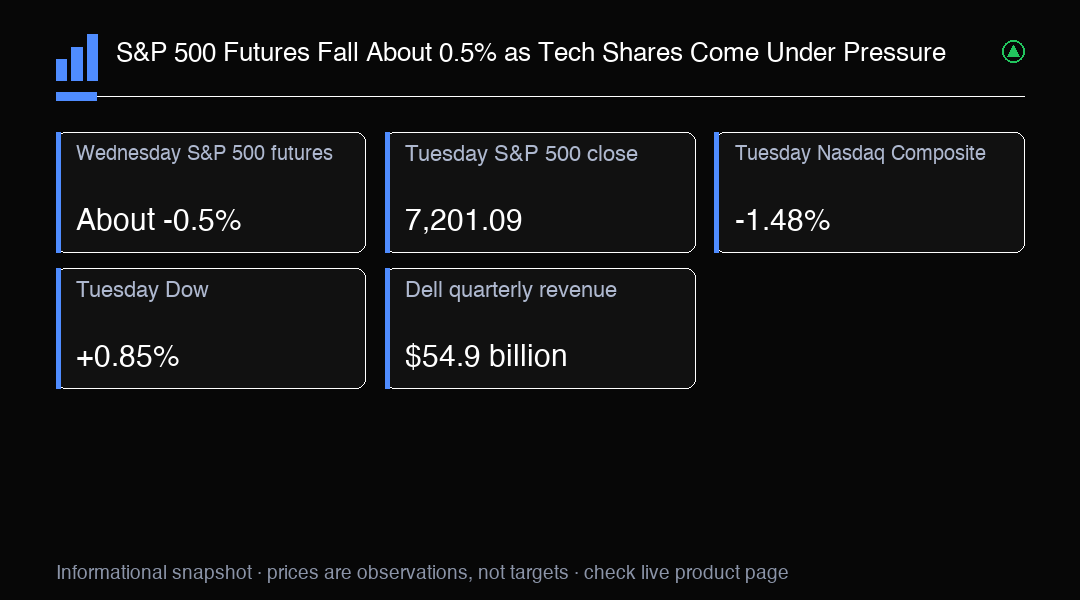
The S&P 500 fell 0.5% to 7,201.09 on Tuesday as a steep selloff in chip stocks outweighed gains elsewhere in the market. Futures were about 0.5% lower early Wednesday, November 25, ahead of US inflation and growth figures due before the Thanksgiving closure.
The Nasdaq Composite lost 1.48% on Tuesday, while the Dow Jones Industrial Average gained 0.85% and the small-cap Russell 2000 rose 0.57%. The S&P 500 pared deeper losses before the close. The split across benchmarks puts that recovery in context. Smaller companies held up even as the biggest technology names came under pressure, and the Dow’s gains showed that parts of the large-cap market also advanced. The Dow gives higher-priced shares more influence, while the S&P 500 weights companies by market value. That difference can widen the gap between the indexes when some of the largest companies by value come under pressure.
Nvidia fell about 5.9% on Tuesday, giving back part of Monday’s 31.5% surge. The PHLX Semiconductor Index dropped about 7.9%, showing how far the selling extended across the chip industry. The speed of the reversal matters because expectations for suppliers can shift faster than customers change their spending plans. Chip shares already reflect assumptions about how much computing capacity customers will buy, how quickly suppliers can deliver it and how much pricing power they can retain. A change in any one of those assumptions can move valuations well ahead of the next round of earnings.
Dell’s earnings, released after Tuesday’s close, offered a reading on the hardware business amid the volatility in chip shares. Fiscal third-quarter revenue reached $54.9 billion, up 103% from a year earlier. Non-GAAP adjusted diluted earnings were $9.45 a share. The quarter gives investors a measure of sales already booked as they weigh prospects for more infrastructure orders. For a server maker, rapid sales growth can come with a change in the mix of products it ships. More revenue from expensive equipment can lift sales faster than earnings if component costs absorb a larger share of the selling price.
Dell raised its fiscal 2027 revenue outlook to $202 billion. That higher forecast puts more weight on delivery schedules and customer budgets in the months ahead. Large orders require components to arrive on time and customers to be ready to take delivery. Financing can also affect when a customer proceeds with a project. Once the equipment is in use, the economics look different for the buyer and the supplier. The supplier earns revenue from selling the hardware. The buyer still needs to put the new capacity to work and generate enough revenue or savings to cover its cost. That difference helps explain why strong hardware sales can coexist with questions about returns on AI investment.
The early futures decline extended the weakness into a different trading window. The initial move reflects how investors priced index exposure ahead of regular trading in the underlying shares. Once those shares open, the contribution from technology and the performance of the rest of the market become clearer. That matters for US500 because a handful of heavily weighted stocks can lift the index on a rebound. Gains across a wider range of industries would point to a more broadly supported recovery.
October’s personal income and spending report is due later Wednesday and will include the personal consumption expenditures price index, the Federal Reserve’s preferred inflation gauge. The release offers a way to read prices alongside household demand. A firmer inflation reading alongside resilient spending could shift expectations toward a firmer policy path. Higher expected rates can weigh on companies whose valuations depend heavily on profits years into the future. An easing in price pressures alongside steady spending could give growth shares some relief, particularly if the release lowers expectations for the path of rates.
The second estimate of third-quarter gross domestic product is due the same day, and weekly jobless claims have been moved forward to Wednesday because of Thanksgiving. The GDP revision offers a look back at how the economy entered the current quarter. Claims offer a more recent, if noisier, view of layoffs. A rise in claims could temper rate expectations, though the equity response would also depend on what the increase implies for household incomes and company sales. That tension helps explain how yields and equities can fall together when investors see weaker growth as the bigger issue. The releases also cover different periods, so an upward GDP revision can coexist with signs of weaker demand or hiring in the more recent data.
US equities will be closed Thursday, November 26, leaving Wednesday’s session to absorb the releases before the holiday. A rush of orders after the data can make the first moves sharp, especially if some participants are already reducing their activity. The interaction between rates and chip stocks will help clarify what drives the next leg. If rate expectations ease and semiconductor shares stay under pressure while other groups steady, concerns specific to the industry may still be carrying more weight. A decline extending to smaller companies and a wider range of sectors would point to a broader reassessment.
Tuesday’s late buying softened the S&P 500’s decline, but participation across sectors will help explain whether that improvement carries into Wednesday. A rebound concentrated in the largest technology shares could lift the headline index even if most stocks remain under pressure. An equal-weighted measure gives each member the same influence and can help put the index move in context. If both versions rise alongside gains in smaller companies, the recovery would look more widespread. If the gap between them grows, the headline move may tell investors more about the largest stocks than about the market as a whole.
One question will outlast the holiday. How much of the market’s earnings growth depends on demand for AI infrastructure holding up? The answer depends in part on how widely earnings are improving across sectors. If demand for hardware stays firm while consumer-facing companies face weaker sales, a smaller set of businesses could account for more of the earnings growth behind the index. If household spending remains healthy, companies outside technology would have more scope to contribute. Wednesday’s figures offer an early test of that balance heading into the holiday.
Trading Insight
If chip stocks rebound after the data, the response in smaller companies offers a second signal. Gains in both groups would indicate a wider recovery, while weakness in small caps would point to continued divergence.