


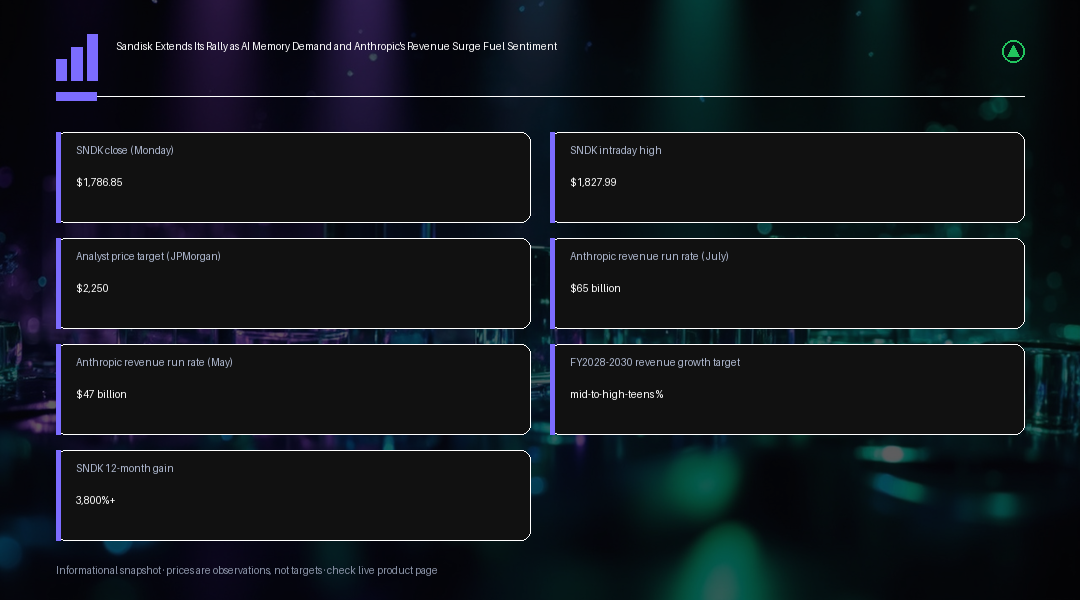
Sandisk shares SNDK surged roughly 9% Monday to close near $1,786.85, after touching an intraday high above $1,827, outperforming a broadly falling market as investors piled back into memory-chip names. Micron gained 4.1%, Marvell added 5.5% and Western Digital also rallied, as a renewed wave of enthusiasm for artificial-intelligence infrastructure spilled over into the hardware suppliers that build the memory and storage AI systems depend on.
Sentiment around Sandisk has been building since the company's investor day earlier this month, when management projected mid-to-high-teens annual revenue growth between fiscal 2028 and 2030, alongside targets for adjusted gross margins near 80% and free-cash-flow margins around 50%. Those targets suggest a business that expects to combine constrained supply, premium pricing and disciplined spending to keep performing well beyond the current AI-driven construction boom. Fresh analyst coverage added further momentum, with JPMorgan initiating coverage at an Overweight rating and setting a price target of $2,250, a notable vote of confidence in the stock's ability to extend its run.
The broader AI backdrop provided additional context for the move. Anthropic disclosed that its annualized revenue run rate exceeded $65 billion in July, up sharply from around $47 billion in May and roughly $9 billion at the end of 2025, with preliminary second-quarter revenue reported above $11.5 billion. A run rate is a projection of a company's expected revenue over a coming period, typically a year, based on its most recent quarterly or monthly figures rather than an audited annual result, so it should be read as a directional signal of growth rather than a confirmed final number. That trajectory has been widely cited as evidence of just how quickly demand for AI compute, and the memory and storage that support it, is scaling.
It is worth being precise about the relationship between these two storylines. Sandisk's rally has been driven primarily by its own fundamentals, namely the investor-day targets and the resulting analyst upgrades, together with a sector-wide rotation back into memory names on AI-driven demand expectations. There is no confirmed public announcement of a direct supply agreement or commercial arrangement between Sandisk and Anthropic specifically; the connection between the two companies is best understood as thematic, both sit within the broader AI infrastructure stack, Anthropic as a model and API provider and Sandisk as a supplier of the flash memory that AI training and inference workloads consume in growing volumes.
AI models require enormous quantities of fast memory and storage both for training, the process of building a model, and for inference, the process of generating answers once training is complete. As usage scales across the industry, that dynamic tends to benefit hardware suppliers positioned to meet the resulting demand, which is the broader argument investors appear to be making around Sandisk and its peers rather than a claim tied to any single customer relationship.
Management's own targets imply confidence that current conditions are not simply a temporary spike. Multiyear supply agreements already cover roughly two-thirds of Sandisk's expected 2028 production capacity, a structure designed to reduce the boom-and-bust volatility that has historically characterized the memory industry. Combined with the margin targets outlined at the investor day, the strategy points toward a business trying to convert cyclical AI-driven demand into a more durable, multi-year growth profile.
Sandisk has now gained more than 3,800% over the past 12 months, even after enduring sharp reversals along the way, which puts Monday's 9% move in perspective: impressive in isolation, but consistent with a stock that has become accustomed to large single-day swings. From a technical perspective, MC Markets' desk view treats the area around $1,800 as the immediate resistance zone, with the recently disclosed $2,250 analyst price target marking the next significant level on a sustained breakout. On the downside, support sits closer to $1,650, with a deeper floor near $1,500 should broader sentiment toward AI-linked hardware names cool.
A stock that has already delivered a gain of this magnitude naturally invites questions about how much further good news is already reflected in the price. The counterargument from bulls is that the investor-day targets, mid-to-high-teens revenue growth, roughly 80% gross margins and roughly 50% free-cash-flow margins, describe a business model that would still look attractive several years out even after such a large run, provided execution matches the guidance. The counterargument from more cautious observers is that a stock up nearly 40-fold in a year has priced in a great deal of that best-case scenario already, leaving comparatively little room for error if AI-related capital spending were to slow or if memory pricing power proves less durable than management currently expects.
The broader memory sector's fortunes have historically swung between severe oversupply and acute shortage, and that history is part of why Sandisk's multiyear supply agreements are being read as a meaningfully positive signal rather than routine corporate messaging. Locking in roughly two-thirds of 2028 capacity years in advance gives both Sandisk and its customers more visibility than the industry has traditionally offered, and reduces the risk that a sudden capacity glut forces prices, and margins, sharply lower the way it has in past cycles. Investors appear to be pricing in a structurally different memory market this time around, one shaped by sustained AI-driven demand rather than the traditional boom-and-bust pattern tied mainly to PC and smartphone shipment cycles.
It is also worth situating Monday's move within the broader AI-hardware rally that has lifted Micron, Marvell and Western Digital alongside Sandisk. That sector-wide participation is itself informative: a single-stock rally driven by one company's guidance would be a narrower story, but a broad advance across memory and storage suppliers suggests the market is repricing the entire category's medium-term demand outlook upward, based partly on data points like Anthropic's revenue trajectory that illustrate how quickly AI-model providers are scaling their own businesses and, by extension, their underlying compute and storage needs.
Taken as a whole, Sandisk's latest advance reflects a combination of company-specific catalysts, investor-day guidance and analyst upgrades, layered on top of a sector-wide AI memory demand narrative that Anthropic's accelerating revenue figures have helped reinforce, even though the two companies are not confirmed to have a direct commercial relationship.
Trading Insight
For traders, the key distinction to keep in mind is that Sandisk's rally is being driven by company-specific catalysts, its own investor-day targets and the resulting analyst price-target increases, layered on top of a sector-wide AI memory demand theme, rather than by any confirmed direct commercial relationship with Anthropic. That matters for how to read future headlines: further strong AI-adoption data points, including updates to Anthropic's own revenue run rate, should be treated as supportive sector context rather than as company-specific news for Sandisk unless a direct agreement is explicitly announced. On the technical side, a sustained close above the $1,800 area would put the $2,250 analyst target in play, while a rejection at current levels could see the stock pull back toward $1,650 support, with $1,500 as a deeper floor if sentiment toward AI-linked hardware cools more broadly. Because Sandisk has already gained more than 3,800% over the past 12 months, traders should expect continued large single-day swings in either direction and size positions accordingly, particularly around future earnings updates or any commentary from major AI labs on compute and memory demand.