


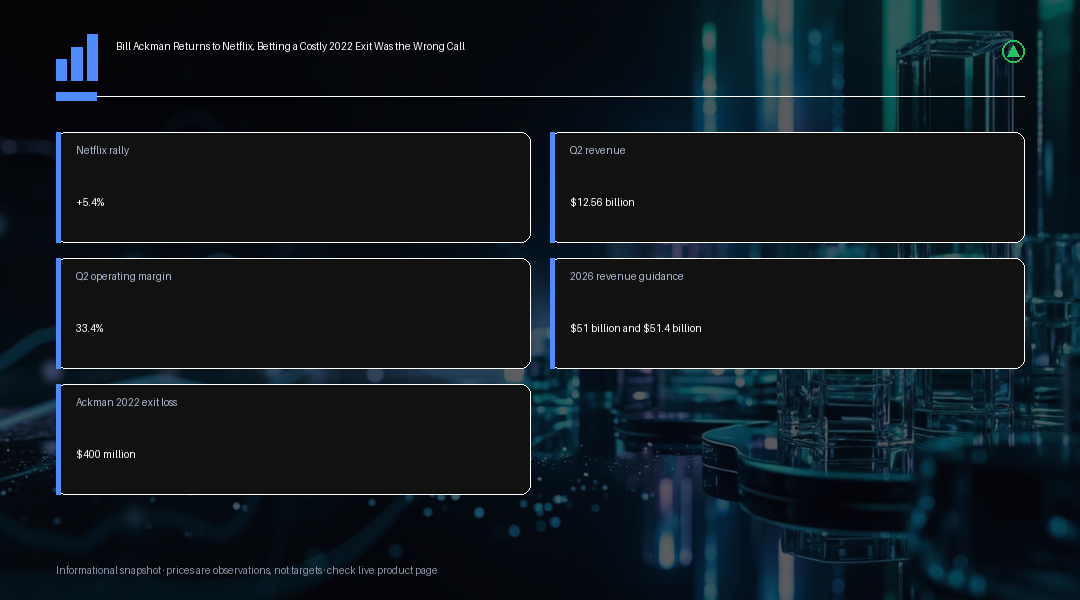
Netflix shares surged 5.4% Thursday after Bill Ackman revealed a new position through Pershing Square, a reversal that carries real personal history. The exact size of the new stake was not disclosed, but Netflix was one of six fresh investments as Ackman deployed nearly $5 billion of capital following his US fund's listing in April. The timing matters as much as the trade itself: Ackman previously bought Netflix during its 2022 subscriber-growth meltdown, then exited only three months later at a loss of roughly $400 million once slowing subscriber additions shattered his original investment thesis. Four years on, he is effectively pressing play on the same idea from a very different starting point.
The new position arrived after Netflix shares had already fallen sharply, down roughly a third to a half from their 2025 peak, giving Ackman a materially lower entry point than his first attempt. His stated rationale centers on a dominant global streaming platform with recurring subscription revenue, meaningful pricing power, and free cash flow that continues to grow even as content spending remains elevated. In value-investing terms, the argument is that the business has kept improving while the share price absorbed a disproportionate amount of bad sentiment, creating a gap between fundamentals and market perception that a patient, concentrated investor can exploit.
Ackman's broader approach at Pershing Square has long emphasized a small number of large, concentrated positions in businesses he believes the market has mispriced, rather than a diversified basket of smaller bets. Deploying capital into six new positions at once following the US fund's April listing represents an unusually active start for a strategy built around patience and concentration, suggesting Ackman saw a broader window of dislocated valuations across several names rather than a single isolated opportunity. Netflix's inclusion in that group signals that, in his view, the streaming giant's recent share-price weakness had become disconnected from an underlying business that is still compounding revenue, margins, and free cash flow at a healthy pace.
The underlying numbers give that thesis some real support. Netflix generated $12.56 billion of second-quarter revenue, up 13% year over year, while net income rose 9% to $3.4 billion. A 33.4% operating margin shows that streaming, once dismissed as a low-margin content-spending arms race, can produce serious and durable profitability once a platform reaches sufficient scale and pricing discipline. Management's guidance for the current year calls for revenue between $51 billion and $51.4 billion, a 31.5% operating margin, and approximately $12.5 billion of free cash flow, a combination that would mark a meaningful step up in both the scale and the quality of Netflix's earnings.
Advertising remains the next major growth lever management is trying to pull. Netflix is targeting roughly $3 billion of ad revenue this year as it builds out its lower-priced, ad-supported tier and expands its advertising technology partnerships. That target is meaningful in absolute terms, but monetization of the ad-supported audience has developed more slowly than some analysts initially expected, even as the advertiser base on the platform continues to expand. The gap between subscriber growth on the ad tier and actual ad-dollar conversion is one of the more closely watched execution questions heading into the back half of the year.
Engagement is the other place where the bull case still has work to do. Netflix members watched more than 97 billion hours of content during the first half of the year, only 2% above the prior year's already-large base, a growth rate that lags the platform's revenue and subscriber momentum. Netflix's own position is that viewing quality and monetization per hour now matter more than simply accumulating raw hours, and that a mature, high-penetration streaming market naturally produces slower hours growth even as revenue per member keeps rising through price increases and advertising. Skeptics counter that stalling engagement can eventually show up in retention and pricing power if it persists for several more quarters.
Content spending remains the other variable worth tracking alongside subscriber and advertising trends. Netflix's ability to keep expanding operating margin toward the 31.5% full-year target while continuing to fund a global content slate, live programming, and gaming initiatives will show whether the platform's cost discipline is structural or simply a function of a lighter content-investment year. Investors who lived through the 2022 drawdown remember how quickly sentiment can shift when subscriber growth disappoints, which is part of why the market is treating this second Ackman disclosure as informative rather than decisive on its own.
There is also an irony in Ackman's own current position. He is attempting this comeback while his own listed fund, Pershing Square USA, has itself lagged the broader market, down about 3.5% through July even as the S&P 500 posted a double-digit percentage gain over the same period. That performance gap adds pressure on his newer, high-conviction bets, including this renewed Netflix position, to work relatively quickly and convincingly if the fund is going to close the gap with a strongly performing benchmark before year-end.
Put together, Ackman's return adds a credible, closely watched name to Netflix's shareholder base and reinforces the narrative that the stock's steep decline from its 2025 peak has pushed valuation back into a range that value-oriented investors find attractive. It does not, on its own, remove the execution risk sitting inside the company's own guidance. Advertising monetization, engagement trends, the durability of recent price increases, and the path toward the stated 31.5% operating margin target are the specific threads that will determine whether this second Ackman trade plays out differently from the first one.
Trading Insight
For traders, the setup here is less about the headline 5.4% pop and more about whether Netflix can convert already-strong headline numbers into the specific milestones management has promised. The 2026 guidance of $51 billion and $51.4 billion in revenue, a 31.5% operating margin, and roughly $12.5 billion of free cash flow provides clear, trackable benchmarks each remaining quarter this year, and any meaningful miss against those targets would undercut the improving-fundamentals argument that is drawing high-conviction investors back in. Advertising is the most binary swing factor: a visible acceleration toward the $3 billion ad-revenue target would support further re-rating, while continued slow monetization despite advertiser growth would keep engagement and ad-tier execution as the market's central concern. Watch the 97 billion hours viewing base and its growth rate each quarter as a proxy for whether recent price increases are being absorbed without denting usage. Because the stock is already well off its 2025 peak, further downside from current levels would need a genuine deterioration in these operating metrics rather than just sentiment, while confirmation of the trends already visible in the second-quarter results would tend to validate Ackman's renewed, larger-scale bet. Position sizing should also account for the fact that a single high-profile investor's disclosure, on its own, does not change Netflix's underlying execution risk.