


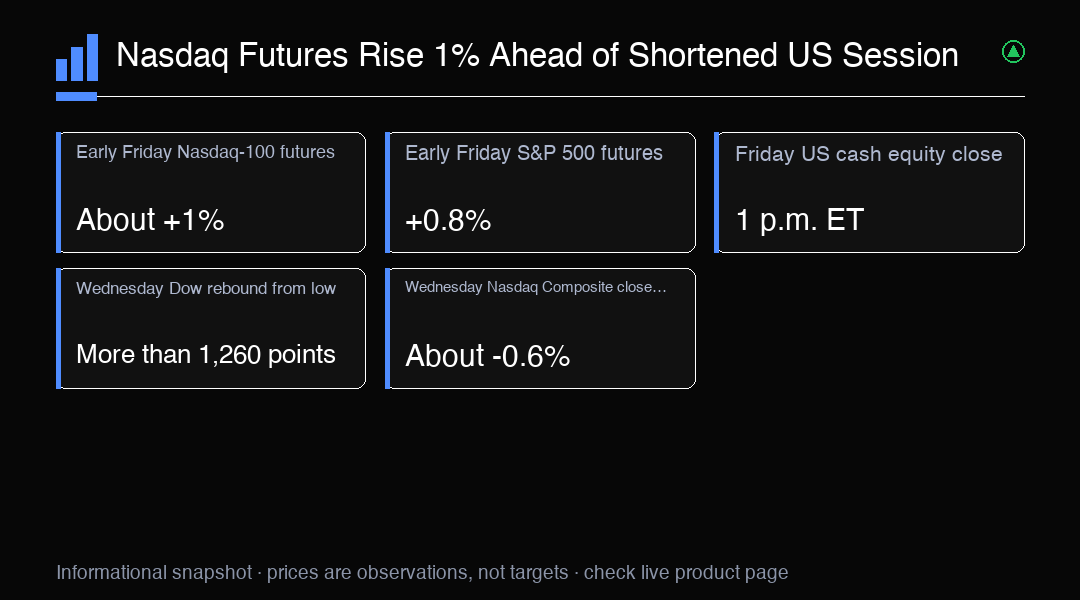
Nasdaq-100 futures rose about 1% in early Asian trading Friday, while S&P 500 futures gained 0.8%, as Wall Street prepared to reopen after Thanksgiving. US cash equities were closed Thursday and are scheduled to finish trading at 1 p.m. ET Friday. The futures gains followed a Wednesday session in which the Dow staged a sharp reversal and the Nasdaq Composite finished lower. The abbreviated session will test whether buying in individual shares extends across industries once regular US trading resumes.
The early Nasdaq-100 futures move reflects trading in a contract linked to the index. Futures can respond to changes in expectations for US equities before the regular cash session opens, when investors can see how the underlying shares are trading. The Nasdaq Composite covers a wider set of Nasdaq-listed stocks, and its performance can differ from that of the Nasdaq-100 during the same session. Comparing Wednesday’s Composite close with Friday’s early Nasdaq-100 futures reading therefore spans different benchmarks as well as different trading periods.
Wednesday’s results showed how uneven a recovery can look across benchmarks. The Dow rebounded more than 1,260 points from its intraday low to finish higher, while the Nasdaq Composite ended about 0.6% lower. Those outcomes establish that the Dow’s reversal coincided with a loss elsewhere in the market. The closes still leave open how many stocks shared in the rebound and whether most Nasdaq losses were concentrated in a few companies or spread across many listings. Those questions matter for assessing whether the holiday reopening brings wider participation.
The size of the Dow’s swing also depends on the starting point. The rebound measures the distance from Wednesday’s intraday low to the close. The daily return uses the previous close as its reference. A steep drop during a session can leave room for a large recovery in points even when the daily gain is modest. An investor who entered near the low would experience much more of that recovery than someone who already held the same exposure at the previous close. Both measurements describe the same session from different starting prices.
For individual US stocks, Wednesday’s close is the last regular-session reference before the holiday. Friday’s opening trades can reflect orders accumulated over the break and changes in the prices buyers and sellers are willing to accept. As more shares begin trading, the opening move gives way to a fuller picture of which prices attract buyers and where sellers are willing to step in. Companies facing their own developments can open with a very different balance of orders from the one implied by the broad futures move.
A shortened holiday session can make price moves harder to interpret. When fewer participants are active, there may be fewer orders available around the last traded price. An order that would normally find enough buyers or sellers at nearby prices can then move the market farther before it is filled. Wider gaps between bids and offers can add to the effect. Thinner trading can amplify gains when buyers dominate and sharpen reversals when sellers appear. The amount available to trade near prevailing prices helps explain why even modest orders can sometimes produce large price changes.
Volume comparisons call for similar care. A shortened day has fewer hours in which to accumulate turnover, and trading activity can vary considerably over the course of a session. Comparing turnover over equivalent stretches of trading helps account for the tighter schedule. A burst of activity at the open can reflect orders waiting for the market to reopen. Steady turnover later in the morning would show that investors remained active once the opening rush passed. Trading near the close can also reflect the earlier deadline for portfolios that need to finish executing orders during the regular session.
Nvidia faces a company-specific risk as the sector attempts to rebound. A halt in shipments of servers containing Nvidia chips to some Southeast Asian markets was reported, bringing export licensing back into focus. The commercial effect of any interruption would depend on the products and destinations involved, the customers affected and the duration of the halt. In server sales, licensing can depend on the destination and the end user. Those details help determine how much of a supplier’s order book could face a delay and whether customers have other ways to obtain the computing capacity they need.
For server makers and their customers, the distinction between a delayed delivery and a lost order has practical consequences. If a system ships later, a delay could shift when a supplier recognizes revenue and when the buyer can put that computing capacity to work. If a customer cancels or changes its order, the effects can extend to the number of systems sold and the mix of components used. Suppliers can also incur costs from holding completed inventory for longer. The effect on earnings depends on the contractual terms and the options available to each customer.
Large constituents can contribute disproportionately to an index return, so the distribution of gains matters when assessing the technology rebound. The number of advancing stocks measures how widely buying is spread. Performance outside technology shows whether the improvement extends to other industries. Within technology, the distribution of gains across chipmakers, hardware suppliers and software companies gives a finer view of demand for the sector. If weakness clusters among businesses with similar export exposure, that would tell investors something different from a decline that reaches companies with unrelated products and customers.
Friday’s cash close will provide a fresh reference for assessing the week’s recovery. Each index’s change from Wednesday’s close will measure the post-holiday session, while its change from the previous week’s close will also account for the earlier losses and reversals. A gain over one session can coexist with a decline over the week if the advance recovers only part of the lost ground. The distance between Friday’s opening and closing levels will also show how much the cash market added to or gave back from its opening move before the shortened session ended.
Trading Insight
The share of stocks that hold above their opening prices into the early close can show whether buying continued after the opening gap. A stock can finish higher than Wednesday’s close even after falling during Friday’s session.