


Technology heavyweights Microsoft and Alphabet are set to report third-quarter results on Wednesday after the Federal Reserve's policy announcement, shifting the spotlight onto cloud growth, capital spending and cash generation. The pair bookends a week that already includes the first estimate of third-quarter US GDP and the September PCE inflation reading, so the bar for a positive market reaction looks high. S&P 500 futures edged slightly higher early Monday, while Nasdaq-100 futures were broadly flat, suggesting tentative positioning ahead of the cascade of events.
Friday's session painted a cautious backdrop. The S&P 500 closed at 7,623.68, down 0.5%, while the Dow Jones shed 653 points, or 1.2%, and the Nasdaq Composite slipped 0.2%. The selling had spread beyond technology, indicating that the rotation was not driven solely by AI-related weakness. Market breadth was narrow and the advance-decline line struggled to keep pace with the major benchmarks, a dynamic that makes any earnings-driven bounce more fragile than it might otherwise appear.
Microsoft's fiscal first-quarter consensus stands near $90.6 billion in revenue and $4.71 in adjusted earnings per share, implying roughly 17% revenue growth and 14% earnings growth. The key line items to watch are Azure growth and the capital-expenditure outlook. Azure's benchmark is 45% growth at constant exchange rates based on Microsoft's prior guidance, and management has repeatedly noted that demand continues to exceed available capacity, which is the core reason investors are willing to fund such heavy spending. Any sign that the growth engine is cooling would weigh heavily on the tech tape, especially after the recent underperformance in chip names.
Capital expenditure is the other swing factor for Microsoft. The company previously flagged more than $50 billion in quarterly capex, a figure that includes the impact of lease-accounting changes, and that scale makes the outlook consequential not only for Microsoft but for chipmakers and data-center suppliers whose order books depend on the trajectory of AI infrastructure demand. Investors will therefore read through the headline numbers to the colour on the buildout, and they will be listening closely for any indication that spending is being pulled forward or pushed back.
Alphabet faces a different set of questions. Third-quarter expectations are $127.9 billion in revenue and $3.00 per-share earnings, or about 25% sales growth and 4.5% earnings growth from a year earlier. Search advertising, YouTube and Google Cloud provide three distinct demand streams, and the market is keen to see whether AI-driven search monetisation is translating into measurable revenue acceleration beyond the cloud unit. The search query market has been absorbing AI traffic at an accelerating clip, but the monetisation question is still being settled live.
Google Cloud enters the report after an exceptionally strong quarter, with revenue rising 82% to $24.8 billion in the three months through June. Wednesday's results will show whether that momentum carried into the third quarter. Search remained central to funding the expansion: search and other advertising revenue grew 17% last quarter while YouTube advertising increased 13%. The market will examine whether AI features continue to lift engagement and advertising opportunities, or whether growth is normalising as the base effects fade.
Alphabet's cash-generation profile has attracted scrutiny after a wide quarter. The company's last annual capex forecast of $195 billion to $205 billion was raised in July, and second-quarter operating cash flow of $39.1 billion was swamped by $44.9 billion in capital expenditure, leaving negative free cash flow of roughly $5.9 billion. How management frames the trade-off between growth and shareholder returns will feed directly into the valuation conversation, and investors are likely to push for more clarity on the sustainability of that cash burn.
Reported profit also needs closer reading. Alphabet's June-quarter earnings per share reached $9.11, boosted by large unrealised investment gains. Those mark-to-market adjustments can make sequential comparisons misleading, so investors are likely to focus on the underlying operating performance rather than the headline EPS figure. The same dynamic applies to Microsoft, where one-off items often obscure the core recurring metrics that analysts use to build their models.
The timing of the earnings adds weight to the session. The Fed announces its decision at 2 p.m. ET, with Microsoft and Alphabet reporting in the evening. Traders will be parsing the Fed's tone for clues on the December rate outlook and then immediately turning to the earnings numbers to gauge whether the AI investment cycle is still on track. The sequence concentrates a great deal of macro and micro data into a single trading session, and the options market has priced in a wide range of outcomes.
Market breadth offers a useful cross-check. Broader tech indices have been underperforming, with the Philadelphia semiconductor index extending its decline from earlier in the week. If either Microsoft or Alphabet can deliver guidance that reaccelerates growth expectations, it could provide enough lift to stabilise the tech complex. A miss on either capex or Azure metrics, however, would likely extend the recent underperformance and could add further pressure to the already-fragile sentiment around AI spending.
Options positioning around the earnings suggests an expectation of big moves. Implied volatility on both names has ticked up ahead of the reports, and the options market is pricing in sizeable after-hours ranges. For traders who prefer to manage rather than predict direction, the elevated premiums create an environment where income strategies and spread structures may outperform straight directional bets. The skew is leaning slightly positive for both names, consistent with the market pricing in a modest upside surprise.
Overall, the confluence of a Fed decision, tier-1 earnings and inflation data makes this one of the denser macro-week openers of the quarter. The market is already pricing in a meaningful reaction, so the path of least resistance for tech stocks likely hinges on whether Microsoft and Alphabet can reframe AI spending as a sustainable rather than a frothy growth story. The $90.6 billion revenue figure for Microsoft and the $127.9 billion mark for Alphabet are the headline thresholds to clear, with Azure's 45% growth target and Google Cloud's momentum the secondary checkpoints.
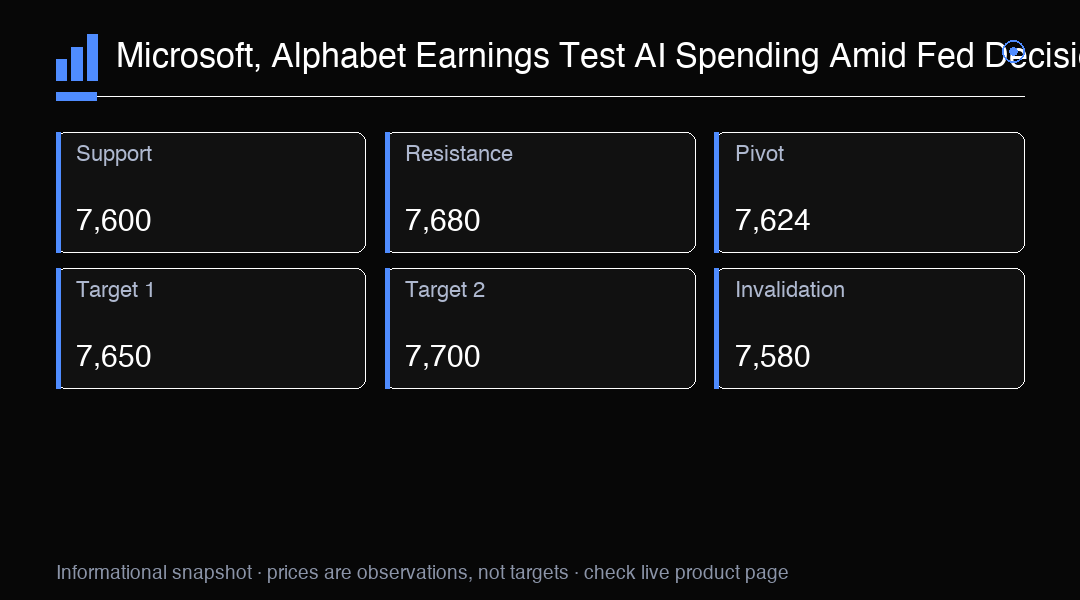
Trading Insight
Microsoft ($90.6B revenue, $4.71 EPS) and Alphabet ($127.9B, $3.00 EPS) report after the Fed; Azure 45% growth and $50B+ capex are key for tech direction. S&P 500 sat near 7,624.