


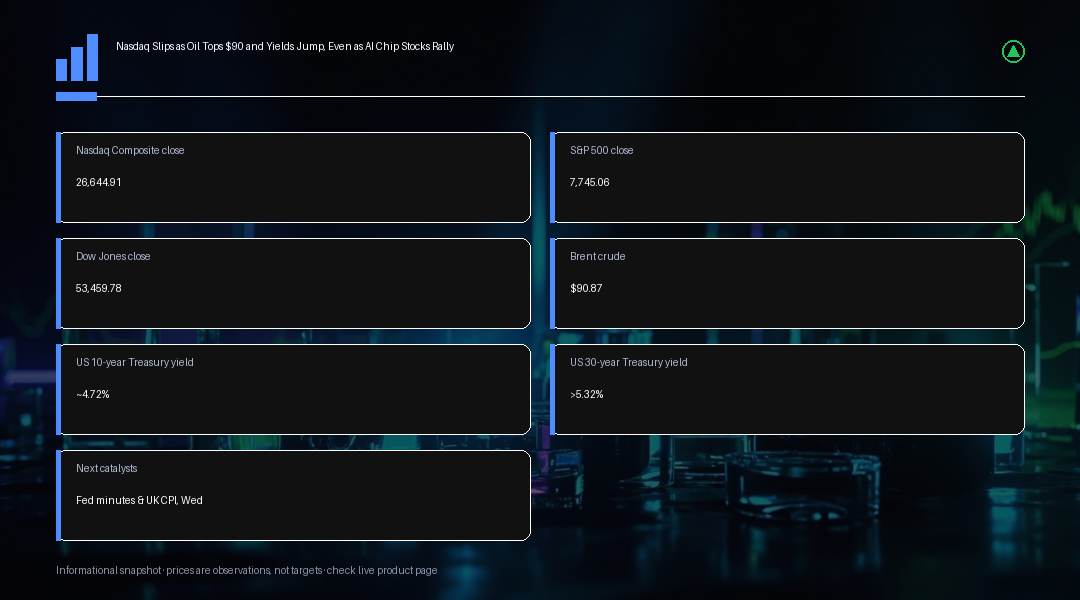
Wall Street's three major indexes retreated Monday as the expiry of the US-Iran ceasefire and stalled Middle East talks pushed oil prices and bond yields higher, overshadowing a pocket of strength in AI-linked chip and memory stocks. The Nasdaq Composite fell 0.3% Monday to 26,644.91, while the S&P 500 and the Dow each lost 0.5%, closing at 7,745.06 and 53,459.78.
Brent crude broke above $90, closing at $90.87, a gain of roughly 2.7% on the session and a level widely rounded to $91 in market commentary, while WTI crude traded near $85. The move followed Washington's decision not to extend its ceasefire with Iran, with Tehran describing its posture as fully offensive, continued restrictions on shipping traffic through the Strait of Hormuz and additional reported disruptions near the Red Sea adding to supply concerns. It is worth being precise that this reflects an expired ceasefire and stalled negotiations rather than a formal declaration of a new war, though markets are treating the geopolitical risk premium as elevated regardless of the exact diplomatic characterization.
Higher oil prices flowed through directly to the bond market. The US 10-year Treasury yield pushed toward 4.72%, while the 30-year yield pushed above 5.32%, its highest level in roughly two decades. Rising yields are a particular headwind for growth-heavy technology valuations, because distant future profits become less attractive to discount back to the present when investors can earn a meaningfully higher return from holding government debt in the meantime.
Not every part of the market moved lower. Sandisk surged 8.9%, Marvell gained 5.5% and Micron added 4.1%, continuing a rally in AI-linked memory and chip names that has been building on the back of accelerating artificial-intelligence infrastructure spending. Anthropic's disclosure that its annualized revenue run rate had topped $65 billion in July added to the broader narrative around how quickly AI compute demand is scaling, even though that figure is a projection based on recent revenue rather than an audited annual result. SpaceX shares also added 4.4% after regulatory filings revealed sizeable institutional stakes from Harvard, Nvidia and Norway's sovereign wealth fund, reinforcing the same AI-and-space-infrastructure investment theme running through Monday's session.
Reddit officially joined the S&P 500 on Tuesday after surging nearly 13% on the announcement, a move that creates mechanical buying demand as index funds are required to acquire the stock to track the benchmark accurately. That kind of forced, passive buying can provide a short-term tailwind independent of the company's underlying fundamentals, and is worth distinguishing from demand driven by active investment decisions.
The pressure was not confined to the United States. Asian markets broadly reversed earlier gains on Tuesday, with Japan's Nikkei sinking 1.6% and the wider regional benchmark slipping 0.3%, while South Korean shares finished close to flat. Japan's own 10-year government bond yield climbed to a roughly three-decade high near 2.94%, illustrating how the rise in global yields and energy costs is spreading well beyond US markets and hitting economies that rely heavily on imported energy especially hard.
Elsewhere, the dollar firmed modestly as investors sought safety, while gold, Bitcoin and Ether each slipped about 0.3%. Gold's softness despite elevated geopolitical tension is consistent with the broader move in yields: a non-yielding asset like bullion becomes comparatively less attractive when government bonds are paying investors meaningfully more to hold them. The muted reaction in both gold and major cryptocurrencies also suggests that Monday's move was read by markets primarily as a rates-and-inflation story rather than a broader flight-to-safety event, which is consistent with the relatively contained, sub-1% declines seen across the major US equity indexes.
Looking ahead, Home Depot's earnings lead Tuesday's US corporate calendar, followed by Target and Lowe's on Wednesday and Walmart on Thursday, giving investors a fresh read on the health of the American consumer. Wednesday also brings minutes from the Federal Reserve's most recent policy meeting alongside the latest UK inflation data, both of which carry the potential to move global yields and equity sentiment further before the week is out.
Retailer earnings carry extra significance this week given the backdrop of rising energy costs. Higher gasoline and transport prices tend to squeeze discretionary household budgets, and investors will be watching commentary from Home Depot, Target, Lowe's and Walmart closely for any early signs that consumers are trading down or pulling back on big-ticket purchases. A resilient set of results would help offset some of the macro anxiety created by the oil-and-yields move, while weaker guidance would reinforce the market's current cautious tone and could add further pressure to already-stretched growth-stock valuations.
From a technical standpoint, MC Markets' desk view treats the 26,600 area as near-term support for the Nasdaq Composite, with a deeper floor near 26,000 should the oil-and-yields pressure intensify. On the upside, a recovery back above 27,000 would be needed to suggest the index has meaningfully shaken off Monday's retreat, a level that would require both a cooling in oil prices and a more stable bond market to be realistically in reach.
The split between the broad index decline and the pocket of strength in AI-linked chip and memory names is itself a useful read on current market psychology. Rather than a uniform risk-off session, Monday looked more like a rotation, capital moving away from long-duration, rate-sensitive growth exposure broadly while still finding its way into a handful of names seen as direct beneficiaries of accelerating AI infrastructure spending. That kind of selective positioning tends to be more fragile than either a clean rally or a clean sell-off, since it depends on the market continuing to draw a sharp distinction between AI-adjacent hardware suppliers and the broader technology complex, a distinction that can blur quickly if sentiment shifts.
The knock-on effects in Asia are also worth watching closely heading into the rest of the week. Japan's 10-year yield reaching a roughly three-decade high alongside a sinking Nikkei suggests that the same yield-driven pressure weighing on US growth stocks is being felt even more acutely in a market that had been supported for years by comparatively low borrowing costs. If that trend continues, it could feed back into global risk sentiment and add another layer of volatility to what is already a data-heavy week for US and UK markets alike.
Trading Insight
For traders, this week's setup is dominated by the interaction between the oil market and bond yields, rather than by any single equity catalyst. A further push in Brent crude above the $91 area, particularly if Hormuz shipping disruptions escalate, would likely keep Treasury yields elevated and extend pressure on growth-heavy Nasdaq names, even if AI-linked chip and memory stocks continue to outperform on a relative basis. Conversely, any sign of a diplomatic de-escalation that eases the oil-supply risk premium could quickly relieve pressure on yields and give the Nasdaq room to test the 27,000 area. Wednesday's combination of Fed minutes and UK inflation data adds a second layer of risk, and because the Fed minutes describe a meeting that predates this week's oil-driven yield move, traders should weight the actual market reaction to yields and the dollar more heavily than the tone of the minutes themselves. The run of US retail earnings from Home Depot through Walmart will also help clarify whether consumer spending can hold up against higher energy costs, a factor that could reinforce or undercut the current cautious equity tone depending on how the results land.