


US equity futures were little changed to modestly higher early Wednesday as investors awaited July's Consumer Price Index report after megacap technology shares led Tuesday's pullback. The setup captures a market that remains constructive on the AI trade but is now waiting for a single inflation print to help decide the next move for rates and, by extension, for growth-heavy indexes.
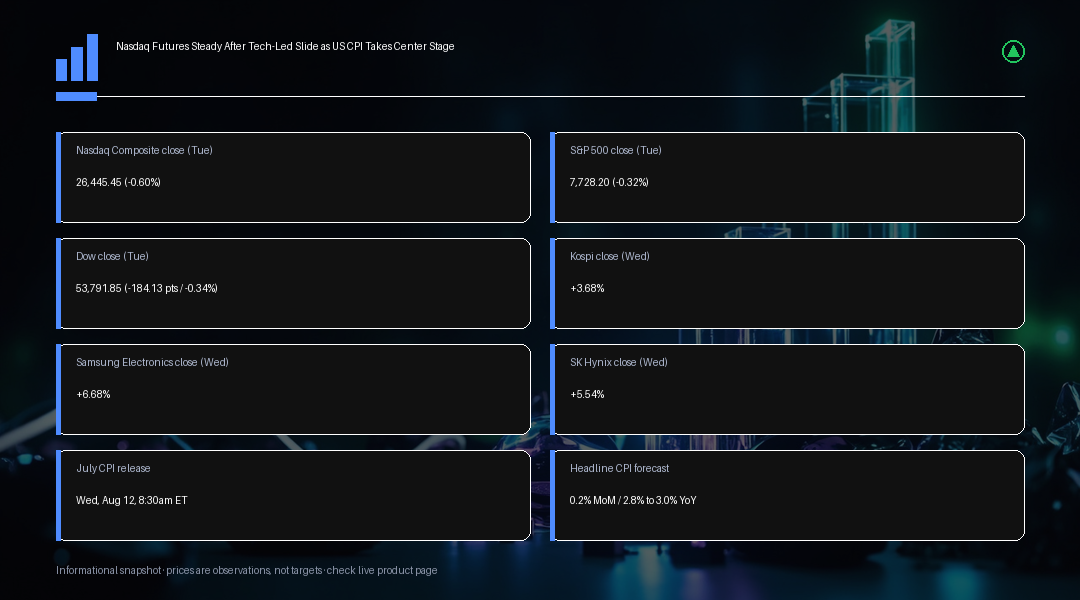
Tuesday's session was a straightforward technology-led decline. The Nasdaq Composite fell 0.60% to close at 26,445.45, the S&P 500 slipped 0.32% to close at 7,728.20, and the Dow Jones Industrial Average dropped 184.13 points, or 0.34%, to close at 53,791.85. Alphabet fell about 3.8%, Amazon declined roughly 2.1%, and SpaceX, whose shares trade through private and secondary-market channels rather than a conventional public listing, fell close to 3.9%.
Renewed pressure in oil markets did much of the damage. Brent crude briefly touched roughly $90 a barrel intraday as optimism faded around a quick resolution involving the Strait of Hormuz, before slipping back below that level later in the session. Higher energy costs matter well beyond the energy sector itself, since they threaten to add fresh inflation pressure at a moment when markets are already trying to read the Federal Reserve's next move, and expensive-growth technology valuations tend to be especially sensitive to any shift in that outlook.
The divergence between megacap technology names and the rest of the market is a thread worth following into the rest of the week. When a handful of very large technology stocks drive most of an index's decline while participation elsewhere holds up better, it typically points to profit-taking or repositioning within a specific sector rather than a broad shift in risk appetite. That distinction matters for how traders read Tuesday's session heading into Wednesday's inflation data, since a genuine broad-based risk-off move and a narrower megacap-specific pullback tend to resolve very differently once the immediate catalyst, in this case the looming CPI report, has passed.
Beneath the headline decline, participation was not uniformly negative. Trading desks described a more mixed session than the megacap-driven index moves suggested, with smaller and mid-sized companies holding up comparatively better than the largest technology names, consistent with a rotation story rather than a broad risk-off move.
Asian markets moved firmly higher into Wednesday, led by South Korea. The Kospi closed up 3.68%, with Samsung Electronics finishing 6.68% higher and SK Hynix up 5.54%, both chipmakers briefly trading more than 7% higher intraday before gains moderated into the close. The rally reflected renewed enthusiasm for AI-memory demand, the specialized chips used to feed data through AI models.
CoreWeave added to the overnight AI-trade momentum after the cloud-infrastructure provider reported second-quarter revenue of approximately $2.575 billion, up 112% year over year, and raised full-year 2026 revenue guidance to $12.4 billion to $13.2 billion. Shares moved sharply higher in after-hours and premarket trading following the release, reinforcing the same AI-infrastructure demand narrative that has supported chip and cloud names through the week.
The next major catalyst is Wednesday's July CPI report, due at 8:30 a.m. Eastern time. Consensus forecasts call for headline inflation of roughly 0.2% month over month and around 2.8% to 3.0% year over year, with core inflation, which excludes food and energy, expected near 0.2% monthly and around 2.7% to 2.9% annually. These figures remain forecasts rather than confirmed data until the release itself.
How markets interpret the print matters as much as the print itself. A cooler-than-expected reading would likely support Treasury yields staying contained, reinforcing the case that the Federal Reserve can remain patient, which tends to favor duration-sensitive growth stocks clustered on the Nasdaq. A hotter reading, especially alongside oil prices that remain elevated, would put upward pressure on yields and revive discussion about the pace of further policy tightening, a combination that has historically weighed disproportionately on high-multiple technology names relative to more value-oriented benchmarks like the Dow.
Positioning ahead of the print also deserves attention. Markets have spent the past several sessions balancing a resilient AI-infrastructure demand story, reinforced again by the South Korean chip rally and CoreWeave's results, against the risk that firmer energy prices complicate the inflation outlook just as the Federal Reserve is trying to judge how much further tightening, if any, is still appropriate. That tension is precisely why a single data release carries outsized importance this week: it will either confirm that inflation is cooling enough to let the central bank stay patient while AI-driven earnings carry the market higher, or it will reintroduce a rates-versus-growth debate that has been mostly absent from recent sessions.
Trading Insight
The setup into Wednesday's CPI release is genuinely two-sided. On one hand, South Korea's chip-led rally and CoreWeave's earnings beat both reinforce that underlying AI-infrastructure demand remains strong, and that combination is likely why futures firmed even after Tuesday's megacap-led pullback. On the other hand, oil's move back toward $90 a barrel introduces a fresh inflation variable that was not fully priced a week ago, and the Nasdaq's heavy weighting toward long-duration growth stocks makes the index especially sensitive to any surprise on the hotter side of the CPI consensus. Traders should treat the actual headline and core prints, not just the consensus estimates, as the key catalyst for the rest of the week, since a print that lands meaningfully above the roughly 0.2% monthly and 2.7% to 2.9% annual core estimates would likely pressure yields higher and could quickly erase Wednesday's early futures gains, while an in-line or softer print would probably let the AI-driven rally in chips and cloud infrastructure names continue to lead. Keeping an eye on oil alongside the inflation data is also worthwhile, since a renewed push through $90 a barrel on further Strait of Hormuz uncertainty would complicate the inflation picture regardless of what Wednesday's CPI report itself shows. Traders should also watch how Treasury yields and the dollar react to the print rather than looking at equities in isolation, since a move in either would help confirm whether the market is treating the data as decisively hawkish, decisively dovish, or genuinely in line with the consensus estimates. Because megacap technology names carried most of Tuesday's decline while broader participation held up better, a clean CPI outcome that removes the immediate inflation overhang could see that leadership rotate back toward the same large-capitalization AI names that have driven most of the index's gains this year.