


Intel reminded Wall Street it still knows how to surprise.
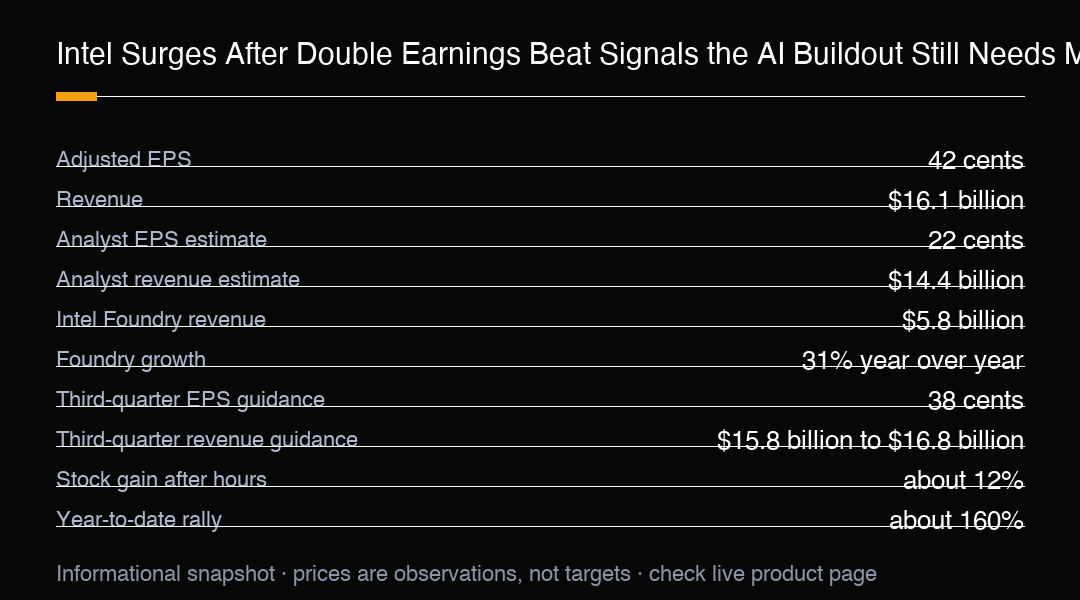
The American chipmaker reported adjusted earnings of 42 cents per share on $16.1 billion in revenue, beating expectations of 22 cents and $14.4 billion, sending the stock as much as 12% higher after hours. For a company that posted a quarterly loss only a year earlier, the turnaround is nothing short of remarkable. The stock had been written off by many investors as a fading industrial name, and the earnings report forced a rethink.
A year ago, Intel was still struggling with excess inventory and weakening demand for traditional PCs. Fast-forward 12 months and the company is delivering the kind of earnings beat that investors had almost forgotten it was capable of. Revenue climbed 25%, posting its fastest growth since the third quarter of 2011. That comparison to 2011 matters because it places the current rebound in historical context. Intel is not just recovering; it is growing at a pace it has not sustained in well over a decade.
The biggest bright spot came from Intel Foundry, where revenue climbed 31% year over year to $5.8 billion, topping analyst estimates. The foundry business manufactures chips for other companies, making it one of Intel's biggest AI growth bets. That segment is important because it shows Intel is not just benefiting from AI demand, but actually enabling it for others. Foundry success also carries higher gross margins than legacy product lines, which improves the overall profitability profile.
Management also served up upbeat guidance, forecasting third-quarter earnings of 38 cents per share on $15.8 billion to $16.8 billion in revenue. Wall Street had been looking for just 27 cents and roughly $15.1 billion. Guidance often matters more than the quarter itself. Investors buy tomorrow, not yesterday : and Intel gave them plenty to think about. The forward-looking numbers suggested that demand is not a one-quarter phenomenon.
The message from management was clear: the AI buildout is not slowing down. Intel said it plans to meaningfully increase investment in equipment, clean-room capacity and advanced chip packaging substrates to support demand through this year and next. Those are capital-intensive commitments, and they signal that Intel believes the current AI cycle has more legs than skeptics assume. Equipment orders and clean-room expansions take months to deliver, so the guidance effectively locks in future revenue for semiconductor suppliers.
The stock has already rallied about 160% this year, though it still sits roughly 30% below its all-time closing high reached in June. That is a reminder of just how wild the AI trade has become. Stocks do not need to fall to be volatile, and Intel's journey from underperformer to market darling in less than a year is proof of how quickly sentiment can turn. The 160% rally was driven by repeated earnings beats and a broader rotation into chip stocks, but the pullback from the June high shows that even strong momentum can stall.
What makes the quarter notable is not just the beat, but the mix. Revenue growth was broad, not concentrated in a single customer or product line. That suggests demand is coming from multiple places : data centers, personal computers, industrial customers and foundry partners : rather than a single contract or one-off shipment. Diversified demand is usually more durable than lumpy demand, and it gives investors more confidence that the recovery can survive a slowdown in any one end market.
Intel's turnaround also matters for the broader semiconductor supply chain. Equipment makers, packaging specialists and chip-testing firms all benefit when Intel expands capacity. The company's spending plan effectively acts as a stimulus check for the industrial side of the tech world, supporting jobs and demand in sectors unrelated to final chip sales. That multiplier effect is often overlooked when investors focus only on Intel's own financials.
There are still risks. Intel operates in a brutally competitive business, and rivals such as TSMC and Samsung have deeper war chests for leading-edge manufacturing. Intel's comeback depends on execution over many quarters, not just one earnings report, and the stock can be punishing if the next guidance disappoints. The semiconductor industry is also cyclical, and a sudden inventory correction or demand pause could expose how quickly sentiment can reverse.
The AI angle is more nuanced than the headline suggests. Not all AI demand benefits Intel equally. Training large models favors the most advanced process nodes, where Intel still trails TSMC. Inference, the actual running of trained models across millions of devices, may be a better long-term fit for Intel's x86 architecture and broad customer base. Investors are betting on inference demand, and that bet is only now being tested. If inference scales as expected, Intel's foundry and client businesses could see sustained demand that supports the valuation for years.
From a risk-management perspective, Intel's improved profile also changes how traders can approach the name. Volatility has compressed after the earnings pop, which reduces option costs for buyers looking to express a bullish thesis. That makes defined-risk structures more attractive than they were during the prior downtrend. Traders who want exposure without full equity risk can use calls or spreads around support zones identified from the daily chart, especially if the next leg is driven by guidance updates rather than macro shocks.
Semiconductor capital equipment makers are another indirect read-through. If Intel's fab expansion translates into tool orders, companies in that supply chain should see improved visibility. That matters because equipment cycles often lead final product cycles by several quarters. Investors watching Intel for clues about the broader AI infrastructure buildout should therefore monitor vendor commentary and order trends, not just Intel's own guidance. The ecosystem signal is usually earlier and sometimes stronger than the headline number.
The bottom line is that Intel's quarter matters less as a single data point and more as a confirmation that the AI capex story is broadening. Foundry revenue, packaging expansion, and equipment commitments all point to a multi-year upgrade cycle. That does not mean the stock cannot pull back, but it does suggest the risk/reward has shifted in favor of bulls on dips. For traders, the practical task is now to identify what news or data would break that narrative, and to watch for those catalysts as closely as they watch the earnings headline.
Trading Insight
Intel's earnings underline that AI infrastructure demand remains robust, with capex now broadening beyond the usual hyperscalers into foundry and packaging capacity. The beat is less about one quarter and more about sustained capacity tightness.