


Major equity indices rallied across the August 12–13 sessions because two supportive forces arrived together: US inflation data reduced immediate rate-hike pressure, while strong AI-infrastructure earnings reinforced the growth story behind technology shares. The move was real, but it was not universal—Nasdaq, the S&P 500 and South Korea's KOSPI confirmed it more clearly than the Dow, Russell 2000 or European markets.
That distinction turns a market headline into a usable framework. Traders can separate the macro engine—inflation, yields and oil—from the earnings engine, then ask whether participation is broadening. For the main technology benchmark in this setup, see the NAS100 product page.
Key takeaways
- July CPI matched expectations, and the next day's PPI reading also eased from June.
- AI-infrastructure earnings gave Nasdaq leadership a company-level catalyst.
- KOSPI confirmed the chip impulse, but weaker breadth elsewhere kept the rally selective.
What started the global indices rally?
The rally began when inflation data lowered the near-term risk of tighter US monetary policy. According to the Bureau of Labor Statistics figures reported on August 12, headline CPI rose 0.1% from June and 3.4% from a year earlier, matching economists' expectations. Core CPI increased 0.2% month over month and 2.5% year over year.
The immediate market response was constructive but measured. Associated Press closing data showed the S&P 500 up 0.3% to 7,748.50 on August 12, while the Nasdaq Composite gained 0.5% to 26,588.49. The Russell 2000 added 0.6%, but the Dow slipped less than 0.1%. In other words, the inflation print removed a threat; it did not make every index move in lockstep.
Confirmation arrived on August 13. AP reported that US producer prices were 4.7% higher than a year earlier in July, down from June's 5.5% rate and slightly better than economists expected. The ten-year Treasury yield eased to 4.65% from 4.68% late Wednesday and 4.72% on Monday. Lower long yields reduced the discount-rate pressure on growth valuations.
Why did AI infrastructure earnings matter?
Inflation opened the door, but AI earnings supplied the leadership. The macro release made higher valuations easier to carry; company results gave investors evidence that demand for computing capacity, servers and chips was still translating into revenue and guidance.
AP reported that Super Micro Computer rose 19% on August 12 after quarterly earnings per share came in 84% above analysts' expectations and management issued forecasts above consensus. CoreWeave gained 19.3% after better revenue and a smaller loss, while Nvidia added 3%. Kiplinger also recorded a 34.1% jump in Nebius after second-quarter revenue increased more than fivefold.
This explains why the Nasdaq response carried more information than a generic “stocks up” headline. AI-infrastructure companies sit close to the spending cycle that supports semiconductor, cloud and data-centre expectations. When their results improve at the same time yields fall, the earnings and valuation channels reinforce each other. The reverse is also true: a strong long-term AI theme does not prevent sharp index corrections when expectations or yields move the other way, as the earlier Nasdaq chip selloff showed.
Was this really a global rally?
It was a cross-market rally with uneven breadth, not a synchronized rise in every region and index. On August 13, the S&P 500 climbed 0.7% to a record 7,798.99, the Nasdaq Composite rose 0.8% to 26,803.03, the Dow added only 0.1%, and the Russell 2000 gained 0.2%. South Korea's KOSPI jumped 3.6%, extending a 3.7% rise reported the day before as its large chip companies amplified the AI move.
But AP also described European indices as lower and the rest of Asia as mixed on August 13. That matters because “global” should describe participation, not just the availability of indices on a market screen. KOSPI's outsized rise confirmed the semiconductor channel; weaker Europe and modest Dow/Russell gains showed that the signal had not become a universal growth or cyclical breakout.
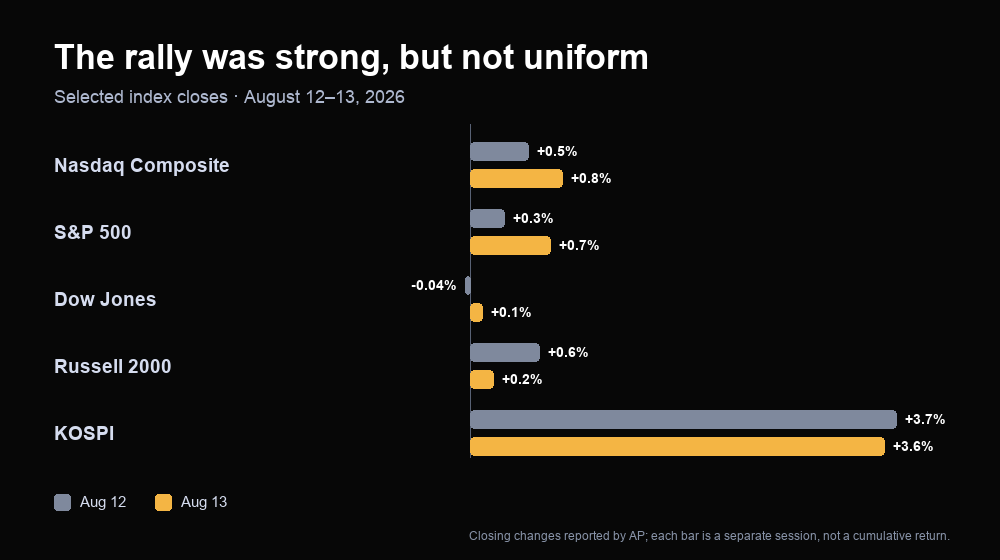
AP closing changes for separate August 12 and August 13 sessions; bars are not cumulative returns.
| Market | Aug 12 close | Aug 13 close | Breadth read |
|---|---|---|---|
| Nasdaq Composite | +0.5% | +0.8% | Technology leadership strengthened |
| S&P 500 | +0.3% | +0.7% | Broad US benchmark confirmed |
| Dow Jones | −0.04% | +0.1% | Blue-chip participation remained limited |
| Russell 2000 | +0.6% | +0.2% | Small caps did not accelerate with Nasdaq |
| KOSPI | +3.7% | +3.6% | Asian chip exposure amplified the move |
What would confirm the move next?
Confirmation requires the macro engine, earnings engine and breadth to remain aligned. A continuation does not need every index to rise by the same amount, but it should show more markets participating without yields or energy costs reversing the supportive conditions.
| Signal | Constructive confirmation | Warning |
|---|---|---|
| US 10-year yield | Holds or eases without a growth scare | Rebounds as inflation expectations rise |
| Nasdaq vs S&P | Technology leads while broad-market participation improves | Only a handful of AI names support the index |
| Dow and Russell | Begin to share the advance | Continue lagging while headline indices set highs |
| KOSPI and global chips | Semiconductor strength persists across sessions | Overnight chip weakness reverses the US lead |
| Brent crude | Remains contained after the 2.1% August 13 fall to $87.07 | Rebounds enough to revive inflation pressure |
For crypto traders, the same checklist helps avoid treating a Nasdaq rally as automatic proof of wider liquidity. Falling long yields and broader equity participation are more useful confirmation than a single technology session. If yields rise while index gains narrow, the macro tailwind is weakening even if the headline benchmark is still green.
Final thoughts
The August 12–13 rally worked because inflation and earnings told compatible stories at the same time. Softer price pressure reduced the immediate rates threat, and AI-infrastructure results gave growth investors a reason to use that opening. The next test is breadth: if more indices and regions join while yields and oil stay contained, the move becomes sturdier. If leadership contracts back into a few AI names, “global rally” remains a useful headline but an incomplete market description.