


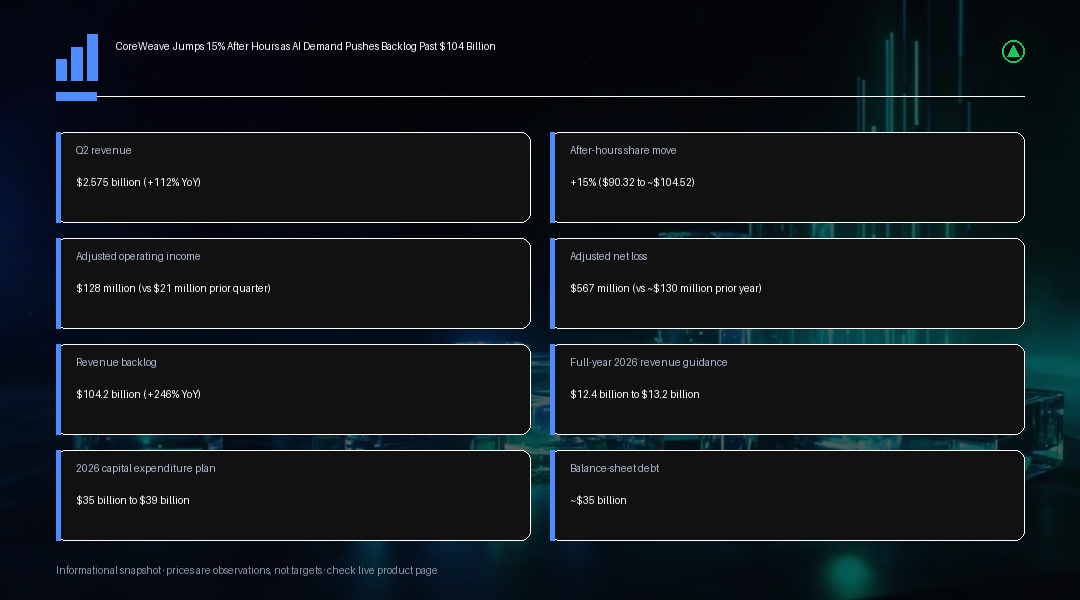
CoreWeave shares jumped about 15% in after-hours trading, moving from a regular-session close of $90.32 to an after-hours high near $104.52, after the AI-cloud infrastructure provider reported second-quarter revenue of approximately $2.575 billion, up 112% from a year earlier and above the roughly $2.56 billion Wall Street had penciled in. The reaction underscores how much of the AI trade still runs through companies that supply the computing capacity behind large models rather than the software layer built on top of them.
This marks the fifth consecutive quarter of record revenue for the company, a streak that reflects how quickly demand for specialized AI computing capacity has scaled since the current wave of large-model training and deployment began. Adjusted operating income reached $128 million for the quarter, sharply ahead of the $21 million posted in the first quarter, a sign that scale is starting to show up in profitability metrics even as the business keeps investing heavily.
The loss picture needs careful framing. Adjusted net loss widened to approximately $567 million, compared with roughly $130 million a year earlier, while the loss under standard accounting rules widened to $626 million from about $290 million in the prior-year quarter. The gap between adjusted and standard accounting losses mainly reflects the depreciation, interest expense, and other non-cash or financing-related charges that come with building capital-intensive infrastructure at this pace.
Management pointed to third-quarter revenue in the range of $3.45 billion to $3.6 billion, and raised full-year 2026 revenue guidance to a range of $12.4 billion to $13.2 billion. Both figures represent company guidance rather than independently confirmed outcomes, and should be read as management's current expectation rather than a locked-in result.
Revenue backlog, the contracted future business still awaiting delivery, reached $104.2 billion at quarter-end, up from $99.4 billion in March and roughly 246% higher than a year earlier. More than half of that backlog is now attached to contracts where customer delivery has already commenced, a more precise description than simply saying the infrastructure is active. Separately, CoreWeave added more than $25 billion of net new customer commitments early in the third quarter that are not included in the quarter-end backlog figure. Those two numbers should be viewed as related but distinct data points rather than combined into one blended total, since the newer commitments still carry their own contract terms, delivery conditions, and timing.
A newer growth line, managed inference, which effectively rents out already-trained AI models to run workloads for customers, showed some of the sharpest scaling in the business. Booked annual recurring revenue for that segment rose from roughly $1 million at launch to more than $100 million, with management targeting at least $250 million of booked annual recurring revenue by the end of 2026.
None of this growth comes cheaply. Capital expenditure reached $9.4 billion in the quarter, up from $6.8 billion in the prior quarter, and the company raised its full-year 2026 capital-spending plan to a range of $35 billion to $39 billion. CoreWeave now carries roughly $35 billion of debt on its balance sheet, a load that reflects just how capital-intensive building AI data-center capacity has become. Outside analysts have separately estimated that the company is unlikely to reach pretax profitability before 2028, an external forecast rather than company guidance, underscoring that this remains a business built on scaling first and proving durable profitability later.
The broader competitive backdrop helps explain why the market is willing to fund this level of spending in the first place. Demand for specialized AI computing capacity has been outrunning available supply for several quarters running, and companies positioned to deliver that capacity quickly have generally been rewarded with premium pricing and long-term contracts rather than the commoditized pricing that typically pressures margins in mature infrastructure businesses. CoreWeave's five straight quarters of record revenue reflect that dynamic directly, and the raised full-year guidance signals that management does not see near-term signs of that demand cooling. The open question for the stock is less about whether AI computing demand is real, this quarter's numbers argue strongly that it is, and more about whether CoreWeave can keep financing its build-out on terms that do not erode returns as competition for capital, power, and hardware access intensifies across the sector.
The combination of surging demand and surging spending is the central tension in the CoreWeave story right now. Record revenue, a record backlog, and rising booked recurring revenue all point to genuine, contracted demand for AI computing capacity. At the same time, tens of billions of dollars in annual capital spending, a widening adjusted loss, and a meaningful debt load mean the company's execution and financing decisions matter just as much as the underlying demand picture for how the stock performs from here.
Trading Insight
The after-hours reaction shows traders reading this print as a genuine demand story first and a leverage story second, but both threads are live. Revenue growth of 112%, a backlog above $104 billion, and a raised full-year outlook are hard to read as anything but bullish for near-term AI infrastructure demand, and that combination is likely why shares moved as sharply as they did once the numbers crossed the wire. The more important question for the weeks ahead is how the market treats the widening adjusted loss and the roughly $35 billion of debt against a $35 billion to $39 billion annual capital-spending plan. As long as backlog conversion stays on track and the booked annual recurring revenue in managed inference keeps climbing toward the $250 million target, the leverage looks financeable against genuine contracted demand. Any sign that data-center use is running behind schedule, that financing costs are rising faster than expected, or that the pretax-profitability timeline is slipping further than the already-distant 2028 marker analysts have floated would quickly shift sentiment from an AI-demand story to a balance-sheet-risk story. Traders should treat the next capital-expenditure update and any commentary on backlog conversion as the key signals to watch, since those are the metrics most likely to move the stock independently of the broader AI-sector narrative. Position sizing around CoreWeave should account for the fact that this stock trades on a wider band of outcomes than a typical established technology name. The bull case rests on backlog conversion, continued guidance raises, and managed inference scaling toward its own targets, while the bear case centers on the widening loss figures, the scale of the debt load, and how quickly capital costs could rise if credit markets grow more cautious about AI infrastructure financing broadly. Watching how the stock behaves around the next capital-expenditure update, rather than reacting only to the headline revenue and backlog figures, is likely to give a clearer read on which side of that range the market is currently pricing.