


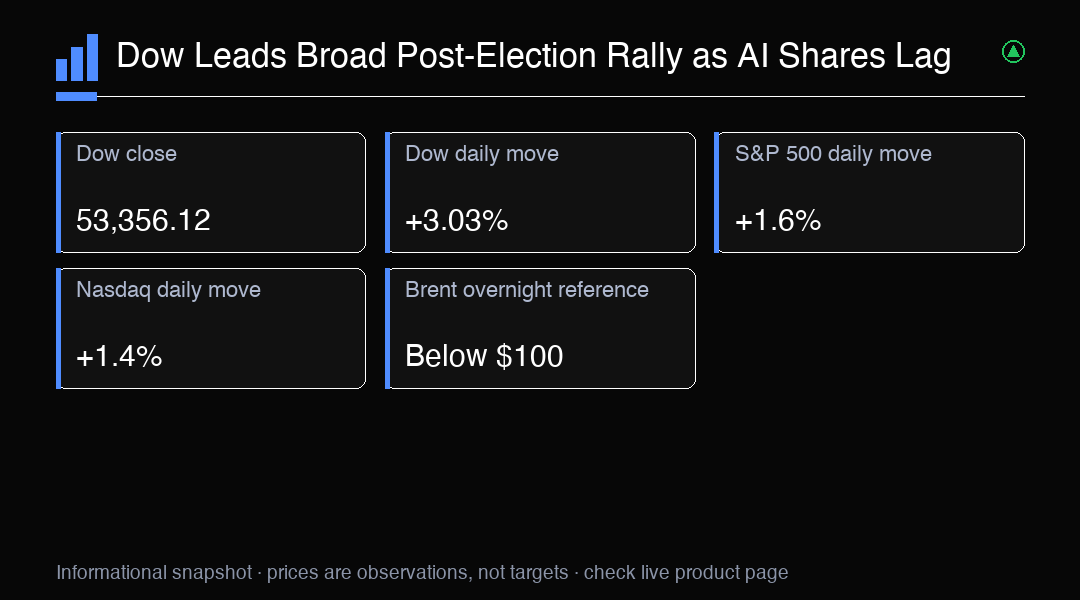
The Nov. 4 session showed how quickly markets can move from political uncertainty to relief, while also revealing that a rising index does not lift every sector. The Dow Jones Industrial Average climbed 3.03%, adding 1,569.40 points to close at 53,356.12. The S&P 500 rose 1.6% to 7,688.62, and the Nasdaq Composite gained 1.4% to 25,736.51. The Dow’s larger advance marked a strong day for established industrial, consumer and financial names relative to technology-heavy shares. Traders should read the move as a broad improvement in risk appetite, not as proof that uncertainty has disappeared or that the rally must continue.
Political expectations helped shape the response. Democrats were projected to win control of both chambers of Congress, giving investors a clearer near-term picture of the balance of power. That result was still a projection, not a certified outcome. Markets often react to the expected implications of an election before every vote is counted, but policy outcomes can take time to clarify. A strong first reaction can also reflect positions being adjusted after traders reduce exposure ahead of an event. The move therefore captures both a change in perceived risk and the mechanics of unwinding cautious positioning. Further policy details may alter how investors assess the implications for taxes, spending and regulation.
The sector mix gives the rally more substance than a gain led by only a handful of technology companies. Nine of the 11 S&P 500 sectors advanced, and consumer discretionary rose 4.27%. That breadth suggests buyers were willing to add exposure across several parts of the market. Yet breadth does not mean every industry shared the same outlook. Energy fell about 4.8%, while AI and data-center shares also weakened. A broad index can rise even when important groups are under pressure, particularly when sectors with large weights or strong daily gains offset losses elsewhere. Traders assessing follow-through can compare sector participation with index performance rather than relying on the headline close alone.
Energy weakness was one notable counterpoint to the equity advance. Brent crude fell nearly 9% overnight and traded below $100. Lower oil prices can ease near-term cost pressure for households and businesses, and that may support parts of the consumer and transport sectors. But a rapid fall in energy can also signal shifting expectations about demand or geopolitical risk. Hopes for an end to the Iran war contributed to selling, though no deal was confirmed. A hoped-for resolution is not the same as an established change in supply conditions. Traders should monitor whether crude stabilizes, extends its decline or rebounds, and consider how each path could affect inflation expectations and energy shares.
The divergence between broad US equities and technology-linked stocks also deserves attention. CoreWeave fell 9.9%, underlining how exposed some AI and data-center companies may be to changes in political expectations and development rules. A rising Nasdaq can conceal losses in individual growth themes, especially when other large constituents are stronger. The session therefore did not show a simple rotation out of all technology or a settled verdict on AI investment. It showed that investors can welcome reduced political uncertainty while still questioning specific companies’ valuations, spending plans or regulatory exposure. Traders following the theme should distinguish a company-level repricing from a change in the broader market trend.
Overnight trading in Asia showed how differently markets can interpret the same political and technology risks. South Korea’s Kospi briefly fell more than 4%, while one market snapshot put Taiwan’s benchmark about 1.8% lower. Japan’s Nikkei slipped 0.5% to 61,914.53. Concerns about possible tighter restrictions on data-center development in key US states weighed on chip-related sentiment, but the regional moves should not be treated as a uniform verdict on Asian technology. Each market has different company exposures, investor positioning and local drivers. The sharp Kospi move also highlights the possibility of fast intraday reversals. Traders should check whether losses persist through the session and whether chip shares continue to lag broader regional indices.
Company results added specific pressure to the semiconductor complex. Qualcomm reported handset revenue down 26% to $5.14 billion, and its shares were down 6.46% after hours at 16:43 ET. Its forward sales guidance was stronger, but that did not remove concerns about smartphone weakness and declining Apple-related revenue. Arm reported revenue of $1.44 billion and adjusted earnings of $0.52 per share. Its shares were down 3.05% after hours at 16:43 ET, even though results beat estimates, as investors reassessed the outlook despite the headline beat. These after-hours prices are timestamped snapshots and can change before the next regular session. The contrast illustrates why traders need to separate headline beats from the parts of a report that drive expectations.
Currency and bond-market moves provide another link between the equity rally and the decline in crude. EUR/USD traded near 1.1273 as the dollar softened. Cheaper energy may ease inflation concerns, which can support bonds and influence expectations for interest rates, but one overnight move cannot establish a lasting trend. Currency prices can respond to relative growth prospects, central-bank expectations and risk sentiment at the same time. Traders watching EUR/USD should compare its movement with changing rate expectations and incoming US data. If the dollar strengthens despite lower oil, that could point to other forces outweighing the energy effect. If it weakens further, the move still needs confirmation across subsequent sessions.
The next scheduled US releases can test whether the market’s relief holds up when attention returns to the economy. Initial jobless claims are due Nov. 5 at 13:30 GMT, or 08:30 ET. The employment report is due Nov. 6 at the same clock time on the following day. Claims offer a more frequent view of labor-market conditions, while payrolls provide a broader monthly snapshot. Neither release dictates a single market response: stronger employment can support growth expectations but may also affect views on inflation and rates; weaker figures can ease rate concerns while raising questions about demand. Traders should compare each result with expectations and watch how stocks, yields and the dollar respond together.
For US30 traders, the session offers a useful case study in reading price action alongside breadth, sector leadership and event risk. The Dow’s strong close and broad participation support the view that buyers returned after election jitters, while falling energy, weaker AI shares and mixed overnight trading show that risks remain uneven. A continuation scenario would involve gains holding across multiple sectors and the index responding constructively to upcoming data. A reversal scenario could emerge if enthusiasm fades, policy expectations shift or economic releases unsettle rate assumptions. Neither scenario is assured. Traders can manage uncertainty by setting position size around their own risk limits, defining in advance what would invalidate a trade, and avoiding decisions based on a single headline or after-hours quote.
Trading Insight
The Dow’s outperformance came with broad sector participation, but energy and AI-linked weakness show that index strength can mask sharp differences beneath the surface. Watch whether breadth holds through upcoming labor data and how US30 responds alongside the dollar and energy prices.