


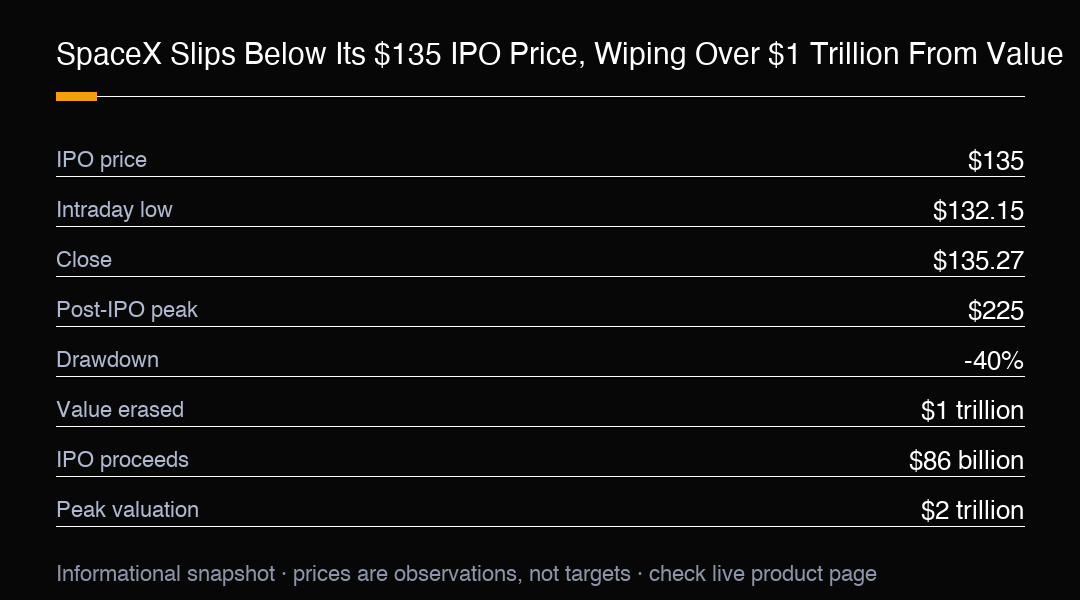
SpaceX shares tumbled this week, briefly slipping below the $135 IPO price and touching $132.15 before clawing back to close at $135.27. The move marks a sharp comedown for a stock that had been a market favourite since its blockbuster listing.
From 'to the moon' to 'please just get me back to my entry price' in a matter of weeks, the reversal has been swift. The shares have now dropped roughly 40% from their $225 post-IPO peak, erasing more than $1 trillion from the company's market value and reminding late buyers how fast sentiment can turn.
The company's bonds, issued after the record listing, have also weakened noticeably, a signal that investors are growing more selective about the group's lofty valuation and not just its share price. Credit markets are echoing the caution already visible in equities, a broader reset in how the story is priced.
The record IPO raised $86 billion at a valuation above $2 trillion, briefly making SpaceX more valuable than Amazon. Since then, excitement has met reality, and reality has been asking uncomfortable questions about price. A classic supply-and-demand worry has returned: as early investors gain the ability to sell, additional supply could outweigh demand.
Valuation concerns add to the pressure. SpaceX remains a fast-growing company, but it is still unprofitable, leaving investors to debate how much future success is already baked into today's share price. A high multiple works only if the growth keeps arriving on schedule, and the market is starting to demand proof.
The next potential catalyst comes quickly. SpaceX is preparing for its 13th Starship test flight, with the launch window opening on Thursday evening. Every successful test brings the company's biggest long-term ambition a step closer, and the reusable launch system sits at the centre of the investment case.
Starship is designed to be fully reusable, lowering launch costs while increasing payload capacity. If it performs as planned, it could unlock everything from cheaper satellite launches to futuristic concepts such as orbital AI data centres. That is the upside the market has been pricing, and the reason the valuation stretched so far.
For now, though, it remains a work in progress. Investors have heard ambitious timelines before, and markets appear to prefer proven launches over promises. The Starship flight is the near-term event that could either rebuild confidence or deepen the reassessment of just how much is already in the price.
The break below the IPO price is psychologically important. The $135 level was the reference point every new holder used to judge success, and losing it turns a symbolic milestone into a test of conviction for those who bought the debut.
For traders, the setup is a high-volatility one. A clean Starship success could spark a sharp relief rally back toward the IPO line, while another delay or failure would likely pressure the shares further and test just how much of the trillion-dollar drawdown the market is willing to tolerate before stabilising.
Liquidity has thinned as the stock traded below its debut reference, and thinner books can exaggerate swings in both directions. That raises the chance of a violent move around the Starship window, regardless of the long-term thesis.
Comparisons to other high-profile listings are inevitable, but SpaceX's scale and dual equity-and-credit market footprint make this a stress test for how much narrative the public markets will fund before demanding results.
For traders, the cleaner play may be to treat the IPO price as the line in the sand: a decisive hold above $135 rebuilds the bullish structure, while sustained trade below it keeps the burden of proof on buyers until the next flight proves the story.
The bond move deserves as much attention as the shares. When both equity and credit widen against a name at the same time, it signals a repricing of the whole capital structure, not just a mood swing in the stock, and that repricing can take time to reverse.
Longer term, the bull case has not changed; it has merely been deferred. Reusable launch at scale is still a step-change in cost, and if Starship delivers, the addressable market expands well beyond legacy satellite launch into areas few competitors can credibly chase.
The discipline for traders is to separate the thesis from the tape. The multi-year story can stay intact while the near-term chart stays messy, and trying to catch both at once usually means ignoring one; define which you are trading before the launch window opens.
For the tape, the IPO line at $135 is now resistance as much as it was support. Reclaiming it on volume would signal the worst of the repricing is over; failing there keeps the stock in the penalty box until a catalyst, most likely the Starship flight, forces a decision.
The bigger lesson for markets is about narrative risk. Few stories were more beloved than this one, and few repricings have been as abrupt; it is a reminder that the most crowded trades carry the most fragile margins of error when the facts start to disagree with the story.
Net, the SpaceX episode is a repricing, not a verdict. The company's long-term edge is intact, but the market is now demanding evidence over enthusiasm, and the coming Starship flight is the first real chance to show that the story and the price can meet again.
Heading into the launch window, the prudent stance is to let the flight speak first. The thesis does not expire this week, but the tape can, and patience around a binary catalyst is usually cheaper than a position sized for a direction the market has not yet chosen.
What makes this episode instructive is its speed. A name that defined momentum a few weeks ago now defines caution, and the swing shows how quickly the market's tolerance for unproven multiples can vanish once a clean reference level like the IPO price gives way.
In the end, patience and a clear level beat prediction. The $135 IPO line is the scoreboard; until it is reclaimed with conviction, the market will treat every bounce as a test rather than a turn.
Trading Insight
SpaceX broke under its $135 IPO price and erased over $1 trillion in value; the 13th Starship test is the next catalyst that could reset sentiment either way.