

US equity futures opened weaker as oil prices jumped after a fresh wave of US–Iran escalation headlines. Nasdaq 100 futures led the decline because an oil-driven inflation shock raised interest-rate concerns — and technology valuations are more sensitive to higher discount rates than the broader market.
The useful framing is not “war equals an automatic crash.” It is a transmission map: crude risk lifts inflation expectations, which can tighten the rate path and pressure long-duration growth assets. For live index pricing, see the NAS100 product page; for crude, see USOIL.
Key takeaways
- Oil shock → rate concerns; Nasdaq futures led US index futures lower.
- Growth and tech multiples reprice first when discount rates rise.
- Near term: does crude hold or fade, and does the cash open confirm the futures gap?
Why did Nasdaq futures fall?
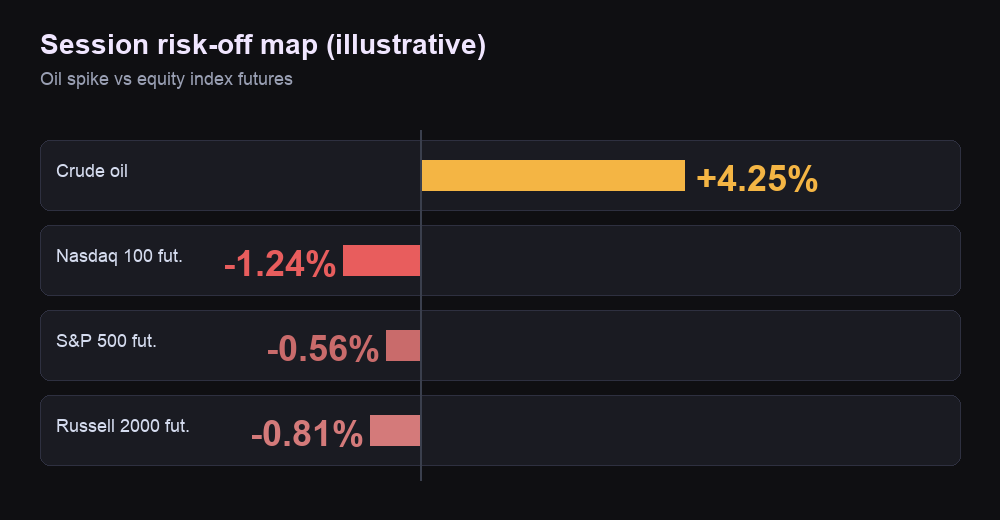
Nasdaq 100 futures fell more than broader equity futures because technology and growth valuations are more sensitive to higher interest-rate expectations. When oil jumps on supply-risk headlines, markets often reprice stickier inflation and a tighter policy path. That raises the discount rate applied to future cash flows. Nasdaq 100 valuations are generally more exposed to changes in long-term discount rates than the broader S&P 500, so the index often reacts more sharply when rate expectations rise.
In Barron’s live market coverage on Monday, July 13, 2026, S&P 500 futures were indicated about 0.3% lower, Nasdaq 100 futures about 1% lower, and Dow futures roughly flat as weekend US–Iran escalation put investors on edge into a busy market week. That hierarchy — Nasdaq leading the downside — fits a rate-sensitive growth selloff better than a uniform dump across every equity benchmark. For a related oil-and-tech tape, see Nasdaq chip pullback and oil risk.
Why do higher oil prices hurt technology stocks?
Higher oil can hurt technology stocks mainly through the inflation and interest-rate channel — not because chip companies burn barrels of crude the way airlines do. A sharp crude move can lift near-term inflation expectations. If bond markets price a stickier Federal Reserve path, long-duration growth equities often reprice first. In trader terms, Nasdaq futures become the high-beta expression of that rates shock.
On the same Monday session, reporting showed a clear oil spike after comments about reinstating a naval blockade on Iran and renewed concern over energy shipments through the Strait of Hormuz. Around midday Eastern on July 13, 2026, Economic Times reported front-month WTI crude futures near $74.20 a barrel (about +4.3%) and Brent crude futures near $79.50 (about +4.4%) — prices at a moment in the session on the active front-month contracts, not end-of-day settlements. Later the same day, CNBC coverage of the Hormuz blockade reported still larger crude moves as blockade language hardened — which is why benchmark, contract, timestamp, and timezone matter.
The same channel can reverse. When de-escalation headlines hit and oil falls sharply, equity futures — especially growth-heavy Nasdaq futures — can rebound even while geopolitical risk stays in the background. The oil price is the measurable driver; the headline alone is not. Same-week notes on the broader index complex: S&P futures slip as oil jumps.
What should traders watch next?
Watch three confirmations: crude direction, Nasdaq’s relative performance, and whether the cash open buys or sells the futures gap.
Scenario A — oil holds gains. If front-month crude keeps most of its session spike, Nasdaq futures keep underperforming S&P futures, and cash equities open soft, the inflation/rates narrative is still in charge. Dip-buying often fails until oil cools.
Scenario B — oil fades. If crude gives back a large share of the spike, Asian risk assets stabilize, and Nasdaq futures lead a reclaim, the session can shift from shock to digestion. That does not prove a new uptrend — only that short-term risk appetite is opening up again.
Scenario A fails quickly if oil reverses hard and futures recover broadly. Scenario B fails quickly if oil makes a second move higher while equity futures retest session lows with Nasdaq still leading the downside.
Futures are the first continuous pricing after a weekend or overnight shock. Cash equities can confirm, fade, or reverse that read once US liquidity arrives. Asia can tip the signal early as well: soft regional benchmarks often show up in Nasdaq futures before New York fully opens.
Session dashboard
| Market | Read (window) | Role |
|---|---|---|
| WTI crude (front-month) | ~$74.20, ~+4.3% (Jul 13, 2026 session window) | Primary risk driver |
| Brent crude (front-month) | ~$79.50, ~+4.4% (same window) | International oil benchmark |
| Nasdaq 100 futures | ~−1% (premarket, Jul 13, 2026) | Most rate-sensitive growth read |
| S&P 500 futures | ~−0.3% (same premarket window) | Broad US risk appetite |
| Dow futures | Roughly flat (same window) | Cyclical / price-weighted check |
| Rates narrative | Oil → inflation → policy path | Why tech multiples reprice first |
Session prices move over the day — later levels may differ. Live quotes: NAS100 and USOIL.
How to use the map
None of these scenarios are certainties. They are conditional maps built from oil transmission, relative index behavior, and how futures gaps behave when cash liquidity arrives:
- A futures gap lower is a hypothesis until the cash open confirms or fades it.
- If oil is the main driver, watch crude for confirmation — not only the equity candle.
- Relative strength matters: Nasdaq leading lower with oil still firm is different from a narrow tech-only move with crude already fading.