


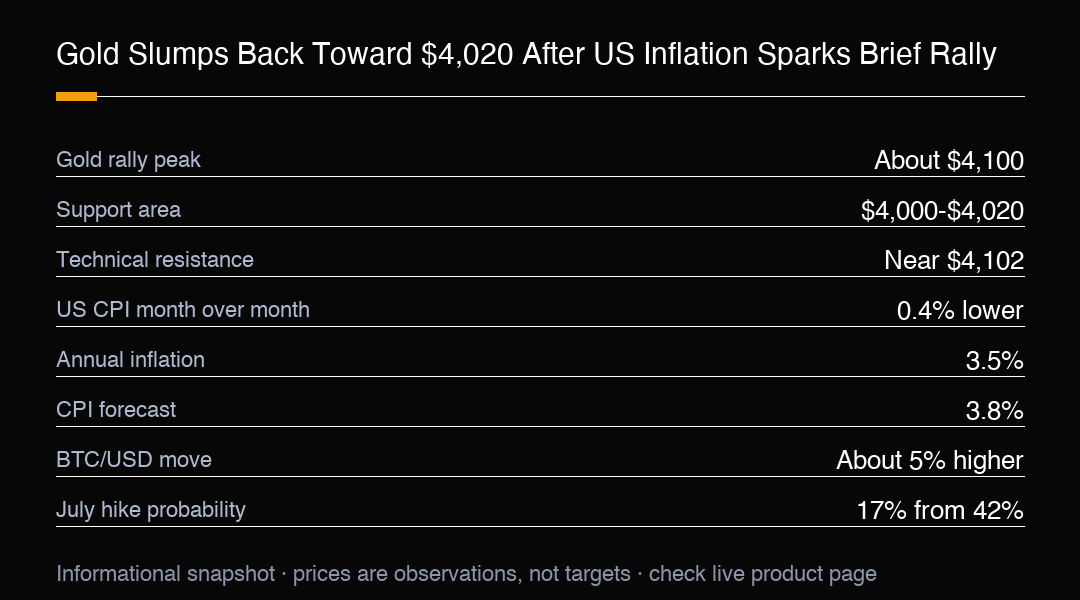
Gold gave back its inflation-driven rally on Tuesday, slipping back toward the $4,000-$4,020 area after briefly trading near $4,100. The initial jump of more than 2% followed a cooler US inflation print, but the move could not hold once oil prices resumed their climb. For XAU/USD traders, the session is a reminder that gold remains caught between softer price data and the rate pressure that energy costs can reintroduce.
The June US inflation report came in below expectations. Consumer prices fell 0.4% month over month, and annual inflation eased to 3.5%, under the 3.8% forecast that economists had pencilled in. That briefly raised hopes the Federal Reserve could slow its rate-hike path. Those hopes faded as crude moved higher again, reviving concern that energy costs could keep inflation sticky.
Higher inflation typically keeps interest rates elevated, and that is usually a headwind for gold because the metal pays no yield. Fed officials welcomed the softer CPI reading but signalled they would need several more months of cooling data before declaring the trend secure. The next test is the producer price index, another gauge that can confirm or contradict the consumer-price surprise.
Technically, the rally ran into resistance near $4,102, where a descending channel acted as a firm ceiling. A failure to reclaim that zone leaves bullion range-bound between the $4,000 and $4,020 support and the overhead barrier. Traders should treat a clean break of either side as a signal rather than assume the inflation story alone will drive direction.
What made the move notable was the divergence with Bitcoin. While gold lost altitude, BTC/USD held near $65,000, up roughly 5%, and climbed back above its 50-day moving average. The split shows risk appetite was not uniformly negative: one haven asset softened while a higher-beta proxy firmed, suggesting the day's driver was rate expectation more than broad safe-haven demand.
The gold-versus-Bitcoin split also says something about positioning. Gold is often treated as a defensive store of value, while Bitcoin is a higher-beta risk asset, yet on Tuesday the defensive instrument weakened and the risk asset held. That suggests the session was driven less by a flight to safety and more by a repricing of rate expectations. When the common factor is yields rather than fear, the usual haven correlation can break, and traders should avoid assuming gold will rise simply because other assets are unsettled.
Rate pricing moved with the data. After the CPI report, traders cut bets on an immediate Fed hike. According to CME's FedWatch Tool, the probability of a July increase dropped to 17% from 42% the prior day. Markets still expect at least one rate rise later this year, with September the focal point, so gold's path remains tied to how quickly inflation evidence accumulates.
The oil link is the part worth watching. Gold's inability to hold gains coincided with renewed crude strength, and the two rarely decouple for long when energy is the inflation trigger. If oil keeps rising, the higher-for-longer rate narrative returns, and that narrative has historically weighed on non-yielding assets. If oil settles, the cooler CPI can reassert itself as the dominant theme.
The broader backdrop complicates a simple inflation trade. Equities and crypto both reacted to the same CPI print, which means gold is now moving inside a cross-asset script rather than a standalone safety bid. When the dollar and Treasury yields are the marginal drivers, gold's direction can flip on a yield move before any new inflation number arrives.
Positioning should reflect that two-way risk. A bullish gold scenario needs either a confirmed slide in inflation or a clear dovish turn from the Fed, neither of which Tuesday's data delivered on its own. A bearish scenario needs oil to push real yields higher and the dollar to firm. Until one side wins, the $4,000-$4,020 band is the level that defines the near-term trade.
Risk control matters because the range is tight and the catalysts are clustered. A stop placed too close to $4,020 can be shaken out by a headline, while a stop below $4,000 carries the risk of a faster drop if oil accelerates. Traders should size around volatility, not around conviction, and wait for the producer-price and consumer-price sequence to confirm which inflation signal the market trusts.
A useful way to frame the trade is to separate the inflation surprise from the energy shock. The cooler CPI was a genuine data point that supported gold, while the oil move was a risk event that undermined it. When the two pull in opposite directions, the price can chop rather than trend, and the $4,000-$4,020 band becomes a holding pattern until one force dominates. Traders who expect oil to stabilise can lean on the soft-CPI story; traders who expect oil to keep climbing should respect the rate-risk story.
The tactical setup is to let the range do the work. Rather than predicting the next inflation print, traders can define risk around the $4,000-$4,020 support and the $4,102 resistance, and react to whichever side breaks first. A daily close back above $4,102 would signal that buyers have reclaimed control and that the soft-CPI narrative is leading; a daily close below $4,000 would confirm that oil-driven rate risk has won the session. Until then, patience inside the band is the lower-risk posture.
For MC Markets traders, XAUUSD offers a clean way to express the gold view without taking on the single-name risk of miners or the leverage of futures. The upcoming CPI and PPI prints will set the next leg, and the $4,102 resistance is the line bulls must reclaim. This is market commentary, not personal financial advice.
Trading Insight
Gold's inflation-fueled rally faded fast, with XAU/USD slipping back toward $4,000-$4,020 after reaching $4,100. June CPI cooled to 3.5% year over year, below the 3.8% forecast, but rising oil revived rate-risk concerns. The July hike probability fell to 17% from 42%, yet September stays in focus. Watch the $4,102 resistance and the $4,000-$4,020 support. This is market commentary, not personal financial advice.